
The short answer
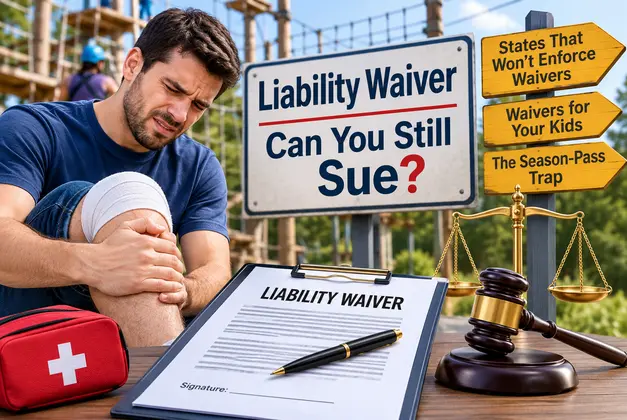
Often, yes. Most waivers cover ordinary carelessness, but generally not gross negligence, recklessness, or intentional harm, and in some states not violations of safety laws.
A few states refuse to enforce injury waivers, and New York voids many gym and recreation waivers.
If the injured person is a child, your signature may not bind them. That depends heavily on your state.
See which issues apply to your waiver →
Do this first:
- Get a copy of the exact waiver you signed. Check your email and your account with the business.
- Write down what happened, and photograph the scene or the equipment.
- Note your filing deadline. It keeps running. Find your state’s deadline.
Laws and rulings verified November 20, 2026. This is not legal advice.
Waiver Issue Checker
Answer a few questions. You’ll get a plain list of issues to raise with a lawyer. It won’t tell you whether your waiver is enforceable. Nothing you enter is saved or sent anywhere.
Your issue checklist
What a Liability Waiver Usually Covers
A clear waiver usually covers the normal risks of the activity and the business’s ordinary carelessness, and not much more.
Courts read waivers as contracts. Most states enforce a clear, unambiguous pre-injury waiver for ordinary negligence, but not for intentional, reckless, or grossly negligent conduct.
Everything in this guide sorts into three tiers.
USUALLY COVERED
- Inherent risks: the dangers built into the activity, like falling while learning to snowboard or a twisted ankle on a trampoline.
- Ordinary negligence: everyday carelessness by the business, if the waiver says so clearly and your state enforces it.
OFTEN NOT COVERED
- Gross negligence and recklessness
- Intentional harm
- Violations of safety laws, in some states
- Defective equipment, as to the manufacturer or anyone the waiver doesn’t name
DEPENDS ON YOUR STATE
- Waivers parents sign for children
- State statutes, like New York’s gym and recreation rule or Montana’s content requirements
- How clear and visible the waiver has to be
Inherent risk vs. ordinary negligence
An inherent risk exists even when everyone does their job well. Ordinary negligence is a mistake the business could have avoided, like a staff member failing to follow its own procedures.
Many waivers try to cover both. Whether the second part holds up depends on the wording and your state.
Why courts enforce clear waivers
Courts generally let adults agree to take on risk in exchange for doing something voluntary. But many states demand that the release be obvious.
Texas, for example, requires “fair notice”: the release must expressly cover the business’s own negligence and be conspicuous (Dresser Industries v. Page Petroleum, 1993). Montana requires a recreation waiver to list the known inherent risks and include a bold jury-trial warning (MCA 27-1-753).
When a Waiver Usually Doesn’t Stop a Lawsuit
The most common ways around a waiver are gross negligence or recklessness, intentional harm, safety-law violations, defective equipment, and unclear or hidden terms.
Gross negligence and recklessness
Gross negligence is conduct far below ordinary care, not just a slip. Most states won’t let a waiver release it.
California’s Supreme Court held that a release of future gross negligence is generally unenforceable as a matter of public policy (City of Santa Barbara v. Superior Court, 41 Cal.4th 747 (2007)).
Texas is unsettled. The Texas Supreme Court hasn’t decided whether a release can cover gross negligence, and its appeals courts have split.
Case: Swanson v. Bittersweet Ski Resort (Michigan, January 9, 2026)
What happened
A volunteer ski patroller was injured at a Michigan ski resort and sued, alleging negligence and gross negligence, among other claims. Michigan’s Supreme Court had already held his release was not ambiguous and sent the case back.
What the court held
On remand, the Court of Appeals held the release did not release a common-law gross-negligence claim, and that the Ski Area Safety Act doesn’t categorically preempt that claim.
What it did not decide
It did not decide whether the resort was actually grossly negligent. That still has to be proved. Read the opinion.
Intentional harm
Courts generally refuse to enforce a waiver for deliberate harm. Some states say so by statute: Louisiana voids advance limits on liability for intentional or gross fault (Civil Code art. 2004), and Montana treats contracts exempting anyone from willful injury as against public policy (MCA 28-2-702).
Safety-law violations
Some states won’t let a business sign away duties a statute or regulation imposes on it. Colorado is the clearest recent example.
Case: Miller v. Crested Butte (Colorado, May 20, 2024, 5–2)
What happened
A father sued after, according to the complaint, his teenage daughter fell about thirty feet from a chairlift and was paralyzed. Releases had been signed.
What the court held
The ski area could not use private release agreements to escape liability for violating the statutory and regulatory duties behind a negligence per se claim under the Ski Safety Act and Passenger Tramway Safety Act. The court reinstated that claim.
What it did not decide
The releases still barred the separate common-law negligence claim. The case did not decide whether the resort broke the law. Read the opinion.
Defective equipment
A waiver usually releases the business you signed with. It usually doesn’t release the company that designed or made a defective harness, binding, or trampoline.
Usually, not always: some waivers also name manufacturers, suppliers, or “affiliates.” Read the “released parties” list. If equipment failed, see our product liability guide.
Montana’s recreation-liability law, for example, doesn’t apply to claims based on the design, manufacture, provision, or maintenance of equipment (MCA 27-1-753(4)).
Unclear or hidden terms
A waiver that never mentions negligence, or hides its release in tiny print on the back of a ticket, is easier to challenge. Courts in many states read unclear waivers against the business that wrote them.
The Season-Pass Trap: How a New Waiver Can Erase an Old Claim
In Colorado, a waiver signed with a new ski pass after an injury released claims the injured person had already filed in court.
What happened in Litterer
In December 2020, a snowboarder collided with a snowmobile driven by a resort employee at Breckenridge. He sued the resort operator and the employee.
While the lawsuit was pending, he recovered enough to ride again and bought a 2022–23 Epic Pass online. Buying it meant agreeing to the pass’s liability waiver.
On September 21, 2026, Colorado’s Supreme Court held that the waiver released his existing claims and affirmed dismissal, 4–3 (Litterer v. Vail Summit Resorts, Inc., 2026 CO 65).
The release language
The majority opinion quotes the key sentences of the release, including:
“I FURTHER RELEASE AND GIVE UP ANY AND ALL CLAIMS AND RIGHTS THAT I MAY NOW HAVE AGAINST ANY RELEASED PARTY AND UNDERSTAND THIS RELEASES ALL CLAIMS, INCLUDING THOSE OF WHICH I AM NOT AWARE, THOSE NOT MENTIONED IN THIS RELEASE AND THOSE RESULTING FROM ANYTHING WHICH HAS HAPPENED UP TO NOW.”
Notice the words “may now have” and “anything which has happened up to now.” That’s what reached backward to the earlier crash.
Case card: Litterer v. Vail Summit Resorts (Colorado, Sept. 21, 2026, 4–3)
What the court held
Because the waiver was signed after the injury, the majority treated it as a release of existing claims, not a pre-injury waiver. So Miller‘s rule about pre-injury releases didn’t apply. Without an underlying claim, the request for exemplary damages also fell away.
The split
Four justices formed the majority. Three dissented, arguing the release of existing claims was buried in dense legal language an ordinary customer would likely miss.
What it did not decide
It did not decide whether the waiver was unconscionable, whether Miller bars releasing negligence per se claims more broadly, or whether the earlier 2020 pass waivers were valid.
Why this matters beyond Colorado
Litterer is Colorado law, it turned on that waiver’s specific words, and it was 4–3. It is a warning, not a national rule.
But many businesses make you accept new terms at every renewal or check-in: gym memberships, trampoline park visits, season passes. Any of them could contain “claims I may now have” language.
What to ask a lawyer before you renew
- Does the new waiver release past or existing claims?
- Can I use the facility without signing new terms, or should I go elsewhere for now?
- If I already signed something, can it be challenged?
| Document | When signed | What it can release | Watch out for |
|---|---|---|---|
| Pre-injury waiver | Before the activity | Future claims, within your state’s limits | Exceptions for gross negligence, recklessness, and (in some states) safety-law violations |
| New pass or membership terms | After the injury, at renewal or check-in | Possibly claims you already have, if the words reach back (as in Litterer) | “Claims I may now have,” “anything which has happened up to now,” “known or unknown” |
| Settlement release | When you settle a claim | The claim you are settling, usually for good | Signing before you know the full cost of your injury. See Should you accept the first offer? |
Your State: Three Approaches
A few states refuse injury waivers, some restrict them by statute or case law, and many enforce clear ones with exceptions.
This is a snapshot of verified examples, not all 50 states. If yours isn’t listed, check your state’s law with a lawyer.
REFUSES
Virginia: pre-injury releases of personal-injury claims are void as against public policy (Hiett, 1992).
Louisiana: any clause that, in advance, excludes or limits liability for causing physical injury is null (Civil Code art. 2004).
What it means for you: a pre-injury waiver generally won’t bar the claim. You still have to prove fault.
RESTRICTS
New York: GOL § 5-326 voids negligence waivers at pools, gyms, and places of amusement or recreation where you paid a fee. Not for facilities whose purpose is instructional.
Montana: since 2015, recreation waivers can cover ordinary negligence and inherent risks only if they meet content rules (MCA 27-1-753).
Connecticut: recreational negligence releases offered to the public have been struck down on public-policy grounds (Hanks, 2005; Reardon, 2006).
Colorado: a ski area can’t release its statutory safety duties (Miller, 2024).
What it means for you: the waiver may be void for your type of facility or claim.
GENERALLY ENFORCES CLEAR WAIVERS
California: ordinary negligence yes; future gross negligence generally no (City of Santa Barbara, 2007).
Texas: only with fair notice (express and conspicuous); gross negligence unsettled.
Michigan: ordinary negligence yes; common-law gross negligence no (Swanson, 2026).
Colorado: common-law negligence yes (Miller, 2024).
What it means for you: the exceptions above are where your claim may survive.
| Approach | Verified examples | What it means for you | Source |
|---|---|---|---|
| REFUSES injury waivers | Virginia; Louisiana | A pre-injury waiver generally won’t bar an injury claim. You still have to prove fault. | Hiett v. Lake Barcroft Cmty. Ass’n, 244 Va. 191 (1992); La. Civil Code art. 2004 |
| RESTRICTS waivers | New York (pools, gyms, recreation, fee paid; instructional facilities excluded); Montana (content rules since 2015); Connecticut (public recreation); Colorado (statutory safety duties) | The waiver may be void for your type of facility or claim, or may fail if it lacks required content. | N.Y. GOL § 5-326; MCA 27-1-753; Hanks (2005), Reardon (2006); Miller (2024) |
| GENERALLY ENFORCES clear waivers, with exceptions | California (not gross negligence); Texas (fair notice required; gross negligence unsettled); Michigan (not common-law gross negligence); Colorado (common-law negligence) | Ordinary negligence is usually released. Look hard at the exceptions. | City of Santa Barbara (2007); Texas fair-notice summary; Swanson (2026); Miller (2024) |
New York’s instructional-facility exception
New York’s § 5-326 doesn’t apply to every place that charges a fee. Courts exclude facilities that are instructional rather than recreational, and they judge the facility’s purpose.
They look at things like the organization’s stated purpose and whether you paid tuition or a fee to use the facility. If a place is recreational and instruction is only an ancillary service, the statute still applies, even if you were hurt during a lesson.
Why Montana isn’t on the “refuses” list
Older lists often put Montana alongside Virginia and Louisiana. Since 2015, though, Montana law allows a recreation waiver for ordinary negligence and inherent risks if it lists the known inherent risks and carries a bold jury-trial warning (MCA 27-1-753).
A waiver that doesn’t meet those rules may still fall under Montana’s general statute against such contracts.
North Carolina’s 2026 ski law favors enforcement
Effective October 1, 2026, North Carolina states the public policy that waivers signed for winter sports are an express acknowledgment of the inherent risks of skiing listed in the statute (G.S. 99C-13, enacted by S.L. 2026-49).
That supports enforcing ski waivers, not restricting them. The listed inherent risks now include collisions with other skiers. Because the law is new, expect court decisions applying it to come later.
Waivers You Sign for Your Kids
Whether a parent’s signature binds a child depends heavily on the state, and states genuinely split.
The birthday-party case
A five-year-old broke his leg at his own birthday party at an indoor inflatable play center in Michigan. His father had signed a waiver on his behalf.
Michigan’s Supreme Court held the waiver didn’t bar the child’s claim. A parent’s pre-injury waiver isn’t enforceable against the child under Michigan common law. The justices wrote several separate opinions, but that was the result (Woodman v. Kera LLC, 486 Mich. 228 (2010)).
Michigan later created a narrow statutory exception for recreational sports run by nongovernmental nonprofits, limited to injuries that result solely from inherent risks (MCL 700.5109, 2011).
Michigan: generally unenforceable
Woodman v. Kera (2010). Narrow nonprofit, inherent-risk exception in MCL 700.5109 (2011). A parent’s promise to indemnify the business for the child’s claim was also held unenforceable (MK v. Auburnfly, Mich. Ct. App. Dec. 17, 2024).
Washington: generally can’t waive
A parent generally can’t release a child’s own future claim for injuries caused by negligence (Scott v. Pacific West Mountain Resort, 1992, a 12-year-old hurt in ski school).
Colorado: allowed by statute, with limits
A parent may release a child’s prospective negligence claim if the decision is voluntary and informed, but not for willful and wanton, reckless, or grossly negligent conduct (C.R.S. § 13-22-107, 2003).
California: upheld in a specific context
A parent-signed release was upheld for a school fundraiser event (Hohe v. San Diego Unified School Dist., 1990). Gross negligence still can’t be released (City of Santa Barbara, 2007).
Ohio: upheld in a specific context
A parent-signed release was upheld for a nonprofit, volunteer-run youth soccer club (Zivich v. Mentor Soccer Club, 1998).
Florida: inherent risks only, with required notice
A natural guardian may waive claims against a commercial activity provider only for inherent risks, with mandatory notice language (Fla. Stat. § 744.301(3)).
| State | Rule | Key case or statute | Year |
|---|---|---|---|
| Michigan | Parental pre-injury waivers unenforceable against the child; narrow nonprofit, inherent-risk exception by statute | Woodman v. Kera LLC; MCL 700.5109 | 2010; 2011 |
| Washington | A parent generally can’t release a child’s future negligence claim | Scott v. Pacific West Mountain Resort, 119 Wn.2d 484 | 1992 |
| Colorado | Allowed if voluntary and informed; not for willful and wanton, reckless, or grossly negligent conduct | C.R.S. § 13-22-107 | 2003 |
| California | Upheld in a specific context (school fundraiser event) | Hohe v. San Diego Unified School Dist. | 1990 |
| Ohio | Upheld in a specific context (nonprofit volunteer youth soccer) | Zivich v. Mentor Soccer Club | 1998 |
| Florida | Natural guardian may waive claims against a commercial provider for inherent risks only, with mandatory notice | Fla. Stat. § 744.301(3) | Current |
Florida’s inherent-risk statute
Florida lets a child’s natural guardian waive the child’s claims against a commercial activity provider, but only for inherent risks. Inherent risks include the provider’s failure to warn of them and the chance that another participant acts carelessly.
The waiver must include a notice headed “NOTICE TO THE MINOR CHILD’S NATURAL GUARDIAN,” in uppercase type at least 5 points larger than the rest. If it complies, it’s presumed valid, and the injury is presumed to come from an inherent risk; overcoming that second presumption takes clear and convincing evidence.
The parent’s own claim
A child’s injury can create two claims: the child’s, and a parent’s own claim, for example for medical bills. They can be treated differently.
Ohio’s Supreme Court held that parents may release their own claims arising from a child’s injury (Zivich, 1998). If only one parent signed, whether that affects the other parent’s claim is a question for a lawyer.
Indemnity clauses aimed at parents
Some waivers ask the parent to repay the business if the child sues. In 2024, Michigan’s Court of Appeals refused to enforce that kind of parental indemnity agreement in a published opinion (MK v. Auburnfly, LLC). Elsewhere, flag the clause for a lawyer.
If you signed for someone else’s child
Brought your child’s friend to a trampoline park and signed the waiver at the counter? Statutes like Florida’s give the power to waive to a child’s natural guardian.
An adult who isn’t the parent or legal guardian may have no authority to sign away the child’s claim at all. Colorado’s statute defines “parent” more broadly, so wording matters. Treat this as a question for a lawyer in your state.
Gyms, Trampoline Parks, Ski Areas, and Camps
The activity changes which exceptions and statutes matter most.
| Activity | What waivers usually cover | Common exceptions to check |
|---|---|---|
| Gym or fitness | Normal exercise risks; ordinary negligence where enforced | New York § 5-326 if you paid a fee (and whether the facility is instructional); broken machines (possible product claim); hidden membership terms |
| Trampoline or indoor play park | Falls and collisions inherent to jumping | Gross negligence (supervision, overcrowding); defective equipment; waivers signed for children, or by someone who isn’t the parent |
| Ski or snowboard | Inherent risks listed in the state ski statute | Safety-statute duties (Colorado Miller); gross negligence (Michigan Swanson); new pass waivers after an injury (Colorado Litterer); North Carolina’s 2026 pro-enforcement law |
| Rafting or water sports | Water, weather, and capsizing risks | Guide conduct far below normal care; defective gear; Montana’s waiver content rules |
| Youth camp or sports | Ordinary sports risks | Your state’s parental-waiver rule; nonprofit vs. commercial operator (Ohio Zivich, Michigan MCL 700.5109); gross negligence |
Trampoline parks in Texas: appeals courts have split on gross negligence. A Dallas appeals court enforced a trampoline-park release that expressly listed gross negligence (2018), while other Texas appeals courts have refused to let releases cover it.
Ski areas: most ski states have safety statutes that list skiers’ and operators’ duties. Those duties can matter as much as the waiver.
Read Your Waiver in 5 Minutes
Nine questions will tell you most of what a lawyer will want to know about your waiver.
- Find the exact version you signed, with its date. Online waivers change each season.
- Does it say “negligence” plainly? Many states require clear words to release negligence.
- Who is released? The business only, or also employees, landowners, manufacturers?
- What risks does it describe? Is your injury one of them, or something different?
- Was it buried? Fine print on a ticket, or one checkbox among many terms?
- Does it include an indemnity clause (you pay their costs)? Flag it for a lawyer.
- Does it release “past” or “existing” claims, or claims you “may now have”? That kind of clause ended the Colorado season-pass case.
- Who signed it? You, a parent, or another adult?
- Is there an arbitration clause or a forum and venue clause? That can change where and how a claim is heard. Ask a lawyer whether it’s enforceable.
If the Waiver Doesn’t Bar Your Claim: What a Case Looks Like
Getting past the waiver only opens the door; you still have to prove the business was at fault and show what the injury cost you.
- Proving fault: what the business knew or should have known, and what it failed to do. See how premises liability is proved.
- Shared fault: if you were partly to blame, your recovery may shrink or, in some states, disappear. See partially at fault.
- Damages: medical bills, lost income, and pain and suffering. See how pain and suffering is calculated.
- What you keep: fees, costs, and liens come out of a settlement. See how much of your settlement you’ll keep.
What to Do This Week
Preserve the evidence, don’t sign anything new with the business, and get your deadline on the calendar.
- Save the waiver. Download or screenshot the version you signed, plus any confirmation emails.
- Preserve evidence. Photos, the equipment involved if you have it, names of witnesses and staff, and incident reports.
- Get and keep medical records. Follow your doctor’s treatment plan.
- Don’t sign new releases, passes, or memberships with the same business.
- Be careful with insurers. Think before giving a recorded statement. If you already did, see already gave a recorded statement?
- Describe what happened accurately and consistently. A waiver dispute is decided on the real facts; never change the story to fit an exception.
- Calendar your deadline. See the statute of limitations by state.
FAQ
Can you sue if you signed a waiver?
Often, yes. Waivers usually cover inherent risks and ordinary negligence, but generally not gross negligence, recklessness, or intentional harm. Some states refuse or restrict waivers. Whether yours holds up depends on its words, the facts, and your state.
Are liability waivers legally binding?
Many are, for ordinary negligence, if they’re clear. Virginia and Louisiana refuse to enforce pre-injury injury waivers, and New York voids many gym and recreation waivers where a fee was paid.
Does a waiver cover gross negligence?
Usually not. California and Michigan courts have refused to let releases cover gross negligence. Texas is unsettled: its Supreme Court hasn’t decided, and its appeals courts have split.
What’s the difference between negligence and gross negligence?
Ordinary negligence is a failure to use reasonable care, like a routine mistake. Gross negligence is conduct far below that standard. Each state defines it a little differently, and the line is often fought over.
Can I sue if equipment broke?
Possibly. The waiver usually protects the business, not the equipment maker, so a product-liability claim may be possible. Check whether the waiver names manufacturers. See our product liability guide.
Are online “click” waivers enforceable?
They can be. Colorado’s Supreme Court enforced an online season-pass waiver in 2026. Clarity and visibility still matter, and some states require conspicuous wording.
Which states don’t enforce liability waivers?
Virginia and Louisiana refuse to enforce pre-injury waivers of personal-injury claims. New York, Montana, and Connecticut restrict them in different ways. Montana has allowed compliant recreation waivers since 2015.
Are gym waivers void in New York?
Many are. GOL § 5-326 voids negligence waivers at pools, gyms, and places of amusement or recreation when you paid a fee. It doesn’t apply to facilities whose purpose is instructional rather than recreational.
Can a parent sign away a child’s right to sue?
It depends on the state. Michigan and Washington generally say no. Colorado and Florida allow it by statute with limits. California and Ohio courts have upheld parental waivers in specific contexts.
What if I signed a waiver for someone else’s child?
You may not have had authority to waive that child’s claim. Statutes like Florida’s give that power to the child’s natural guardian. Ask a lawyer in your state.
Can I sue a trampoline park after signing a waiver?
Possibly, if an exception applies: gross negligence, defective equipment, a state rule like New York’s, or a parental waiver your state won’t enforce. Courts disagree, so the details matter.
Can I sue a ski resort after signing a waiver?
Sometimes. In Colorado, a release can’t bar a claim based on violating ski safety statutes. In Michigan, a release didn’t bar a common-law gross-negligence claim. North Carolina’s 2026 law favors enforcing ski waivers for inherent risks.
Can buying a new season pass cancel my lawsuit?
In Colorado, it did. In Litterer (Sept. 21, 2026, 4–3), a new pass waiver that released claims the buyer “may now have” ended his pending lawsuit. Talk to a lawyer before buying a new pass from the same business.
Does renewing a gym membership affect my claim?
It could, if the renewal terms release existing claims. Read the terms first, and talk to a lawyer before renewing with the business you have a claim against.
What is an indemnity clause in a waiver?
A promise that you’ll pay the business’s costs, including legal fees, if a claim is brought. Michigan’s Court of Appeals refused to enforce one a parent signed for a child’s injury (2024). Flag any indemnity clause for a lawyer.
Does the waiver protect the equipment manufacturer?
Usually not, unless the waiver names it. Read the list of released parties.
How long do I have to file?
It depends on your state and the type of claim, and children’s deadlines may differ. See our statute of limitations guide.
Do I need a lawyer for a waiver case?
It’s strongly worth a consultation. Waiver cases turn on exact wording and state law, and many personal-injury lawyers offer free initial consultations. Get help quickly if a child was hurt or a deadline is near.
Sources Checked for This Guide
- Litterer v. Vail Summit Resorts, Inc., 2026 CO 65 (Colo. Sept. 21, 2026)
- Miller v. Crested Butte, LLC, 2024 CO 30 (Colo. May 20, 2024)
- Swanson v. Bittersweet Ski Resort, Inc. (Mich. Ct. App. Jan. 9, 2026, on remand)
- Woodman v. Kera LLC, 486 Mich. 228 (2010)
- MK v. Auburnfly, LLC (Mich. Ct. App. Dec. 17, 2024)
- N.Y. General Obligations Law § 5-326
- N.Y. Appellate Division (4th Dept. 2013), applying the instructional-vs.-recreational facility test
- Fla. Stat. § 744.301(3)
- N.C. Gen. Stat. Chapter 99C, including § 99C-13 and S.L. 2026-49
- City of Santa Barbara v. Superior Court, 41 Cal.4th 747 (2007)
- Montana MCA § 27-1-753 and § 28-2-702
- Louisiana Civil Code art. 2004
- Hiett v. Lake Barcroft Community Ass’n, 244 Va. 191 (1992)
- Hanks v. Powder Ridge Restaurant Corp. (Conn. 2005); Reardon v. Windswept Farm (Conn. 2006)
- C.R.S. § 13-22-107
- Hohe v. San Diego Unified School Dist. (1990); Zivich v. Mentor Soccer Club (Ohio 1998); Scott v. Pacific West Mountain Resort, 119 Wn.2d 484 (1992)
- Texas A&M Real Estate Research Center: Texas fair-notice rule and the open gross-negligence question
Last updated:
This article is general information, not legal advice. Whether a waiver is enforceable depends on the document’s language, the facts, and state law. Laws and rulings were verified on November 20, 2026 and may change.

Daniel Hayes is the founder and sole researcher at AdvoraHQ. He covers U.S. personal finance, insurance, and consumer law — working directly from IRS publications, federal and state statutes, court opinions, and SEC filings rather than secondary summaries. His focus is the gap between what readers think they know and what the source documents actually say. Daniel is not a licensed attorney, CPA, or financial advisor; his articles are educational and not personalized advice. Reach him at Daniel.Hayes@advorahq.com.
