
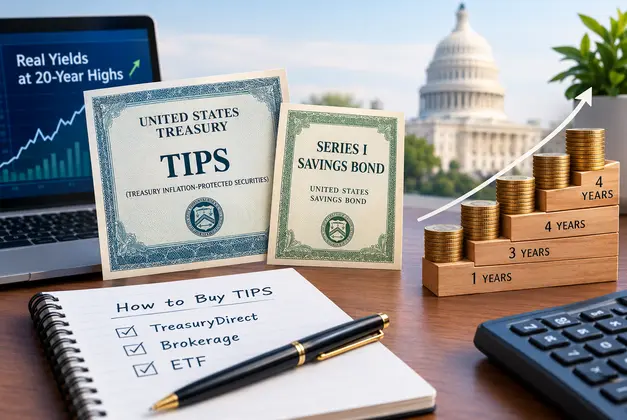
TIPS (10-year)
2.90% above inflation
Locked for about 10 years if held to maturity (auction of Nov 19, 2026; real yield 2.903%).
New I Bonds
1.40% above inflation
For up to 30 years (bought Nov 2026–Apr 2027). The 5.51% you see in headlines is the first six months, inflation included.
Quick decision
I Bonds fit money you might need after a year, up to $10,000 a year per person, with no price swings.
TIPS fit larger amounts, a known horizon, and retirement accounts, where the phantom tax doesn’t bite.
Holding 2021–22 I Bonds at 0% fixed? Compare them with both options below.
Compare your after-tax return →
After-Tax Real Return Calculator: TIPS vs. I Bonds vs. Savings
This calculator compares TIPS, I Bonds and an optional savings rate after tax and after inflation, using your own assumptions. It shows what each could be worth in today’s dollars, using only your inputs. It illustrates; it never tells you what to buy.
Three steps: your money, your rates, your taxes. Every rate is editable. Nothing you enter is stored or sent anywhere.
Your results
I Bonds
TIPS, held to maturity
Savings or CD
Full breakdown
How the math works
- Growth is compounded once a year. Real life is slightly different.
- I Bonds: growth is about fixed + inflation + fixed x inflation. Federal tax is due once, at redemption. A 3-month interest penalty is applied before year 5.
- TIPS: growth is (1 + real yield) x (1 + inflation) – 1. In a taxable account, federal tax is charged each year on the full growth and paid from it.
- Savings or CD: interest is taxed each year at your federal plus state rate.
- “Today’s dollars” divides the after-tax value by (1 + inflation) for each year.
- Real vs. headline rates
- Side-by-side
- How to buy TIPS
- TreasuryDirect trap
- Phantom tax
- ETF vs. individual
- Old I Bonds
- TIPS ladder
Rates verified . The TIPS figure is the Nov 19, 2026 auction result; I Bond rates took effect Nov 1, 2026. TIPS yields change daily; I Bond rates reset May 1 and Nov 1.
Real Yield vs. the Headline Rate: What These Numbers Actually Mean
A real yield is the return you earn above inflation. TIPS now offer about 2.90% above inflation for ten years, while a new I Bond locks 1.40% above inflation, so compare those two figures, not 2.90% against the 5.51% headline.
Here is the idea in one line. If a bond pays a 2.90% real yield and inflation runs 3%, your money grows about 6% in dollars, and about 2.90% of that is growth in what the money can buy.
The 5.51% I Bond rate is a nominal rate that applies for the first six months only. It combines the 1.40% fixed rate with an inflation component of 2.04% for six months, about 4.08% a year. The fixed part never changes; the inflation part resets every six months.
Compare real to real: 2.90% vs. 1.40%
Breakeven inflation is the gap between a regular Treasury note and a TIPS of the same term. At the Nov 19 auction close, the 10-year note yielded 5.05%, so breakeven was about 2.15%. If inflation averages more than that, the TIPS beat the note held to maturity.
LOCKED REAL RETURN TIPS bought at the Nov 19 auction yield: 2.903% a year above inflation if held to maturity. I Bonds bought Nov 2026–Apr 2027: 1.40% fixed.
WHAT CAN MOVE Inflation itself, TIPS prices if you sell early, and your taxes. Today’s TIPS yield may differ from the auction result.
YOUR CHOICE The account, the holding period, and how much liquidity you need.
TIPS vs. I Bonds, Side by Side
TIPS lock a higher real return than I Bonds today and have no purchase cap, but their prices can fall if you sell early. I Bonds lock a lower real return, cap purchases at $10,000 a year per person, and can’t be redeemed for 12 months.
| Feature | I Bonds | TIPS |
|---|---|---|
| Real return locked | 1.40% fixed, for bonds bought Nov 2026–Apr 2027, for up to 30 years | About 2.90% for the 10-year auctioned Nov 19, 2026, if held to maturity. Other terms differ. |
| Purchase limit | $10,000 per person per calendar year (electronic). Gifts count toward the recipient’s limit. No paper bonds via tax refund since Jan 1, 2025. | No annual cap for ordinary investors |
| Minimum | $25 | $100 |
| Where to buy | TreasuryDirect only | TreasuryDirect, a brokerage (auction or secondary market), or a fund |
| Can you sell early | Not in the first 12 months. Before 5 years you lose the last 3 months of interest. | Yes, at the market price through a broker. From TreasuryDirect: 45-day hold, then a transfer to a broker. |
| Price risk | None; the redemption value doesn’t fall | Yes, if sold before maturity; prices move with real yields |
| Deflation protection | The bond’s value doesn’t decline | At maturity you get the greater of inflation-adjusted principal or original par |
| Federal tax timing | Deferred until you redeem (or the bond stops earning) | In a taxable account, yearly on interest and the inflation adjustment (Forms 1099-INT and 1099-OID) |
| State tax | Exempt | Exempt |
| IRA eligible | No | Yes, through a brokerage IRA |
| Best fit | Money you may need after a year, within the limit | Larger amounts, a known horizon, and retirement accounts |
The table doesn’t point to a single winner, because the right choice depends on horizon, liquidity, account type and the real-yield gap, not on a dollar amount. Use the calculator to test your own numbers.
How to Buy TIPS: Four Routes
You can buy TIPS four ways: a noncompetitive bid at TreasuryDirect, a noncompetitive bid at a brokerage auction, a secondary-market purchase through a broker, or a TIPS fund. The first three give you an individual bond with a maturity date. A fund has none.
| Route | Bid type | Sell early? | Fees | Best for |
|---|---|---|---|---|
| TreasuryDirect (auction) | Noncompetitive only | Not directly: 45-day hold, FS Form 5511, then a broker sells | No purchase fee or commission | Buy-and-hold to maturity |
| Brokerage, at auction | Noncompetitive (typical for individuals) | Yes, any market day, at the market price | Varies by broker; check its fee schedule | IRAs, or keeping the option to sell |
| Brokerage, secondary market | Not applicable; you pay the dealer’s quoted price | Yes, at the market price | Often built into the bid/ask spread; some brokers add a commission | Picking exact maturities for a ladder |
| ETF or mutual fund | Not applicable | ETF: any market day. Mutual fund: end-of-day price. | Fund expense ratio; possible trading costs | Small, regular purchases with no fixed horizon |
Step by step, by route
Route 1: TreasuryDirect (auction, noncompetitive)
- Open a TreasuryDirect account and link a bank account.
- Check the next auction date. Treasury announces each auction about a week ahead.
- In BuyDirect, choose TIPS, the term (5, 10 or 30 years) and the amount. The minimum is $100.
- Submit before the noncompetitive deadline: 12:00 p.m. Eastern on auction day, per Treasury’s auction announcements. Confirm the cutoff in BuyDirect.
- You accept the yield the auction sets. The security settles into your account and the money typically leaves your linked bank account on the issue date.
- To sell early: hold 45 days, send FS Form 5511 to transfer the TIPS to a bank or broker, then the broker sells.
Route 2: Brokerage, at auction
- Open or use a brokerage account (taxable or IRA).
- Find upcoming TIPS auctions in the broker’s bond or fixed-income center.
- Place a noncompetitive order before the broker’s cutoff, often the day before the auction. Confirm the cutoff with your broker.
- The auction sets the yield. The TIPS settle into your IRA or taxable account.
- Sell any market day at the market price, which can be higher or lower than you paid.
Route 3: Brokerage, secondary market
- Search the broker’s bond screen by maturity year or CUSIP.
- Check the real yield to maturity, the price and the index ratio. The index ratio shows how much inflation has accrued since the TIPS was issued, and you pay for that accrued adjustment.
- Read the order confirmation preview carefully: many screens show an unadjusted price and an adjusted price, and accrued interest is added.
- Remember that the deflation floor protects only the original par amount, not what you paid above it.
- Use a limit order and compare the bid/ask spread before you submit.
Route 4: ETF or mutual fund
- Compare funds by average maturity or duration and expense ratio. Broad funds and short-term funds behave differently; for example, the iShares TIPS Bond ETF (TIP) is a broad fund and the iShares 0-5 Year TIPS Bond ETF (STIP) is a short-term one. These are examples, not recommendations.
- Buy it like a stock, or through a mutual fund order.
- Understand that a fund has no maturity date. Its price falls when real yields rise, and there is no date on which it pays par.
On the Nov 19 auction, a reopening of a 10-year TIPS issued in July, the coupon of 2.375% was already set. The bond priced below par to reach the 2.903% real yield. That is normal for a reopening: the coupon is fixed at the first auction, and the price adjusts.
The TreasuryDirect Trap: Easy to Buy, Slow to Sell
Buying TIPS at TreasuryDirect is simple, but you can’t sell there. After a 45-day hold, you request a transfer to a bank or broker with a mailed FS Form 5511, and only then can the broker sell the TIPS for you at the market price.
TIPS bought at TreasuryDirect: 45-day hold, then a mailed form before you can sell
- Hold the TIPS in TreasuryDirect for 45 days. The hold also applies to reinvestments made with new funds.
- Open a brokerage account if you don’t have one, and ask it for its wire name, routing (ABA) number and the agent or broker’s name and phone number.
- In TreasuryDirect, go to Manage Direct, choose Transfer securities, pick External Transfer, and open the link for FS Form 5511, the TreasuryDirect Transfer Request.
- Complete the form and mail it as its instructions direct. Follow any certification step the form requires.
- Treasury customer service performs the transfer once the form is received and approved, then emails you a confirmation.
- Place the sale with your broker. It happens at the market price on that day.
Treasury doesn’t promise a timeline in the pages we checked, so allow extra time before you need the cash. Securities moved into TreasuryDirect from a broker aren’t subject to the 45-day hold.
TreasuryDirect still makes sense for people who are certain to hold to maturity, such as a ladder builder who plans to spend each rung as it matures. If you might sell early, buy at a brokerage instead.
LOCKED REAL RETURN The same yield at auction, whichever route you use.
WHAT CAN MOVE The market price on the day your broker finally sells.
YOUR CHOICE How sure you are that you will hold to maturity.
The Phantom-Income Tax — and Where to Hold TIPS
In a taxable account, TIPS can create a tax bill on income you haven’t received: the yearly inflation adjustment to your principal is federally taxable, even though you only collect it at maturity or sale. Holding TIPS in an IRA or Roth avoids that bill.
In a taxable account, TIPS can create a tax bill on income you haven’t received
TreasuryDirect and brokers report two things each year: a Form 1099-INT for interest paid, and a Form 1099-OID for the change in your principal. In a year of deflation, the OID amount can be negative. Interest and inflation accruals are exempt from state and local tax.
A worked one-year example (illustrative)
- You hold $10,000 of TIPS in a taxable account.
- Inflation raises your principal by about $300. You receive none of it in cash.
- The coupon pays about $240 in cash.
- Taxable income for the year: about $540.
- At a 24% federal rate, the tax is about $130. About $72 of that comes from the $300 you haven’t received, so it must come from other cash.
The tax also trims your real return. At a 24% federal rate and 3% inflation, a 2.90% real yield works out to roughly 1.5% after tax in a taxable account. The calculator runs the same math with your inputs.
Where to hold TIPS
- Traditional IRA or 401(k): no yearly tax on the accruals. Withdrawals are taxed as ordinary income, and required minimum distributions apply (see RMD rules).
- Roth IRA or Roth 401(k): no yearly tax, and qualified withdrawals are tax-free.
- Taxable account: you pay federal tax each year on income you haven’t received, but state and local tax doesn’t apply. That can matter in a high-tax state.
For the bigger picture on matching investments to accounts, see asset location.
I Bonds work differently. Federal tax is deferred until you redeem, and state and local tax doesn’t apply. In some cases the interest can be excluded when it pays qualified higher-education costs; check the IRS rules and income limits. I Bonds can’t go into an IRA.
LOCKED REAL RETURN The pre-tax real yield of the TIPS you buy.
WHAT CAN MOVE Your tax rate, and the size of each year’s inflation adjustment.
YOUR CHOICE Taxable, traditional or Roth. This one decision can matter as much as the yield.
TIPS Funds vs. Individual TIPS: Why Funds Can Lose Money
A TIPS fund has no maturity date, so its price moves with real yields and never converges on a guaranteed payout. An individual TIPS held to maturity returns its inflation-adjusted principal, with a floor at original par, whatever happened to prices in between.
A TIPS fund isn’t a TIPS bond: it has no maturity date
When real yields rise, the prices of existing TIPS fall. If you own an individual TIPS, that is a paper loss you can wait out. A fund keeps buying and selling bonds, so a drop in value stays in the fund’s price until yields fall again.
That is why broad TIPS funds fell sharply in 2022, even though inflation was high. Rising real yields outweighed the inflation adjustments. For the exact calendar-year figure for any fund, check the fund sponsor’s published returns.
Duration matters. Short-term TIPS funds hold bonds close to maturity, so their prices move less when real yields change. Funds holding longer maturities move more.
- Funds offer: diversification, small purchase sizes, automatic reinvestment and easy trading in an IRA.
- Individual TIPS offer: a known maturity date, a known real yield at purchase and no expense ratio.
LOCKED REAL RETURN Individual TIPS held to maturity. A fund locks nothing.
WHAT CAN MOVE A fund’s price, its payouts and its yield.
YOUR CHOICE A fixed date and a known result, or convenience and diversification.
If you want background on bond funds generally, see how to invest in bonds.
Can You Lose Money on TIPS?
You can lose money on TIPS by selling before maturity after real yields have risen, by holding a fund through a rate spike, or by paying more than par on the secondary market and then facing deflation; held to maturity, an individual TIPS pays at least its original par.
- Selling early: if real yields rose after you bought, your TIPS is worth less on the market.
- Deflation and the par floor: at maturity you receive the greater of inflation-adjusted principal or original par. The floor protects par, not what you paid above it.
- Buying above par: on the secondary market, you pay for inflation already accrued. If prices then fall, you could get back less than you paid.
- Taxes: in a taxable account, yearly tax on the inflation adjustment lowers what you keep.
- The index: TIPS follow the consumer price index for all urban consumers, which may not match your own costs.
Plainly: TIPS sold before maturity can be worth more or less than you paid.
Should You Buy I Bonds Now?
A 1.40% fixed rate is the highest since November 2006, so new I Bonds are a reasonable home for money you can leave alone for at least a year. The trade-offs are the $10,000 yearly limit, a 12-month lock, and a 3-month interest penalty before year five.
I Bonds: locked for 12 months; 3-month interest penalty before 5 years
- The rate: bonds bought from Nov 1, 2026 through Apr 30, 2027 get the same 1.40% fixed rate. The next fixed rate is set May 1, 2027 and could be higher or lower.
- The limit: $10,000 per person per calendar year in electronic I Bonds. Paper I Bonds through a tax refund ended Jan 1, 2025.
- Gifts: a gifted I Bond counts toward the recipient’s limit, not the giver’s. Gifting doesn’t raise anyone’s limit. See how much money you can gift tax-free.
- Liquidity: you can’t redeem for 12 months. Redeem before 5 years and you lose the last 3 months of interest.
- Taxes: federal tax is deferred until redemption, and state and local tax doesn’t apply.
Against a high-yield savings account or CD, an I Bond trades flexibility for inflation protection. Savings rates float and can fall, while the I Bond’s fixed rate is set for the life of the bond. For cash you may need soon, see where to park cash, how savings interest is taxed and whether to break a CD.
Keep your emergency money liquid first. I Bonds aren’t a substitute for it (see how much emergency fund you need).
Holding Old 0%-Fixed I Bonds? What to Do Next
I Bonds from 2021–22 with a 0% fixed rate earn about 4.08% for November 2026 through April 2027, because only the inflation component applies. Whether to move the money depends on the penalty, the tax on accumulated interest, and how the alternatives compare.
This section covers where the money could go next. The cash-out decision itself, including the tax and timing details, lives in when to cash out 2021–22 I Bonds.
A 4-question checklist
- Have they passed 5 years? If not, redeeming costs 3 months of interest.
- What do they earn now (about 4.08% for Nov 2026–Apr 2027) versus a new bond’s 1.40% fixed plus inflation?
- Will you use this year’s $10,000 limit for the new bonds, or move the rest into TIPS?
- What federal tax is due on the accumulated interest when you redeem? (See the cash-out guide.)
The gap is the fixed rate. An old 0% bond earns only inflation. A new bond earns inflation plus 1.40%, and a 10-year TIPS bought now locks about 2.90% above inflation. Redeeming the old bond makes its accumulated interest taxable in that year, unless you reported some of it earlier.
The new inflation rate resets every six months for both old and new I Bonds, so the 4.08% is not permanent.
Building a Simple TIPS Ladder for Retirement Income
A TIPS ladder is a set of TIPS maturing in consecutive years, so one rung matures each year and pays inflation-adjusted principal you can spend. It turns a lump sum into a known real income stream for a fixed number of years.
The example below targets $30,000 a year in today’s dollars for ten years, 2027 through 2036. Later rungs are larger because the coupons they pay reduce what the earlier rungs need to cover.
| Maturity year | Face amount (today’s dollars) | Purpose |
|---|---|---|
| 2027 | $24,600 | Covers 2027 spending (year 1) |
| 2028 | $25,100 | Covers 2028 spending (year 2) |
| 2029 | $25,600 | Covers 2029 spending (year 3) |
| 2030 | $26,100 | Covers 2030 spending (year 4) |
| 2031 | $26,600 | Covers 2031 spending (year 5) |
| 2032 | $27,200 | Covers 2032 spending (year 6) |
| 2033 | $27,700 | Covers 2033 spending (year 7) |
| 2034 | $28,300 | Covers 2034 spending (year 8) |
| 2035 | $28,800 | Covers 2035 spending (year 9) |
| 2036 | $29,400 | Covers 2036 spending (year 10) |
| Total | $269,400 | About $30,000 a year in today’s dollars |
Real ladders use the maturities that exist. TIPS mature in specific months, and not every year offers every month, so builders pick the maturity nearest each year. Each January’s new 10-year TIPS, such as the 2037 maturity due at auction on Jan 21, 2027, extends the ladder.
Building one, step by step
- Decide the yearly income you want and the number of years it must last.
- Choose the account. An IRA avoids the phantom tax; a taxable account doesn’t.
- List the maturities available at your broker and pick one per year.
- Size each rung so principal plus the coupons from remaining rungs meet your target.
- Buy at auction or on the secondary market, and hold to maturity.
In a traditional IRA, required minimum distributions can force withdrawals on a schedule you didn’t choose. Ladder maturities and coupons can supply that cash. See RMD rules.
TIPS ladder vs. annuity
- Ladder: you keep control and access to the money, it can pass to heirs, and the real income is known. It ends after the last rung, so it doesn’t cover living longer than planned.
- Annuity: the payments can last for life, but they depend on the insurer, come with fees and limit your access. Some are not inflation-adjusted.
Related reading: annuities compared, retirement income planning and retirement withdrawal order. For stock-market context, see average stock market return after inflation. Municipal bonds are another option for taxable accounts; see are municipal bonds worth it.
When to Buy: The Next TIPS Auctions
The next TIPS auctions are a 5-year reopening on December 23, 2026 and a new 10-year TIPS on January 21, 2027, per Treasury’s tentative schedule. Dates can change, and Treasury confirms each auction in an announcement about a week before it.
| Term | Type | Announcement | Auction | Settlement | Source |
|---|---|---|---|---|---|
| 5-year TIPS | Reopening | Dec 17, 2026 | Dec 23, 2026 | Dec 31, 2026 | Treasury tentative schedule |
| 10-year TIPS | New issue | Jan 14, 2027 | Jan 21, 2027 | Jan 29, 2027 | Treasury tentative schedule |
| 30-year TIPS | New issue | Feb 11, 2027 | Feb 18, 2027 | Feb 26, 2027 | Treasury tentative schedule |
| 10-year TIPS | Reopening | Mar 11, 2027 | Mar 18, 2027 | Mar 31, 2027 | Treasury tentative schedule |
| 5-year TIPS | New issue | Apr 15, 2027 | Apr 22, 2027 | Apr 30, 2027 | Treasury tentative schedule |
The usual calendar: the 5-year TIPS is a new issue in April with reopenings in August and December. The 10-year is new in January and July, with reopenings in March, May, September and November. The 30-year is new in February, with reopenings usually in June and October.
Waiting for a particular auction is a bet on yields, which can rise or fall. TIPS also trade on the secondary market every business day, so the auction calendar isn’t the only way in.
Frequently Asked Questions: TIPS vs. I Bonds
Here are short answers to the questions people ask most when comparing TIPS and I Bonds, the two Treasury bonds that protect against inflation, with rates as of November 24, 2026 and links to the sections that cover each topic in more depth.
Are TIPS or I Bonds better right now?
Neither wins for everyone. Compare real to real: about 2.90% for a 10-year TIPS versus 1.40% for a new I Bond. TIPS lock more, but can lose value if sold early and can create a tax bill in a taxable account. I Bonds have no price swings but are capped and locked for 12 months.
Is a 1.40% I Bond fixed rate good?
It is the highest fixed rate since November 2006, and it stays for the life of the bond. It is lower than the roughly 2.90% real yield on a 10-year TIPS, so the real trade-off is a lower locked return for no price risk, tax deferral and a purchase cap.
Why is the I Bond rate 5.51% if the fixed rate is 1.40%?
The 5.51% is a composite rate that adds inflation to the fixed rate. The inflation part is 2.04% for six months, about 4.08% a year, and it resets every six months. Only the 1.40% is fixed. The 5.51% applies to the first six months of a new bond.
Can you lose money on TIPS held to maturity?
At maturity you receive the greater of inflation-adjusted principal or original par. If you bought above par on the secondary market and deflation followed, you could get back less than you paid. In a taxable account, yearly tax also lowers what you keep.
Why did my TIPS ETF lose value during inflation?
A TIPS fund has no maturity date, so its price follows real yields. When real yields rose sharply, as in 2022, prices fell by more than the inflation adjustments added. Short-term TIPS funds are less sensitive to this than funds with longer maturities.
How do I buy TIPS at TreasuryDirect?
Open an account, link a bank account, and choose TIPS, the term and an amount of at least $100 in BuyDirect before the noncompetitive deadline on auction day. TreasuryDirect accepts noncompetitive bids only. See the step-by-step routes.
Can I sell TIPS early from TreasuryDirect?
Not directly. You must hold the TIPS for 45 days, then transfer them to a bank or broker with FS Form 5511, then ask the broker to sell. If you might sell early, buying at a brokerage avoids this.
Is it better to buy TIPS at auction or on the secondary market?
Neither is better in general. An auction gives you the yield the auction sets for that security. The secondary market lets you choose an exact maturity at the current market yield, but you pay the bid/ask spread and the accrued inflation adjustment shown by the index ratio.
What is phantom income on TIPS?
It is the yearly increase in your TIPS principal from inflation. The IRS treats it as taxable income each year, reported on Form 1099-OID, even though you don’t receive it until maturity or sale. It is exempt from state and local tax.
Should TIPS be in an IRA or a taxable account?
An IRA or Roth avoids the yearly tax on income you haven’t received. A taxable account makes more sense only if you accept that tax, or the state-tax exemption matters a lot to you. See asset location.
Can I hold I Bonds in an IRA?
No. I Bonds are bought through TreasuryDirect and can’t be held in an IRA.
How much in I Bonds can I buy per year?
Up to $10,000 per person per calendar year in electronic I Bonds. The extra paper I Bonds bought with a tax refund ended on Jan 1, 2025.
Can I buy I Bonds as a gift to get around the limit?
No. Gift bonds count toward the recipient’s limit in the year they are delivered, not the giver’s. A gift doesn’t create extra room. See gifting money for the tax side.
Should I cash in my 2021–22 I Bonds?
It depends on whether you’ve passed 5 years, the tax due on the accumulated interest, and where the money would go. Old 0%-fixed bonds earn about 4.08% for Nov 2026–Apr 2027. See the checklist above and the cash-out guide.
How do I build a TIPS ladder?
Decide the yearly income and the number of years, choose the account, pick one maturity for each year, size each rung so principal plus remaining coupons meet your target, and hold to maturity. See the ladder example.
When is the next TIPS auction?
Per Treasury’s tentative schedule, a 5-year reopening is set for Dec 23, 2026 and a new 10-year TIPS for Jan 21, 2027. These dates can change, so check Treasury’s announcements.
Sources
- TreasuryDirect: I bonds interest rates
- TreasuryDirect: selling a Treasury marketable security (45-day hold)
- TreasuryDirect: transferring securities and FS Form 5511
- TreasuryDirect: tax forms and withholding (Form 1099-OID)
- Treasury FS Publication 0042: TIPS
- TreasuryDirect: FAQ on ending paper I Bonds via tax refund
- Treasury: tentative auction schedule
- Treasury auction results for the Nov 19, 2026 10-year TIPS reopening (CUSIP 91282CRE3): published on TreasuryDirect. The 2.903% and 2.15% figures here are as reported by Tipswatch.
- Tipswatch: the Nov 1, 2026 I Bond rates (secondary source; verify against Treasury)
- FRED: DFII10, the 10-year real yield
- IRS Publication 550: Investment Income and Expenses
Last updated: . We update this page after each TIPS auction and when I Bond rates reset on May 1 and Nov 1.
This article is general information, not investment or tax advice. Yields and rates were verified on November 24, 2026 and change. The calculations are simplified illustrations. TIPS sold before maturity can lose money, and I Bonds can’t be sold for 12 months. Consult a tax professional about your situation.

Daniel Hayes is the founder and sole researcher at AdvoraHQ. He covers U.S. personal finance, insurance, and consumer law — working directly from IRS publications, federal and state statutes, court opinions, and SEC filings rather than secondary summaries. His focus is the gap between what readers think they know and what the source documents actually say. Daniel is not a licensed attorney, CPA, or financial advisor; his articles are educational and not personalized advice. Reach him at Daniel.Hayes@advorahq.com.
