
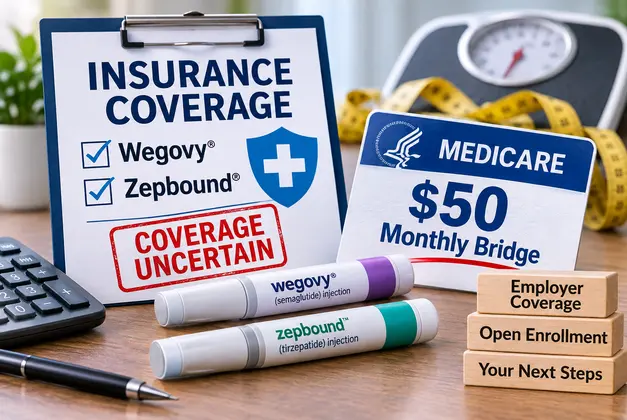
- DEPENDS Employer plan: maybe. Fewer large employers cover weight-loss use each year; check your 2027 drug list now.
- DEPENDS ACA Marketplace: rarely for weight loss alone.
- COVERED Medicare: yes, through a temporary $50/month program called the GLP-1 Bridge, if you qualify (through Dec. 31, 2027).
- DEPENDS Medicaid: only in some states, and fewer than last year.
- COVERED Any plan: often yes if the drug is prescribed for an approved condition such as type 2 diabetes, heart risk, or sleep apnea.
- Medicare: Dec. 7
- ACA Marketplace: Dec. 15 for Jan. 1 coverage; Jan. 15 in most states
- Employer: your company’s window
ACA dates vary by state, so confirm on your exchange. See ACA Open Enrollment 2027 Deadline.
Find your coverage path in 30 seconds →
Verified Nov. 7, 2026. Coverage, prices, and state policies are changing quickly. Not medical or insurance advice.
GLP-1 Coverage Path Finder
Choose what your prescriber actually documented.
Coverage at a Glance, by Insurance Type
Coverage for weight-loss use depends on who pays, while coverage for diabetes, heart, and sleep apnea uses is far more common.
| Insurance | Weight-loss use | Other approved conditions | What to check | Key date |
|---|---|---|---|---|
| Employer | DEPENDS | Usually covered | 2027 formulary, PA criteria | Your enrollment window |
| ACA | Rarely covered | Usually covered | Plan drug list | Dec. 15 / Jan. 15 |
| Medicare Part D / MA-PD | Bridge ($50) if eligible | Covered under Part D | Bridge criteria | Dec. 7; Bridge ends Dec. 31, 2027 |
| Original Medicare, no Part D | NOT COVERED | None | Consider Part D | Dec. 7 |
| Medicaid | DEPENDS by state | Required | State preferred drug list | State changes |
| TRICARE Prime/Select | With prior authorization | Covered | PA and step therapy | None |
| TRICARE For Life | NOT COVERED since Aug. 31, 2025 | Diabetes covered | Part D, then Bridge | None |
| Uninsured | Cash | Cash | Official channels | None |
Employer Plans: Why Coverage Is Shrinking, and What to Check This Open Enrollment
Many large employers are cutting weight-loss GLP-1 coverage, so your 2027 drug list may differ from this year’s.
Business Group on Health’s survey of 127 large employers found coverage for weight management fell from 72% in 2025 to 60% in 2026, and 14% have dropped or plan to drop it by 2027, up from 10% earlier in the year. Other surveys define “large” differently and report lower numbers (Mercer found 5% of employers with more than 500 staff plan to drop it), so treat these as a trend, not a prediction for your employer.
Some employers keep coverage but raise BMI thresholds or tighten other criteria. Cigna ended coverage for its own employees in July 2026. Starbucks ended coverage for weight loss in October 2026 but still covers the drugs for diabetes and other approved conditions. Coverage for diabetes generally continues.
If your employer is self-funded, HR rather than the insurer often decides what is covered, so ask HR as well as the carrier.
Script: call your plan (employer or ACA)
Script: ask HR (employer dropping coverage)
ACA Marketplace Plans
ACA plans rarely cover GLP-1s for weight loss alone, according to KFF analysis, so check each plan’s drug list before you enroll.
Search the plan’s formulary for your exact drug and look for prior authorization notes. Do this before the deadline for the plan year you want. See Bronze, Silver, or Gold for 2027 and ACA Open Enrollment 2027 Deadline.
Medicare: The $50 GLP-1 Bridge, Explained
Medicare covers weight-loss GLP-1s only through a temporary program, the Bridge, which charges $50 per monthly supply from July 1, 2026 through Dec. 31, 2027.
Six things to know:
- Who qualifies. You are 18 or older, with a standalone Part D plan or a Medicare Advantage plan with drug coverage. CMS assesses BMI and health criteria at the start of therapy, in three tiers: BMI 35 or higher; BMI 30 or higher with heart failure, uncontrolled high blood pressure, or chronic kidney disease; or BMI 27 or higher with qualifying heart or vascular disease. Confirm exact conditions in the CMS Bridge FAQ. Your prescriber decides what applies to you, and must also confirm you are making recommended lifestyle changes. CMS looks at BMI when therapy was first started, even if that was before the Bridge or before you joined Part D. If you lose or change your Part D coverage, you no longer qualify.
- Covered drugs. Wegovy (injection and pill), Zepbound KwikPen only, and Foundayo. Not covered: Zepbound vials or single-dose pens, Ozempic, Mounjaro, Rybelsus, or compounded products.
- The $50 is outside the cap. The program operates outside Part D, so the $50 doesn’t count toward your Part D deductible or yearly out-of-pocket cap ($2,100 in 2026; check CMS for the 2027 figure).
- No Extra Help. Extra Help (LIS) doesn’t reduce the $50, and it can’t go on the Medicare Prescription Payment Plan.
- How to start. Your prescriber submits the Bridge prior authorization. It is separate from your Part D plan’s process.
- The “already eligible” rule. You’re not eligible if you already get, or qualify for, a Medicare-covered GLP-1 for another reason.
| Rule | What it means for you |
|---|---|
| Dates | July 1, 2026 through Dec. 31, 2027 |
| Your cost | $50 per monthly supply |
| Yearly drug cap | The $50 doesn’t count toward it |
| Extra Help | Doesn’t lower the $50; no Medicare Prescription Payment Plan |
| Covered formulations | Wegovy injection and pill, Zepbound KwikPen, Foundayo |
| Who’s excluded | Anyone who already gets or qualifies for Part D coverage of a GLP-1 for another reason; people under 18; people without Part D |
| How to start | Your prescriber submits the Bridge prior authorization |
Medicare Advantage: a plan with drug coverage counts. See Medicare Advantage Plans and Switching to Medigap. Some retiree or employer drug coverage may not qualify, so check the CMS FAQ.
BALANCE: CMS’s April 21, 2026 memo delayed the Part D portion for 2027, so don’t look for a “BALANCE plan.” After Dec. 31, 2027: not announced; check CMS.
Script: call your Medicare plan
Sources: CMS Medicare GLP-1 Bridge, Medicare.gov.
Medicaid: Which States Still Cover Weight-Loss Use
Weight-loss coverage is optional for states, so it depends on where you live, and fewer states cover it now.
KFF counted 13 states covering it under fee-for-service as of Jan. 2026. Since then, Massachusetts ended coverage July 1, 2026, and Rhode Island restricts it from Oct. 1, 2026. Coverage is required for diabetes, heart, and sleep apnea indications. Check your state’s preferred drug list, because the count keeps moving.
TRICARE and VA
TRICARE For Life lost weight-loss GLP-1 coverage on Aug. 31, 2025, while Prime and Select still cover with prior authorization.
Prime and Select use prior authorization and step therapy. Diabetes GLP-1s remain covered. A TRICARE For Life member with Part D can check the Bridge. VA covers GLP-1s for weight management under its own criteria, so ask your VA prescriber.
Covered for Another Condition
Part D and Medicaid must cover GLP-1s for FDA-approved non-weight-loss uses, which can make coverage easier.
These include type 2 diabetes, cardiovascular risk reduction (Wegovy, 2024), obstructive sleep apnea with obesity (Zepbound, 2024), and MASH with moderate to advanced liver scarring (Wegovy, 2025). Check the FDA label for each drug’s exact indications, and ask your prescriber whether one applies to you.
Denied or Dropped? What to Do Next
Read the denial reason first, because a prior-authorization denial can be appealed while a formulary exclusion is harder to fight.
Ask your prescriber for a letter of medical necessity, and request transition supplies if coverage is ending. Keep every denial letter. See How to File a Health Insurance Appeal and Was Your Claim Denied by an Algorithm?
Appeal letter outline
Paying Cash: The Official Channels and What They Cost
Manufacturer direct channels and TrumpRx.gov offer cash prices that change often, so treat these as “from” prices.
| Drug | Channel | Starting price as of Nov. 7, 2026 | Where to confirm |
|---|---|---|---|
| Foundayo (lowest dose) | LillyDirect | From about $149/month | LillyDirect |
| Wegovy pill (starter) | NovoCare | From about $149/month | NovoCare |
| Wegovy or Zepbound injections | NovoCare, LillyDirect, TrumpRx.gov | Typically $299–$449+/month by product and dose | TrumpRx.gov |
A prescribed medication for a diagnosed disease is generally an HSA/FSA-eligible expense (check IRS Pub. 502). See HSA vs. FSA. Compounded GLP-1s aren’t FDA-approved and aren’t covered by the Bridge.
Your 2027 Cost, Side by Side
The $50 Bridge, a plan copay, and cash prices all behave differently against deductibles and caps.
| Path | What you pay | Counts toward deductible or cap? | Extra Help applies? | Savings card allowed? |
|---|---|---|---|---|
| Commercial plan | Your plan’s copay or coinsurance | Usually yes; check your plan | Not applicable | Yes, commercial only |
| Part D (other condition) | Your Part D cost share | Yes | Yes | No |
| Bridge | $50 per monthly supply | No | No | No |
| Cash | Listed price | No | No | Not applicable |
FAQ
Does insurance cover Wegovy for weight loss?
It depends on your plan. Employer coverage is shrinking, ACA plans rarely cover it, Medicaid varies by state, and Medicare uses the $50 Bridge.
Does insurance cover Zepbound?
The same pattern applies. Under Medicare’s Bridge only the KwikPen is covered. Zepbound is also FDA-approved for sleep apnea with obesity, which can open a different coverage path.
Does Medicare cover Wegovy or Zepbound in 2027?
Part D can cover them for approved non-weight-loss uses. For weight loss, the Bridge charges $50 per monthly supply through Dec. 31, 2027. Nothing has been announced for after that.
What is the Medicare GLP-1 Bridge?
A temporary CMS program running July 1, 2026 through Dec. 31, 2027. Your prescriber submits a prior authorization, and eligible people pay $50 per monthly supply for covered drugs.
Does the $50 count toward my Part D out-of-pocket cap?
No. The Bridge runs outside Part D, so it doesn’t count toward your deductible or yearly cap.
Does Extra Help lower the $50?
No.
Does the Bridge cover Zepbound vials?
No. Only the Zepbound KwikPen is covered. Zepbound vials and single-dose pens are not.
Does Medicare Advantage count for the Bridge?
Yes, if your Medicare Advantage plan includes drug coverage. A plan without drug coverage does not qualify.
What happens after December 2027?
The Bridge is scheduled to end Dec. 31, 2027. What follows hasn’t been announced, so check CMS for updates.
Which states’ Medicaid covers weight-loss GLP-1s?
KFF counted 13 states with fee-for-service coverage as of Jan. 2026. Massachusetts ended coverage July 1, 2026, and Rhode Island restricts it from Oct. 1, 2026. Check your state’s preferred drug list.
Does TRICARE cover Wegovy?
TRICARE Prime and Select cover it with prior authorization and step therapy. TRICARE For Life ended weight-loss coverage on Aug. 31, 2025, though diabetes GLP-1s remain covered.
Do ACA plans cover weight-loss drugs?
Rarely, for weight loss alone. Check each plan’s 2027 drug list before you enroll.
My employer is dropping coverage. What can I do?
Ask HR when coverage ends, whether it continues for diabetes or other documented conditions, and whether transition supplies are available. Then price the official cash channels. Use the HR script above.
Will insurance cover Zepbound for sleep apnea?
Zepbound is FDA-approved for obstructive sleep apnea with obesity. Part D and Medicaid must cover approved uses, and commercial plans usually do with prior authorization. Your prescriber must document the condition.
Can I use a savings card with Medicare?
No. Savings cards are for commercial insurance only and can’t be used with Medicare, Medicaid, TRICARE, or other government coverage.
What’s the cheapest legitimate cash price?
Use the manufacturer channels and TrumpRx.gov. As of Nov. 7, 2026, entry pills start around $149 a month, and injections are typically $299–$449+ a month depending on product and dose. Prices change often, so confirm on the official pages.
Can I use my HSA or FSA?
A prescribed medication for a diagnosed condition is generally a qualified medical expense. Confirm with your plan administrator and IRS Pub. 502.
What should I do if my prior authorization is denied?
Read the denial reason, ask your prescriber for a letter of medical necessity, and file an appeal. See the denial section above.
Sources: Medicare.gov and CMS (Medicare GLP-1 Bridge FAQ and prescriber information; BALANCE Model); KFF (Medicaid GLP-1 coverage, Jan. 2026); Business Group on Health (2026 employer survey); TRICARE.mil; FDA labels; NovoCare, LillyDirect, and TrumpRx.gov; IRS Pub. 502.
General information, not medical, insurance, or legal advice. Coverage depends on your plan, program rules, and your prescriber's documentation. Prices and policies verified Nov. 7, 2026 and change frequently.

Daniel Hayes is the founder and sole researcher at AdvoraHQ. He covers U.S. personal finance, insurance, and consumer law — working directly from IRS publications, federal and state statutes, court opinions, and SEC filings rather than secondary summaries. His focus is the gap between what readers think they know and what the source documents actually say. Daniel is not a licensed attorney, CPA, or financial advisor; his articles are educational and not personalized advice. Reach him at Daniel.Hayes@advorahq.com.
