
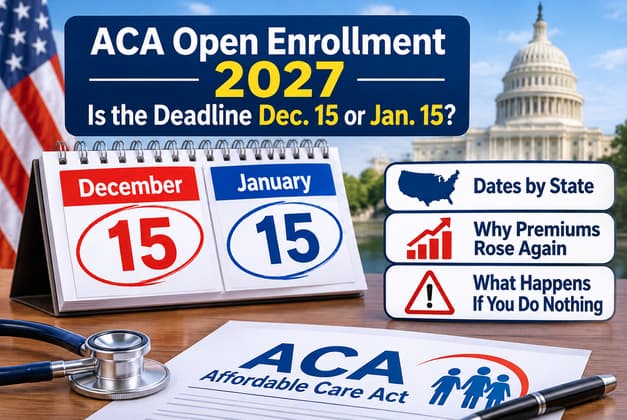
Quick Answer: Two Dates, Not One
On HealthCare.gov, Open Enrollment for 2027 coverage runs Nov. 1, 2026 to Jan. 15, 2027, but Dec. 15 is the last day to start coverage on Jan. 1.
Open Enrollment ends
Jan. 15, 2027
Last day to enroll or change plans on HealthCare.gov. Open Enrollment started Nov. 1, 2026.
Last day for Jan. 1 coverage
Dec. 15, 2026
Enroll Dec. 16 to Jan. 15 and coverage starts Feb. 1, 2027.
State-run exchanges set their own end dates. Check yours below.
Why you keep seeing Dec. 15: A rule that would have ended Open Enrollment on Dec. 15 was struck down by a federal court in June 2026. Many sites have not updated.
Find your state’s deadlines and whether you must act →
Warning: Doing nothing this year is riskier. Premiums rose again, some insurers are leaving, and excess subsidies must now be repaid in full at tax time. See what happens if you do nothing →
Dates verified on HealthCare.gov and on state exchange or government pages on . Dates we could not confirm are marked “Check.” Court status as of .
Open Enrollment Deadline & Action Checker
This checker shows your exchange, your two deadlines, and whether you need to act.
Your result
This tool runs in your browser. It does not ask for your name, income, Social Security number or Marketplace ID, and it saves and sends nothing.
Related: how to estimate your 2027 income and Bronze vs. Silver vs. Gold for 2027.
The 2027 Key Dates (HealthCare.gov)
On HealthCare.gov, 2027 Open Enrollment runs Nov. 1, 2026 through Jan. 15, 2027, and Dec. 15 is only the cutoff for coverage that starts Jan. 1.
| Date | What happens |
|---|---|
| Nov. 1, 2026 | Open Enrollment starts. You can enroll, renew or change plans. Coverage can begin as early as Jan. 1. |
| Dec. 15, 2026 | Last day to enroll or change plans for coverage that starts Jan. 1. |
| Jan. 1, 2027 | Coverage starts if you enrolled or changed by Dec. 15 and paid your first premium. |
| Jan. 15, 2027 | Open Enrollment ends. Last day to enroll or change plans. After this you need a Special Enrollment Period. |
| Feb. 1, 2027 | Coverage starts if you enrolled or changed Dec. 16 to Jan. 15 and paid your first premium. |
Coverage does not start until your first premium is paid. Choosing a plan by Dec. 15 but paying late can push back your start date.
Dec. 15 = Jan. 1 coverage. Jan. 15 = last day (HealthCare.gov).
Plan for Dec. 15 if you want no gap. Treat Jan. 15 as the backstop, not the goal.
Why So Many Sites Say Dec. 15
Many sites print Dec. 15 as the last day because a 2025 federal rule would have made it so, and a court threw that part of the rule out on June 12, 2026.
What the 2025 rule would have done
The Marketplace Integrity and Affordability rule (90 Fed. Reg. 27,074, published June 25, 2025) would have shortened Open Enrollment starting with 2027 coverage. State exchanges would have had to finish by Dec. 31. HealthCare.gov would have ended on Dec. 15.
What the court did
On June 12, 2026, the U.S. District Court for the District of Maryland ruled in City of Columbus v. Kennedy (No. 25-cv-2114) and vacated the shortened Open Enrollment provision.
The order also vacated the $5 charge on auto re-enrolled $0-premium enrollees on HealthCare.gov and most of the other provisions the plaintiffs challenged. One provision, the premium adjustment method, was upheld.
What happens next
The government filed a notice of appeal to the Fourth Circuit on July 16, 2026 (Fourth Circuit No. 26-1938). As of Nov. 2, 2026 we found no appeals-court ruling. HealthCare.gov lists Jan. 15 as the end date.
A second case, Columbus II, produced a July 16, 2026 order that stayed eight provisions of the 2027 Notice of Benefit and Payment Parameters nationwide. They include ending standardized plans and expanding catastrophic-plan eligibility.
Why you keep seeing Dec. 15: the court backstory
The shortened window was written into a federal rule, then vacated by a court. Pages written before June 12, 2026 may still describe the old plan. The appeal is pending, so we re-check weekly.
Idaho and Vermont set earlier end dates on their own exchanges. See Table 2.
Court status as of . Litigation can change quickly. Sources: SHVS litigation tracker (July 24, 2026), CMS and court filings.
Deadlines in States With Their Own Exchange
Twenty-one states and D.C. run their own exchange, and their dates can differ from HealthCare.gov’s, so check your exchange before you rely on Dec. 15 or Jan. 15.
The other 29 states use the HealthCare.gov dates in Table 1. Arkansas runs its own exchange arrangement but enrolls through HealthCare.gov.
Oregon moved off HealthCare.gov on Nov. 1, 2026 and now enrolls through its own platform, Explore Health.
CHECK YOUR STATE
We could not confirm every date on the exchange’s own page on Nov. 2, 2026. Those are marked “Check.” Do not rely on a third-party date for them. Visit or call your exchange.
Use the checker above for your state, or open the full table.
Show the full table of state exchange deadlines
| State | Exchange | Last day for Jan. 1 | Final day | Verified |
|---|---|---|---|---|
| California | Covered California | Dec. 31, 2026 | Jan. 31, 2027 | Exchange site |
| Colorado | Connect for Health Colorado | Dec. 15, 2026 | Jan. 15, 2027 | Government notice |
| Connecticut | Access Health CT Open Enrollment began Oct. 23, 2026. | Dec. 15, 2026 | Jan. 15, 2027 | Exchange site |
| District of Columbia | DC Health Link Plans chosen Jan. 16-31 start Mar. 1. | Dec. 15, 2026 | Jan. 31, 2027 | Exchange site |
| Georgia | Georgia Access | Check Georgia Access (third-party sources report Dec. 15, 2026) | Check Georgia Access (third-party sources report Jan. 15, 2027) | Not confirmed |
| Idaho | Your Health Idaho Idaho's window is Oct. 15 – Dec. 15, 2026. | Dec. 15, 2026 | Dec. 15, 2026 | Exchange site |
| Illinois | Get Covered Illinois | Dec. 15, 2026 | Jan. 15, 2027 | Exchange site |
| Kentucky | kynect health coverage | Check kynect (last year's cutoff was Dec. 15, 2025) | Jan. 15, 2027 | Jan. 1: Not confirmed. Final: Exchange site. |
| Maine | CoverME.gov | Dec. 15, 2026 | Jan. 15, 2027 | Exchange site |
| Maryland | Maryland Health Connection | Check Maryland Health Connection (the exchange has listed Dec. 31 in past years) | Jan. 15, 2027 | Jan. 1: Not confirmed. Final: Exchange site. |
| Massachusetts | Massachusetts Health Connector Open Enrollment began Oct. 23, 2026. | Dec. 23, 2026 | Jan. 23, 2027 | Government notice |
| Minnesota | MNsure | Check MNsure (third-party sources report Dec. 15, 2026) | Check MNsure (third-party sources report Jan. 15, 2027) | Not confirmed |
| Nevada | Nevada Health Link | Check Nevada Health Link (the exchange has listed Dec. 31 in past years) | Jan. 15, 2027 | Jan. 1: Not confirmed. Final: Exchange site. |
| New Jersey | Get Covered New Jersey | Dec. 31, 2026 | Jan. 31, 2027 | Exchange site |
| New Mexico | beWellnm | Dec. 31, 2026 | Jan. 15, 2027 | Government notice |
| New York | NY State of Health | Dec. 15, 2026 | Jan. 31, 2027 | Government notice |
| Oregon | Explore Health Oregon left HealthCare.gov and launched its own platform on Nov. 1, 2026. | Check Explore Health | Jan. 15, 2027 | Jan. 1: Not confirmed. Final: Government notice. |
| Pennsylvania | Pennie | Dec. 15, 2026 | Jan. 15, 2027 | Exchange site |
| Rhode Island | HealthSource RI | Check HealthSource RI (last year's cutoff was Dec. 23, 2025) | Jan. 31, 2027 | Jan. 1: Not confirmed. Final: Exchange site. |
| Vermont | Vermont Health Connect Vermont's Open Enrollment ends earlier than most. | Dec. 15, 2026 | Dec. 28, 2026 | Exchange site |
| Virginia | Virginia’s Insurance Marketplace | Dec. 15, 2026 | Jan. 29, 2027 | Exchange site |
| Washington | Washington Healthplanfinder | Dec. 31, 2026 | Jan. 15, 2027 | Exchange site |
What Happens If You Do Nothing
If you do nothing, you are usually re-enrolled in the same plan, or a similar one if yours ends, and your subsidy is recalculated from the information on file.
What automatic re-enrollment does
HealthCare.gov re-enrolls current Marketplace customers so they do not have a gap in coverage. You get a letter saying whether it is the same plan or a different one. Costs can still change.
You can switch by Dec. 15 for a Jan. 1 start, or until Jan. 15 for a Feb. 1 start.
Why it is riskier this year
- Prices moved. The average benchmark silver premium is up about 13% for 2027, so the same plan may cost more even after your credit.
- Your insurer may be leaving. Your plan could end Dec. 31, 2026, and the plan you are matched to may not include your doctors.
- Your subsidy rests on old information. If the income or household on file is out of date, your advance credit may be too high or too low.
- Mistakes cost more at tax time. Starting with tax year 2026, you repay the full excess advance credit. See the repayment section.
IN EFFECT FOR 2027
Auto re-enrollment still works for 2027. Premium and subsidy changes, insurer exits and full repayment of excess credits all apply.
BLOCKED BY COURT
The $5 charge on auto re-enrolled $0-premium enrollees was vacated on June 12, 2026, so you should not see it. The government has appealed.
Looking ahead to 2028
On Oct. 23, 2026, HHS proposed a rule to carry out new pre-enrollment verification requirements. It would essentially end automatic re-enrollment with subsidies for most consumers beginning in 2028. Comments are due Nov. 27, 2026. It is a proposal, not a final rule.
Check that your account is active
In September 2026 HHS cancelled coverage for about 760,000 people it called “phantom” enrollees, meaning an agent or broker may have enrolled them without their knowledge. Some cancellations were reversed. Log in and confirm your coverage is active.
| Situation | If you do nothing | If you act by Dec. 15 |
|---|---|---|
| You have a plan and your insurer is staying | You are usually re-enrolled in the same plan, or a similar one if yours ends. Your premium and subsidy are recalculated from the information on file, and your cost may be higher. | You compare plans, update your income and household, and keep or switch. You may find a lower total cost. |
| Your insurer is leaving (Cigna, Baylor Scott & White, others) | Your plan ends Dec. 31. Your exchange may match you to another insurer’s plan or may require you to choose. Your doctors and drugs may not be covered. | You pick a plan after checking doctors, hospitals and drugs. Coverage starts Jan. 1. |
| Your income or household changed | Your subsidy is based on old data. If it is too high, you repay the full excess at tax time. | You update your application so the advance credit matches your situation. |
| You are uninsured | You have no coverage on Jan. 1. You can still enroll through the final day, with a later start. After that you need a Special Enrollment Period. | Your coverage starts Jan. 1 once your first premium is paid. |
| Your job coverage, COBRA or Medicaid is ending | You may have a gap. A Special Enrollment Period, usually 60 days, may be available. | You enroll by your state’s Jan. 1 cutoff or use a Special Enrollment Period. |
Excess subsidies are now repaid in full at tax time.
See how repayment works, and how to estimate your 2027 income.
If Your Insurer Is Leaving (Cigna and Others)
If your insurer is leaving the Marketplace, your plan ends Dec. 31, 2026, so choose a new plan yourself by your exchange’s Jan. 1 cutoff instead of waiting to be matched.
As of Oct. 28-29, 2026, KFF counts 11 carriers leaving at least one state and 7 entering a new state. Cigna is the largest exit, leaving all 11 states where it sells individual plans.
| Insurer | States | Enrollees affected | Source | Date |
|---|---|---|---|---|
| Cigna | Arizona, Colorado, Florida, Georgia, Illinois, Indiana, Mississippi, North Carolina, Tennessee, Texas, Virginia (all 11 states where it sells individual plans) | About 369,000 members (Cigna, first quarter 2026) | Cigna announcement; KFF tracker | Announced Apr. 30, 2026; KFF updated Oct. 28, 2026 |
| Baylor Scott & White Health Plan | Texas | About 100,000 (about 2.6% of Texas Marketplace enrollees) | Becker’s Payer; company announcement as reported | Announced Apr. 2026 |
| CareSource | Indiana (about 60,000 members). Reports also name Ohio and West Virginia. | Indiana: about 60,000 | KFF tracker; Becker’s Payer | KFF June 2026; check your letter |
| Medica | Iowa, Kansas, Oklahoma | Not disclosed | Becker’s Payer | 2026; check your letter |
| Molina Healthcare | Cutting its Marketplace footprint from 14 states to 6. The list of states we could verify was not complete. | Not disclosed | Becker’s Payer | 2026; check your letter |
| All carriers (KFF count) | 11 carriers exit at least one state; 7 carriers enter a new state | Varies by county | KFF | Oct. 28-29, 2026 |
What to do, in order
- Find your letter. It names the end date and your options. Insurers must give at least 90 days’ notice when they discontinue a product, and 180 days when they leave a state’s entire individual market (45 CFR 147.106). No letter? Check your account messages and call your insurer.
- See how your exchange handles it. HealthCare.gov generally moves people into a similar plan from another insurer. State exchanges set their own rules. Boulder County’s enrollment center tells Cigna members in Colorado to pick a new plan themselves.
- Check your doctors, hospitals and drugs in each new plan’s directory and drug list, then confirm with the office. Our guides on HMO vs. PPO and how health insurance works explain networks and costs.
- Pick your own plan by Dec. 15 (or your state’s Jan. 1 cutoff in Table 2).
- Pay your first premium by the due date so coverage starts.
If your insurer is leaving, you may be matched to another plan unless you pick one, and your doctors may not be in it.
The Baylor Scott & White exit is the health plan, not the hospital system. Whether its doctors are in your next plan depends on that plan’s network.
Paying Back Subsidies: The Cap Is Gone
Starting with the 2026 tax year, you must repay the full amount of any excess advance premium tax credit, because the old repayment caps are gone.
Section 71305 of the One Big Beautiful Bill Act removed the caps for tax years beginning after Dec. 31, 2025. The first returns affected are 2026 returns filed in 2027. The old caps ranged roughly from $375 to $3,250.
You reconcile on Form 8962. If advance payments exceeded the credit you qualify for, the whole excess is added to your tax bill.
How it works
The full excess is repaid at any income. Where you land against 400% of the poverty level decides whether you qualify for the credit at all. It does not decide how much you repay.
Illustration, with invented numbers: you receive $4,000 in advance credits during the year, and your final income qualifies you for $2,500. You owe $1,500. Under the old rules a cap could have limited that bill.
How to lower the risk
- Update your income and household in your Marketplace account whenever they change, not only in November.
- Consider taking less of the credit in advance and claiming the rest at tax time. Ask your exchange how.
- If your income swings, as for many self-employed people, read self-employed health insurance costs.
- Estimate your income carefully with our 2027 income guide.
- If you receive advance credits, file a tax return with Form 8962, even if you would not otherwise have to file.
This is general information, not tax advice. For your situation, ask a tax professional or a free tax-help program.
What Changed for 2027 and What Courts Blocked
For 2027, higher premiums, no enhanced credits, full repayment and insurer exits are in effect, while several federal rule changes remain blocked by courts as of Nov. 2, 2026.
We label each item with one of three tiers: IN EFFECT FOR 2027, BLOCKED BY COURT, or CHECK YOUR STATE.
IN EFFECT FOR 2027
Enhanced premium tax credits expired. Credits generally apply at 100%-400% of the federal poverty level, and not above 400%.
Since: Jan. 1, 2026
Source: KFF, Oct. 30, 2026
IN EFFECT FOR 2027
Average benchmark silver premium up 13% for 2027 (HealthCare.gov states 11%, state-based exchanges 16%).
Since: 2027 plan year
Source: KFF, Oct. 30, 2026
IN EFFECT FOR 2027
No cap on repaying excess advance premium tax credits. You repay the full excess on Form 8962.
Since: Tax years beginning after Dec. 31, 2025 (first affected: 2026 returns filed in 2027)
Source: One Big Beautiful Bill Act, section 71305; IRS
IN EFFECT FOR 2027
Cigna leaves the individual market in 11 states; Baylor Scott & White leaves Texas. Other carriers leave some states.
Since: Plans end Dec. 31, 2026
Source: KFF insurer tracker, Oct. 28, 2026
IN EFFECT FOR 2027
Premium tax credits limited to lawful permanent residents, Cuban and Haitian entrants, and COFA residents. Refugees, asylees and trafficking victims can still buy coverage, without credits.
Since: 2027 plan year
Source: KFF, Oct. 30, 2026
IN EFFECT FOR 2027
Out-of-pocket maximum rises to $12,000 (self-only) and $24,000 (other than self-only).
Since: 2027 plan year
Source: CMS 2027 payment parameters guidance, Jan. 29, 2026
IN EFFECT FOR 2027
Bronze and catastrophic plans are treated as HSA-compatible.
Since: Jan. 1, 2026
Source: One Big Beautiful Bill Act; IRS Notice 2026-5
BLOCKED BY COURT
Shortened Open Enrollment (Dec. 15 on HealthCare.gov, Dec. 31 for state exchanges).
Since: Vacated June 12, 2026. Government appeal pending.
Source: City of Columbus v. Kennedy; SHVS, July 24, 2026
BLOCKED BY COURT
$5 charge on auto re-enrolled $0-premium enrollees on HealthCare.gov.
Since: Vacated June 12, 2026. Government appeal pending.
Source: City of Columbus v. Kennedy; SHVS, July 24, 2026
BLOCKED BY COURT
Pre-enrollment verification for most Special Enrollment Periods on HealthCare.gov, and extra income checks when tax data are missing or show income under 100% of poverty.
Since: Vacated for 2026 (June 12, 2026); stayed for 2027 (July 16, 2026)
Source: SHVS, July 24, 2026
BLOCKED BY COURT
Failure-to-reconcile rules that cut off advance credits.
Since: Suspended by CMS for 2026 and 2027 (July 22, 2026)
Source: SHVS, July 24, 2026; KFF
BLOCKED BY COURT
Ending standardized plans on HealthCare.gov.
Since: Stayed July 16, 2026 (Columbus II)
Source: SHVS, July 24, 2026; KFF
BLOCKED BY COURT
Wider catastrophic-plan eligibility. Eligibility stays limited to people under 30, people whose coverage would cost more than 8.5% of income, and people with a hardship exemption.
Since: Stayed July 16, 2026 (Columbus II)
Source: KFF, Oct. 30, 2026; SHVS
BLOCKED BY COURT
Looser network adequacy rules, and bronze plans with out-of-pocket limits above the legal maximum.
Since: Stayed July 16, 2026 (Columbus II)
Source: SHVS, July 24, 2026
CHECK YOUR STATE
State Open Enrollment deadlines (Table 2).
Since: Varies by state
Source: Each state exchange
CHECK YOUR STATE
State-funded subsidies: New Mexico, California and New Jersey continue; Rhode Island and Virginia are new for 2027.
Since: 2027 plan year
Source: KFF, Oct. 30, 2026
CHECK YOUR STATE
State coverage requirements with a penalty on the state tax return: California, Massachusetts, New Jersey, Rhode Island and D.C.
Since: Varies by state
Source: State tax agencies
CHECK YOUR STATE
Medicaid work requirements: people denied or removed from Medicaid only for not meeting them cannot get premium tax credits. Forty-three states and D.C. must start in 2027.
Since: 2027; timing varies by state
Source: KFF, Oct. 30, 2026
| Change | Status | Since | Source |
|---|---|---|---|
| Enhanced premium tax credits expired. Credits generally apply at 100%-400% of the federal poverty level, and not above 400%. | IN EFFECT FOR 2027 | Jan. 1, 2026 | KFF, Oct. 30, 2026 |
| Average benchmark silver premium up 13% for 2027 (HealthCare.gov states 11%, state-based exchanges 16%). | IN EFFECT FOR 2027 | 2027 plan year | KFF, Oct. 30, 2026 |
| No cap on repaying excess advance premium tax credits. You repay the full excess on Form 8962. | IN EFFECT FOR 2027 | Tax years beginning after Dec. 31, 2025 (first affected: 2026 returns filed in 2027) | One Big Beautiful Bill Act, section 71305; IRS |
| Cigna leaves the individual market in 11 states; Baylor Scott & White leaves Texas. Other carriers leave some states. | IN EFFECT FOR 2027 | Plans end Dec. 31, 2026 | KFF insurer tracker, Oct. 28, 2026 |
| Premium tax credits limited to lawful permanent residents, Cuban and Haitian entrants, and COFA residents. Refugees, asylees and trafficking victims can still buy coverage, without credits. | IN EFFECT FOR 2027 | 2027 plan year | KFF, Oct. 30, 2026 |
| Out-of-pocket maximum rises to $12,000 (self-only) and $24,000 (other than self-only). | IN EFFECT FOR 2027 | 2027 plan year | CMS 2027 payment parameters guidance, Jan. 29, 2026 |
| Bronze and catastrophic plans are treated as HSA-compatible. | IN EFFECT FOR 2027 | Jan. 1, 2026 | One Big Beautiful Bill Act; IRS Notice 2026-5 |
| Shortened Open Enrollment (Dec. 15 on HealthCare.gov, Dec. 31 for state exchanges). | BLOCKED BY COURT | Vacated June 12, 2026. Government appeal pending. | City of Columbus v. Kennedy; SHVS, July 24, 2026 |
| $5 charge on auto re-enrolled $0-premium enrollees on HealthCare.gov. | BLOCKED BY COURT | Vacated June 12, 2026. Government appeal pending. | City of Columbus v. Kennedy; SHVS, July 24, 2026 |
| Pre-enrollment verification for most Special Enrollment Periods on HealthCare.gov, and extra income checks when tax data are missing or show income under 100% of poverty. | BLOCKED BY COURT | Vacated for 2026 (June 12, 2026); stayed for 2027 (July 16, 2026) | SHVS, July 24, 2026 |
| Failure-to-reconcile rules that cut off advance credits. | BLOCKED BY COURT | Suspended by CMS for 2026 and 2027 (July 22, 2026) | SHVS, July 24, 2026; KFF |
| Ending standardized plans on HealthCare.gov. | BLOCKED BY COURT | Stayed July 16, 2026 (Columbus II) | SHVS, July 24, 2026; KFF |
| Wider catastrophic-plan eligibility. Eligibility stays limited to people under 30, people whose coverage would cost more than 8.5% of income, and people with a hardship exemption. | BLOCKED BY COURT | Stayed July 16, 2026 (Columbus II) | KFF, Oct. 30, 2026; SHVS |
| Looser network adequacy rules, and bronze plans with out-of-pocket limits above the legal maximum. | BLOCKED BY COURT | Stayed July 16, 2026 (Columbus II) | SHVS, July 24, 2026 |
| State Open Enrollment deadlines (Table 2). | CHECK YOUR STATE | Varies by state | Each state exchange |
| State-funded subsidies: New Mexico, California and New Jersey continue; Rhode Island and Virginia are new for 2027. | CHECK YOUR STATE | 2027 plan year | KFF, Oct. 30, 2026 |
| State coverage requirements with a penalty on the state tax return: California, Massachusetts, New Jersey, Rhode Island and D.C. | CHECK YOUR STATE | Varies by state | State tax agencies |
| Medicaid work requirements: people denied or removed from Medicaid only for not meeting them cannot get premium tax credits. Forty-three states and D.C. must start in 2027. | CHECK YOUR STATE | 2027; timing varies by state | KFF, Oct. 30, 2026 |
Bronze, catastrophic and HSAs
Bronze and catastrophic plans are treated as HSA-compatible beginning Jan. 1, 2026 (IRS Notice 2026-5). See Bronze vs. Silver vs. Gold for 2027 for the cost math.
Immigration status and credits
Premium tax credits are limited to lawful permanent residents, Cuban and Haitian entrants, and residents of the Freely Associated States. Refugees, asylees and trafficking victims can still buy a plan without credits.
Medicaid work requirements
If you are denied or removed from Medicaid only because you did not meet a work requirement, you cannot get premium tax credits. Forty-three states and D.C. must start these requirements in 2027. Timing varies, so check your state.
Missed the Deadline? Your Options
If you miss the deadline, you can still get covered through a Special Enrollment Period, Medicaid or CHIP, or other routes, but you generally cannot buy a Marketplace plan until the next Open Enrollment.
- Special Enrollment Period. Events such as losing job-based coverage, moving, marriage, or a new baby usually give you about 60 days. See adding a newborn.
- Medicaid and CHIP. You can apply any time of year if you qualify.
- COBRA. It keeps your job plan for a limited time, often at full cost. Read COBRA insurance explained.
- No job. See health insurance without a job for every option.
- Short-term plans. Use caution. They usually do not follow ACA rules, can exclude pre-existing conditions, and may not count as coverage under a state requirement.
Dropping a plan on your own, or missing a payment, usually does not open a Special Enrollment Period.
Review Your Plan in 15 Minutes
Do these eight steps before your state’s Jan. 1 cutoff and you will catch most of the problems this year’s changes can cause.
- Log in and update income and household for 2027. Use our income estimate guide.
- Check that your current coverage is active and that you have read your notices.
- Look up your doctors, hospitals and prescriptions in each plan’s directory and drug list.
- Compare premium + deductible + out-of-pocket maximum (the 2027 limit is $12,000 for one person), not premium alone. See Bronze vs. Silver vs. Gold.
- If your income qualifies, check Silver plans for cost-sharing reductions.
- If your insurer is leaving, pick your own plan by Dec. 15. Do not rely on the match.
- Save the confirmation and pay the first premium by the due date.
- Get free help: certified assisters, or the Marketplace Call Center at 1-800-318-2596 (TTY 1-855-889-4325).
Frequently Asked Questions
These are the questions readers ask most about the 2027 deadline, in plain terms.
When is the open enrollment deadline for 2027?
On HealthCare.gov, Open Enrollment ends Jan. 15, 2027. Dec. 15, 2026 is the last day to enroll for coverage that starts Jan. 1. State exchanges set their own dates, so check Table 2.
Is open enrollment Dec. 15 or Jan. 15?
Both dates matter. Dec. 15 is the cutoff for Jan. 1 coverage. Jan. 15 is the last day to enroll or change plans on HealthCare.gov, with coverage starting Feb. 1.
Was open enrollment shortened for 2027?
A federal rule would have shortened it, but a federal court vacated that provision on June 12, 2026, and the government has appealed. HealthCare.gov still lists Jan. 15. A few state exchanges set earlier end dates themselves, such as Idaho (Dec. 15) and Vermont (Dec. 28).
What happens if I enroll after Dec. 15?
On HealthCare.gov, enrolling Dec. 16 through Jan. 15 means coverage starts Feb. 1, so January may be uncovered. Some state exchanges have later Jan. 1 cutoffs, such as Dec. 31 in California, New Jersey and Washington.
What happens if I don’t do anything during open enrollment?
If you have Marketplace coverage, you are usually re-enrolled in the same plan or a similar one, and your subsidy is recalculated from the information on file. If you are uninsured, nothing happens and you stay uninsured.
Will I be automatically re-enrolled?
Usually yes if you have Marketplace coverage now. HealthCare.gov sends a letter saying whether it is the same plan or a different one. HHS has proposed rules that would end most automatic re-enrollment with subsidies starting in 2028, but they are not final.
What if my insurance company is leaving the Marketplace?
Your plan ends Dec. 31, 2026. Look for your discontinuation letter, check which plans include your doctors, and pick your own plan by your exchange’s Jan. 1 cutoff rather than waiting to be matched.
Is Cigna leaving the Marketplace in my state?
Cigna is leaving the individual market in all 11 states where it sells plans: Arizona, Colorado, Florida, Georgia, Illinois, Indiana, Mississippi, North Carolina, Tennessee, Texas and Virginia. If your state is not on that list, Cigna is not your Marketplace insurer.
Why did my premium go up for 2027?
The enhanced federal premium tax credits expired at the end of 2025, and insurers priced in a smaller, sicker pool of enrollees. KFF reports the average benchmark silver premium is up 13% for 2027, after 26% from 2025 to 2026.
Do I still get a subsidy in 2027?
Premium tax credits generally go to eligible people with income from 100% to 400% of the federal poverty level, and not above 400%. Immigration status also matters. Estimate your income with our 2027 ACA income guide.
Do I have to pay back my premium tax credit?
Yes, if the advance credits you received exceed the credit you qualify for. Starting with tax year 2026, you repay the full excess. The old repayment caps no longer apply.
Is there a penalty for not having health insurance in 2027?
There is no federal penalty. California, Massachusetts, New Jersey, Rhode Island and D.C. have their own coverage requirements with penalties on the state tax return.
Can I get health insurance after Jan. 15?
Usually only with a Special Enrollment Period, such as after losing job-based coverage or moving. You can apply for Medicaid and CHIP at any time if you qualify.
What is a Special Enrollment Period?
It is a window outside Open Enrollment, triggered by an event such as losing coverage, moving, marriage, or having a baby. It is usually 60 days. Documents may be requested.
Do state exchanges have different deadlines?
Yes. Twenty-one states and D.C. run their own exchanges, and several have different Jan. 1 cutoffs and end dates. Use the checker above or Table 2.
Where can I get free help enrolling?
Call the Marketplace Call Center at 1-800-318-2596 (TTY 1-855-889-4325), or find local help at HealthCare.gov/find-assistance. State exchanges also run their own help lines and certified assisters.
Sources
These are the primary sources behind the dates and figures above.
- HealthCare.gov, Dates and deadlines and automatic re-enrollment
- KFF, 9 Things to Watch for the 2027 ACA Open Enrollment Period (Oct. 30, 2026)
- KFF, Tracking Insurer Participation Changes in 2027
- SHVS, Litigation Status of Marketplace Rule Provisions (July 24, 2026), on City of Columbus v. Kennedy, No. 25-cv-2114 (D. Md.)
- CMS, 2027 payment parameters guidance (out-of-pocket maximum)
- Health Affairs Forefront, proposed pre-enrollment verification rule (Oct. 27, 2026)
- IRS, About Form 8962
- Each state exchange’s own Open Enrollment page, linked in Table 2
Last updated: . We re-check the appeal and state dates weekly through Jan. 31.
Disclaimer: This is general information based on HealthCare.gov, CMS, state exchanges, KFF and court records verified on Nov. 2, 2026. Litigation may change some rules. It is not insurance, tax or legal advice. Confirm your dates and options with HealthCare.gov or your state exchange, or ask a free certified navigator.

Daniel Hayes is the founder and sole researcher at AdvoraHQ. He covers U.S. personal finance, insurance, and consumer law — working directly from IRS publications, federal and state statutes, court opinions, and SEC filings rather than secondary summaries. His focus is the gap between what readers think they know and what the source documents actually say. Daniel is not a licensed attorney, CPA, or financial advisor; his articles are educational and not personalized advice. Reach him at Daniel.Hayes@advorahq.com.
