
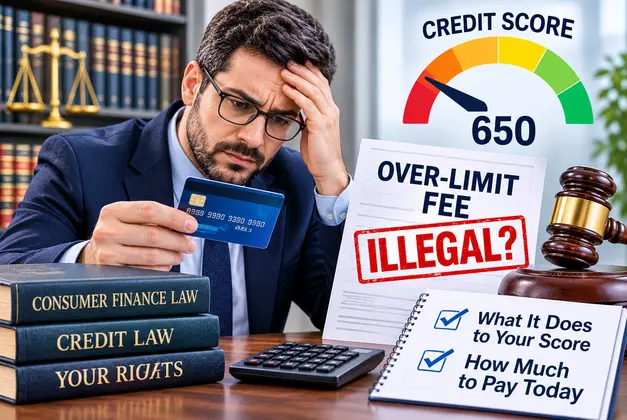
Going over your limit feels urgent, but it is usually fixable today. Start with the three facts that matter most.
Quick Answer: Three Facts Before You Panic
- 1. You can be charged an over-limit fee only if you opted in. Even then it can’t be more than the amount you went over, and only once per billing cycle.
- 2. Going over your limit can’t, by itself, raise the interest rate on the balance you already have.
- 3. Your credit score usually sees the balance reported on your statement closing date, not today’s. Pay it down before then and you limit the damage.
Find exactly how much to pay before your statement closes →
Were you charged a fee? Check if it was allowed →
Rules verified against 12 CFR § 1026.56 on November 2, 2026.
Over-Limit Payment Calculator
Enter your numbers and get the payment that puts you back under your limit, plus the payments that bring your reported utilization down to about 30% or 10%. Everything stays in your browser. Don’t enter card numbers or names.
What Happens the Moment You Go Over
Your card either declines, approves with no fee, or approves and charges a fee, and which one you get is largely the issuer’s choice.
Three tiers sit behind every answer on this page. We write them as words so you never have to decode a color.
| Outcome | Can the bank do it? | Fee? | Interest? | What to do |
|---|---|---|---|---|
| Declined | Yes. ISSUER’S CHOICE. No issuer has to approve an over-limit transaction, even if you opted in (comment 56(b)-2). | No over-limit fee, because no over-limit transaction was paid. | None on the declined purchase. | Pay down, use another card, and don’t keep retrying the same charge. |
| Approved, you never opted in | Yes. It may approve without your consent (§ 1026.56(b)(2)). | NO FEE ALLOWED. | Yes. Interest accrues on the purchase as usual. | Pay under the limit before the statement closes, then confirm your opt-in status. |
| Approved, you opted in | Yes. ISSUER’S CHOICE. | FEE ONLY IF YOU OPTED IN. No more than the amount over, once per cycle. | Yes. Interest accrues as usual. | Run the fee check below. If you were charged, ask for a reversal and consider opting out. |
Why one card declines at $1 over and another approves $200 over
Each issuer sets its own authorization rules, and nothing in federal law makes it approve. Some decline anything that would cross the line. Others approve and rely on other tools.
An issuer that has a policy of declining over-limit transactions doesn’t need an opt-in program at all (comment 56(b)-1). One that approves without your consent still can’t charge a fee for it.
If the opposite happened and your card declined while you still had room, see our guide on a card declined with available credit.
When an Over-Limit Fee Is Illegal
Federal law bars an over-limit fee in at least seven situations, and the biggest one is simply that you never opted in.
The rule is 12 CFR § 1026.56 in Regulation Z. It says the issuer may pay an over-limit transaction without your consent but “may not charge a fee for paying the transaction” (comment 56(b)(2)-1).
The three “I couldn’t have avoided it” examples
The CFPB’s commentary gives three examples where the issuer couldn’t have prevented the overage, and still no fee is allowed without opt-in:
Two things that don’t count as consent
The opt-in must come after a separate notice, and the issuer has to confirm it in writing or electronically before any fee. A signature on the card application alone is not consent.
All seven situations
| Situation | Fee allowed? | Rule |
|---|---|---|
| You never opted in | NO FEE ALLOWED | § 1026.56(b) and (b)(2); comment 56(b)(2)-1 |
| Opt-in not yet confirmed in writing or electronically | NO FEE ALLOWED | § 1026.56(b) |
| Interest or plan fees charged this cycle are the only reason you’re over | NO FEE ALLOWED for that cycle | § 1026.56(j)(4); comment 56(j)-5. Fees or interest carried over from earlier cycles don’t count. |
| You paid and the issuer was slow to restore your available credit | NO FEE ALLOWED | § 1026.56(j)(2); comment 56(j)-3 |
| Fourth cycle for the same overage | NO FEE ALLOWED, unless another over-limit transaction occurred in one of the last two cycles | § 1026.56(j)(1)(ii) |
| A second fee in the same cycle | NO FEE ALLOWED | § 1026.56(j)(1)(i) |
| Your limit was just lowered and you’re over only because of the cut | CHECK YOUR NOTICE DATE. No fee or penalty rate for exceeding the new limit until 45 days after notice. | § 1026.9(c)(2)(vi) |
You never opted in
NO FEE ALLOWED.
Rule: an issuer may pay the transaction without consent but may not charge a fee for it.
Citation: § 1026.56(b) and (b)(2); comment 56(b)(2)-1.
Opt-in not yet confirmed in writing
NO FEE ALLOWED.
Rule: the issuer must confirm your opt-in in writing or electronically before it can charge.
Citation: § 1026.56(b).
Interest or fees are the only reason you’re over
NO FEE ALLOWED for that cycle.
Rule: fees or interest charged in that same cycle can’t be the sole cause. Amounts carried over from earlier cycles don’t count.
Citation: § 1026.56(j)(4); comment 56(j)-5.
You paid and your credit wasn’t restored promptly
NO FEE ALLOWED.
Rule: no fee when the overage results from the issuer’s delay in restoring available credit after your payment.
Citation: § 1026.56(j)(2); comment 56(j)-3.
Fourth cycle for the same overage
NO FEE ALLOWED, unless another over-limit transaction occurred in one of the last two cycles.
Citation: § 1026.56(j)(1)(ii).
A second fee in the same cycle
NO FEE ALLOWED.
Rule: no more than one over-limit fee per billing cycle.
Citation: § 1026.56(j)(1)(i).
Your limit was just lowered
CHECK YOUR NOTICE DATE.
Rule: no fee or penalty rate solely for exceeding the new limit until 45 days after the issuer gave notice.
Citation: § 1026.9(c)(2)(vi).
Can They Charge Me an Over-Limit Fee?
Answer five questions for an initial check of what the rule allows. It never tells you whether you will be charged.
If You Did Opt In: The Limits on the Fee
Even with your consent, the fee is capped at the amount you went over, limited to once per billing cycle, and limited to three cycles for the same overage.
The size cap
An over-limit fee can’t exceed the dollar amount of the overage (§ 1026.52(b)(2)(i)(A)). If you’re $12 over, the fee can’t be more than $12.
Once per cycle, three cycles at most
The rule says an issuer “may not impose more than one over-the-limit fee or charge” in a billing cycle (§ 1026.56(j)(1)(i)). For the same overage it generally can’t charge more than three billing cycles.
If you get the balance under the limit by the payment due date, the commentary says no fee can be charged for that cycle. A new over-limit transaction in one of the last two cycles lets the issuer keep charging on the earlier overage (§ 1026.56(j)(1)(ii)).
What about the safe harbor?
Regulation Z also sets “safe harbor” amounts, which are fee levels an issuer can charge without proving its costs. Be careful with the current figure.
The CFPB’s March 2024 rule published $32 for a first violation and $43 for a repeat within six billing cycles for penalty fees other than late fees. A federal court in the Northern District of Texas vacated that rule on April 15, 2025. The December 2025 annual adjustment notice did not restate the penalty fee amounts, so we can’t confirm a single current number.
Revoking your opt-in
You can revoke at any time (§ 1026.56(g)). Consent lasts until you revoke it or the issuer stops paying over-limit transactions (§ 1026.56(h)). The issuer must act as soon as reasonably practicable (§ 1026.56(i)).
Revoking doesn’t make the issuer reverse fees for earlier overages (comment 56(g)-1), so ask for a courtesy reversal separately.
Other protections
An issuer can’t make the size of your credit limit depend on whether you opt in, if it charges a fee for the service (§ 1026.56(j)(3)). An authorized user who isn’t jointly liable can’t opt in or revoke on behalf of the account (comment 56(f)-1).
What It Does to Your Credit Score
Going over your limit can hurt your score through high utilization, and what counts is usually the balance your issuer reports at your statement closing date.
Utilization is your balance compared with your limit. A balance above 100% sits at the extreme end of that scale and is a strong negative signal. No fixed number of points applies, so be wary of any site that promises one. Our utilization guide covers the ratio in depth.
The closing date matters more than the due date
Issuers typically report the balance as of your statement closing date. Your due date comes weeks later. A payment made after the statement closes may protect you from interest and late fees but may not change the balance that was already reported for the cycle.
Report timing varies by issuer, so treat this as the usual pattern rather than a guarantee.
“I paid it off but my score dropped”
Scores update when new data is reported. If you paid after the balance was reported, the high balance can stay on your report until the next cycle’s report. Widely used models generally score the balance currently reported, so a lower reported balance can recover the utilization part of your score.
| Scenario (limit $2,000) | Balance | Utilization | After paying |
|---|---|---|---|
| Over the limit, nothing paid | $2,100 | 105% | $0 |
| Pay $200 | $1,900 | 95% | $200 |
| Pay to about 30% | $600 | 30% | $1,500 |
| Pay to about 10% | $200 | 10% | $1,900 |
Can They Raise Your Interest Rate?
Going over your limit can’t, by itself, raise the rate on the balance you already have, because that generally takes a payment more than 60 days late.
Under § 1026.55, the main exception that reaches existing balances is a required minimum payment not received within 60 days after its due date, and the issuer must first give the notice required by § 1026.9(g). If you then make six consecutive on-time minimum payments, the issuer must restore the prior rate on those balances.
New transactions work differently. After the first year of the account, an issuer can raise the rate on new transactions with 45 days’ advance notice, and the increase can’t reach transactions made before or within 14 days after the notice. During the first year, increases are generally barred.
| Balance | What’s required | Notice | Timing |
|---|---|---|---|
| Existing balance | A required minimum payment not received within 60 days of its due date (§ 1026.55(b)(4)) | Written notice under § 1026.9(g) | Rate must return to the prior level after six consecutive on-time minimum payments |
| New transactions, first year | Generally can’t be raised. Going over the limit is not one of the listed exceptions. | Not applicable | First year after account opening |
| New transactions, after year one | The issuer may raise the rate going forward if your agreement and notice allow it (§ 1026.55(b)(3)) | At least 45 days before the effective date | Doesn’t apply to transactions made before or within 14 days after the notice |
What to look for in a notice
Check the effective date, which should be at least 45 days out, which balances it applies to, and what triggered it. Our interest rate increase notice guide walks through it.
“My Limit Was Lowered and Now I’m Over”
If your issuer cut your limit and that put you over, it can’t charge an over-limit fee or penalty rate solely for exceeding the new limit until 45 days after it gave you notice.
The CFPB says the same thing in plain terms in its answer on credit limit reductions. Under § 1026.9(c)(2)(vi), the notice can be written or oral and must say the limit “has been or will be decreased.”
The 45 days is a notice period, not an amnesty. After it passes, a fee still needs your opt-in, and any penalty rate still has to follow the rate rules above.
What to do
Ask the issuer for the date it gave notice and put that date on your calendar. Pay down below the new limit inside the 45 days if you can. For the rest of the story, including score effects, see our guide on a credit limit lowered without warning.
Your Minimum Payment May Jump
Many card agreements add the over-limit amount to your next minimum payment, so your bill can rise even when no fee was charged.
Check your card agreement and your statement’s minimum payment section. Pay at least the full minimum due, and the calculator above already counts what you need to get back under the limit.
For how minimums are calculated, see why your minimum payment went up. If the interest charge is what surprised you, read about being charged interest after paying the statement balance.
The Next 24 Hours: Step by Step
You can handle this in five steps, starting with the numbers.
- 1. Check pending charges. Holds and pending charges can settle at a different amount, so add them to your balance before you decide what to pay.
- 2. Pay before the closing date. Use the calculator, and pay at least the amount it shows to get back under the limit.
- 3. Pause autopays and subscriptions on that card. A recurring charge can push you over again, so move them to another card until the balance is down.
- 4. Call your issuer. Use the phone script to confirm your opt-in status and ask for any improper fee to be reversed.
- 5. Set a balance alert. Pick an amount below your limit so you hear about it before the next overage.
How to Get a Fee Reversed and Opt Out
Call, say what the rule requires, and ask for the reversal and the opt-out in writing.
Phone script: reverse the fee and opt out
- 1. “I went over my limit on (date). I’d like to confirm whether I’m opted in to over-limit transactions on this account.”
- 2. If not opted in and charged: “Since I never opted in, an over-limit fee isn’t permitted under Regulation Z, section 1026.56. Please reverse it.”
- 3. If interest put you over: “The overage was caused only by interest or fees you charged, so a fee isn’t allowed. Please reverse it.”
- 4. If opted in: “I’d like to revoke my over-limit opt-in today, and I’m asking for a one-time courtesy reversal.”
- 5. “Can you tell me the exact amount I need to pay to be back under the limit, including pending charges?”
- 6. “Please send written confirmation of the reversal and of my opt-out.”
- 7. Write down the date, time, rep name, and confirmation number.
If the issuer says no
Ask for a supervisor, then dispute the fee in writing and keep a copy. If you believe a fee broke these rules, you can file a complaint with the CFPB.
The opt-out can usually be done by phone or through your account, and the issuer can’t make revoking harder than opting in was (comment 56(c)-1).
Stop It Happening Again
The most effective step is making sure you haven’t opted in, then keeping a cushion below your limit.
Over Limit vs. Maxed Out vs. Declined With Credit Available
These three situations sound alike but carry different fee risk, score effects, and fixes.
| What it means | Fee risk | Score effect | Fix | Our guide |
|---|---|---|---|---|
| Over the limit: your balance is above your limit | FEE ONLY IF YOU OPTED IN | Utilization above 100% is a strong negative signal | Pay under the limit before the statement closes | This guide |
| Maxed out: your balance is at or near your limit | No over-limit fee, because you haven’t crossed the line | High utilization | Pay down toward 30% or lower | Credit utilization ratio |
| Declined with available credit: the card refuses a charge though you have room | No over-limit fee, because nothing went over | A decline doesn’t itself change your balance | Call the issuer about holds, fraud flags, or payment delays | Declined with available credit |
If You Can’t Pay It Down
If you can’t get under the limit this month, ask your issuer for help before you miss a payment.
Start with a credit card hardship program, which can lower your rate or payment for a set period. You can also speak with a nonprofit credit counselor through the National Foundation for Credit Counseling.
What not to do
Don’t skip the minimum payment, take a cash advance to cover the gap, or open new cards just to move the balance. Be cautious with any company that charges a fee to “erase” your debt.
FAQ
Short answers to the questions people ask most after going over.
What happens if you go over your credit limit?
Your card may decline, approve with no fee, or approve and charge a fee. A fee requires your opt-in, and interest accrues either way.
Can you go over your credit limit at all?
Yes, if the issuer approves the transaction. Nothing requires it to approve one, even if you opted in (comment 56(b)-2).
Why was my purchase approved even though it put me over?
That’s the issuer’s choice, and some charges can’t be stopped at all: a small purchase never sent for authorization, a pump charge that settles above the hold, or a recurring charge that posts first.
Can a bank charge an over-limit fee if I didn’t opt in?
No. Without your opt-in, it may pay the transaction but may not charge a fee for it (§ 1026.56(b)(2)).
How much can an over-limit fee be?
No more than the amount you went over (§ 1026.52(b)(2)(i)(A)), and only once per billing cycle. A $12 overage means a fee of $12 at most.
Can interest charges put me over the limit and trigger a fee?
Not for that cycle, if fees or interest charged in the same cycle are the only reason you’re over (§ 1026.56(j)(4)). Amounts carried over from earlier cycles don’t count toward that protection (comment 56(j)-5).
I paid but my available credit hasn’t updated. Can they charge me?
An issuer may not assess an over-limit fee if the overage results from its decision not to promptly restore your available credit after your payment is credited (comment 56(j)-3). If your payment hadn’t been credited yet, ask the issuer when it posted.
How many times can they charge an over-limit fee?
Once per cycle, and generally not for more than three billing cycles for the same overage. A new over-limit transaction in one of the last two cycles lets the issuer continue charging on the earlier one.
How do I opt out of over-limit fees?
Call or use your account, then ask for written confirmation. The issuer must act as soon as reasonably practicable, and revoking doesn’t reverse earlier fees.
Does going over my credit limit hurt my credit score?
It can, through high utilization on the balance your issuer reports. No fixed number of points applies.
How long does it take my score to recover?
It depends on when your issuer reports a lower balance. That is often the next statement cycle, though timing varies by issuer.
Will going over my limit raise my interest rate?
Not on your existing balance, which generally takes a payment more than 60 days late. New transactions follow separate notice and first-year rules.
My bank lowered my limit and now I’m over. Can they charge me?
Not solely for exceeding the new limit until 45 days after the issuer gave notice of the decrease. A fee also still requires your opt-in.
Why did my minimum payment go up?
Many card agreements add the over-limit amount to the minimum payment. Check your statement and agreement, and see our minimum payment guide.
Can my card be closed for going over the limit?
Your card agreement controls whether an issuer can close or reduce a line. Regulation Z doesn’t promise it won’t, so keep your balance below the limit.
What if I’m an authorized user and went over?
The issuer can’t treat an authorized user’s opt-in or revocation as the account’s if that user isn’t jointly liable (comment 56(f)-1). The account owner should check the opt-in status.
Do pending charges count toward my limit?
They usually reduce your available credit right away, and a pending amount can settle higher or lower. Include them in your calculation.
Can I ask for a credit limit increase right after going over?
You can ask, but the issuer decides. Paying the balance down first helps your case. See our credit limit increase guide.
Sources
- 12 CFR § 1026.56, Requirements for over-the-limit transactions (CFPB)
- 12 CFR § 1026.55, Limitations on increasing annual percentage rates (CFPB)
- 12 CFR § 1026.9, Subsequent disclosure requirements (CFPB)
- 12 CFR § 1026.52, Limitations on fees (eCFR)
- Can my credit card issuer reduce my credit limit? (CFPB)
- Credit CARD Act of 2009 (Congress.gov)
- CFPB credit card late fees rule vacated by Texas district court (Holland & Knight, April 22, 2025)
- Submit a complaint (CFPB)
Last updated:
This is general information based on federal Regulation Z as verified on November 2, 2026. Your card agreement and your issuer’s practices may differ. It is not legal or financial advice.

Daniel Hayes is the founder and sole researcher at AdvoraHQ. He covers U.S. personal finance, insurance, and consumer law — working directly from IRS publications, federal and state statutes, court opinions, and SEC filings rather than secondary summaries. His focus is the gap between what readers think they know and what the source documents actually say. Daniel is not a licensed attorney, CPA, or financial advisor; his articles are educational and not personalized advice. Reach him at Daniel.Hayes@advorahq.com.
