
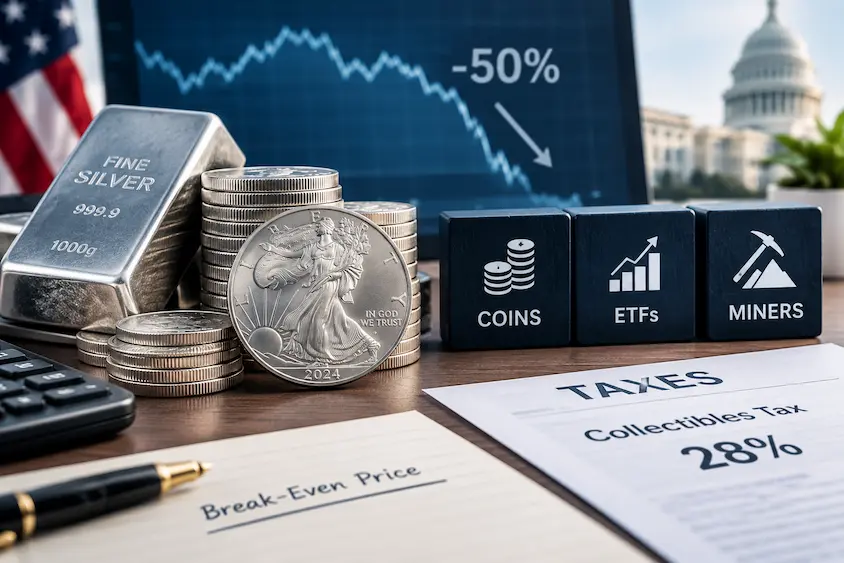
Quick answer: Silver hit a record of about $121.60 an ounce on January 29, 2026, and traded near $54.28 on October 26, 2026 — less than half its peak.
Whether to buy is your call. What this guide shows is what it costs. The price on the screen isn’t the price you pay.
Dealer markups, buyback discounts, storage, and a federal tax rate on physical silver that can reach 28% all move your break-even. Mining stocks are taxed differently.
The three hidden costs
What you pay above spot when you buy.
What you give up when you sell back below spot.
Up to 28% on physical silver; stock rates on miners.
Prices as of October 26, 2026 (Trading Economics); tax rules verified October 26, 2026. Not a recommendation to buy or sell.
Real Break-Even & After-Tax Calculator
Pick a mode, fill in your numbers, and press the button. Nothing you type leaves this page.
Use 0 if the dealer pays full spot.
From the fund’s prospectus. The default is a placeholder, not any fund’s figure.
A what-if number, not a prediction.
Spot plus the dealer premium, shipping, and sales tax. Leave blank for an ETF.
Selling at a loss? See our Tax-Loss Harvesting Calculator — and talk to a CPA before you act.
What Happened to the Silver Price in 2026
Silver more than doubled into a record on January 29, 2026, crashed the next day, and slid to its lowest level in 11 months by late October.
The dated record
- Jan. 23, 2026: silver crossed $100 for the first time (Nasdaq/INN).
- Jan. 29, 2026: intraday record of about $121.60. Sources put it between $121.62 and $121.67 (Money Metals).
- Jan. 30, 2026: its worst day in modern history — down over 26%, and as much as 36% intraday (etf.com).
- Oct. 14, 2026: fell 6.29% to $55.74, then its lowest close of the year (Yahoo Finance).
- Oct. 15, 2026: Comex futures closed at $56.84 (futures data).
- Oct. 23, 2026: dropped below $54, lowest since November 2025 (Forbes).
- Oct. 26, 2026: about $54.28 (Trading Economics).
The old ceiling near $50
For decades, silver topped out near $50. The January 18, 1980 London fix was $49.45 (Money Metals).
The April 2011 run peaked at an intraday $49.82 on April 25, 2011 (CPM Group via Monex). Silver finally cleared that ceiling in October 2025.
Why it fell — what reporters and analysts said
No single cause has been proven. These are the explanations that were reported, with who reported them:
- January 30: profit-taking and margin calls after the run-up (Metalsmine).
- Also January 30: Bloomberg reported that selling by the largest 2x leveraged silver ETF sped up the drop (Bloomberg).
- October 14: hotter September inflation data raised the odds of a Fed rate hike, per Saxo Bank's Ole Hansen (Forbes).
- Late October: analysts pointed to rising oil prices and a tech-stock selloff that pushed traders to sell metals (Trading Economics).
From about $121.62 to $54.28, silver is down roughly 55%. Getting back to the record would take a gain of about 124%. That is math, not a forecast.
Wondering whether this is the moment? That's a broader question — see Is Now a Good Time to Invest?
Five Ways to Own Silver
You can hold the metal, a fund that holds the metal, a fund that holds futures, mining stocks, or futures — and each has a different cost and a different tax rate.
| Method | What you own | Cost to own | How fast you can sell | Max federal long-term tax |
|---|---|---|---|---|
| Coins & bars | Metal in your hands or in a vault you pay for | Dealer premium, buyback discount, shipping, storage, insurance, possible sales tax | Often same day to a dealer; shipping adds days | 28% collectibles rate (lower if your bracket is lower) |
| Metal-backed ETF | A share of a trust holding vaulted metal | Yearly expense ratio, paid by selling metal; bid-ask spread | Market hours, through a broker | Generally 28% — check the prospectus |
| Futures-based fund | A fund holding silver futures, often a partnership | Expense ratio, roll costs; leveraged versions decay | Market hours | Often 60/40 under Section 1256 — check the prospectus |
| Mining stocks | Shares in companies that mine silver | Trading costs; fund fees if you use a fund | Market hours | 20% (0/15/20% stock rates) |
| Futures contracts | Leveraged exchange contracts on silver | Margin, commissions, rolling; losses can exceed your deposit | Nearly around the clock | 60/40 blend — about 26.8% at top rates, before NIIT |
How to compare them without picking a product
- What it holds: metal, futures, or companies.
- All-in cost: premium plus buyback spread, or expense ratio plus bid-ask spread.
- Tax wrapper: read the "U.S. federal income tax" section of the prospectus.
- Who holds it: you, a vault, a trust's custodian, or a futures exchange.
- How you'd sell: to a dealer at their bid, or on an exchange.
Leveraged silver funds reset daily and can lose value even when silver ends flat — see Why Leveraged ETFs Lose Value.
Silver Coins vs. Silver Bars
Coins usually cost more over spot but are easier to recognize and sell in small pieces; bars usually cost less per ounce but are harder to verify and split.
Premiums
Premiums change with the product, the size, and demand. They tend to jump when buyers rush in. Compare quotes as a percentage over spot, on the same day.
Liquidity
A 1-ounce coin can be sold one at a time. A 100-ounce bar is sold all at once, at one price. Ask what the dealer pays for each before you buy.
Authentication
Fakes exist, and bars are easier to fake than well-known coins. Buy products a dealer can verify, check weight and size, and keep every receipt.
Legal-tender coins
A $1 face value on a silver coin doesn't change its tax treatment. Gains are still collectibles gains. Legal-tender status can matter for state sales tax and for IRA eligibility — covered below.
What Silver Really Costs: Markup, Spread, Storage
Physical silver has to rise just to break even, because you buy above spot, sell below it, and pay to store it in between.
A worked example (assumptions, not quotes)
Say you buy 100 one-ounce coins at the October 26, 2026 spot of $54.28. Assume an 8% premium, a 3% buyback discount, $150 a year for storage and insurance, and a two-year hold.
$58.62 per ounce. $5,862.24 total.
At a $70 test spot, the dealer pays $67.90 an ounce. Break-even spot before tax: $63.53 — 17% above $54.28. Storage adds $300.
Gain of $927.76. At a 28% rate: $259.77 in federal tax. At a 24% bracket: $222.66.
On screen, $54.28 to $70 looks like a $1,572 gain on 100 ounces. After the markup, spread, storage, and 28% tax, you'd keep about $368.
A metal-backed ETF has no dealer premium or buyback discount. Its fee is paid by selling a little metal each year. At a placeholder 0.40% expense ratio, two years leaves about 99.2 ounces per 100.
That's a different cost, not a verdict. An ETF is not metal in your hand, and its tax rate is generally the same. More on comparing fees: Investment Fees.
Sales tax when you buy
There is no single rule. It depends on your state and it has been changing.
- Washington ended its bullion exemption on Jan. 1, 2026 (Tax Foundation, 2026).
- Virginia's exemption was set to lapse June 30, 2026 (Sovos, May 19, 2026). Check whether it was extended.
- Some states exempt only purchases above a dollar threshold.
- Counts of exempt states differ by source, so check your own state's revenue department.
At least one large online dealer says it charges sales tax based on the ship-to address, not your home address (dealer disclosure). Ask yours.
How Silver Is Taxed in the U.S.
Long-term gains on physical silver and most metal-backed ETFs are collectibles gains taxed at up to 28%; short-term gains are taxed as ordinary income; mining stocks get regular stock rates.
| Type | Held 1 year or less | Held more than 1 year | Extra |
|---|---|---|---|
| Coins & bars | Ordinary rates, 10%–37% | Collectibles: your bracket, capped at 28% | NIIT 3.8% above thresholds; state tax |
| Metal-backed ETF (grantor trust) | Ordinary rates | Generally same as metal: up to 28% | NIIT; state tax; grantor letter |
| Mining stock or stock fund | Ordinary rates | 0%, 15%, or 20% | NIIT; state tax |
| Futures and many futures-based funds | 60% long-term / 40% short-term | Same 60/40 — holding period doesn't matter | Marked to market at year-end; often a K-1; NIIT; state tax |
28% is a ceiling, not a flat rate
The IRS says net collectibles gains are taxed at a maximum 28% rate (Topic 409). If your ordinary rate is below 28%, the lower rate generally applies. Schedule D's 28% Rate Gain Worksheet does the math.
Short-term gains
Sell within a year and the gain is ordinary income. At the top bracket that's 37% — higher than the 28% cap.
Metal-backed ETFs
A grantor-trust ETF treats you as owning a slice of the metal. The iShares Silver Trust's own tax disclosure says this gives collectibles treatment (SEC filing). Each fund is different — read its prospectus tax section.
Net investment income tax (NIIT)
A 3.8% tax applies to investment income once modified AGI passes $200,000 (single or head of household), $250,000 (married filing jointly), or $125,000 (married filing separately) (IRS Topic 559).
Mining stocks
Miners are ordinary stocks. For 2026, the 0% rate covers taxable income up to $49,450 (single) or $98,900 (joint). The 20% rate starts above $545,500 (single) or $613,700 (joint), per IRS Rev. Proc. 2025-32. More: Capital Gains Tax.
Futures and futures-based funds
Regulated futures are taxed 60% long-term and 40% short-term, whatever the holding period. Open positions are marked to market at year-end. Funds built this way often send a Schedule K-1 (Fidelity).
State tax
Most states tax capital gains as regular income; a few have no income tax. Ask a CPA how your state treats the gain.
Does Selling Silver Get Reported to the IRS?
Only some sales are reported by the dealer — but you owe tax on every gain either way.
Form 1099-B: only certain metal, in certain amounts
The IRS rule: a precious-metal sale isn't reportable unless its form and quantity could satisfy a CFTC-approved futures contract. Sales to one customer within 24 hours are added together (IRS correction, Jan. 30, 2026).
Dealers read that rule two ways:
- Current contract reading: the Comex silver contract calls for five 1,000-oz bars of .999 silver from approved brands. On this reading, coins and 90% silver aren't reportable (dealer CPA analysis, updated July 15, 2026).
- Older industry list (1992): 1,000 oz or more of .999 bars, and $1,000 face value of 90% U.S. coins. Many dealers still follow it (example).
- Either way: American Silver Eagles aren't on the reportable list (dealer guidance).
Form 8300: paying more than $10,000 in cash
A business that receives more than $10,000 in cash in one transaction, or in related transactions, must file Form 8300. It's due within 15 days (IRS Form 8300 guide).
"Cash" can include a cashier's check or money order of $10,000 or less. A personal check or a wire isn't cash for this form. Splitting payments to dodge the form is itself illegal.
How banks report cash is a separate set of rules — see Cash Deposit Reporting Rules.
| Transaction | Form | Who files | Does it change your tax? |
|---|---|---|---|
| Selling a reportable bullion quantity to a dealer | 1099-B | The dealer | No. It reports proceeds; you report the gain or loss. |
| Selling ETF or mining-stock shares | 1099-B | Your broker | No. |
| Paying a dealer more than $10,000 in cash | Form 8300 | The dealer, within 15 days | No. It's a cash report, not a tax. |
| Selling non-reportable items (e.g., Silver Eagles, rounds, small bars) | None from the dealer | — | No. The gain is still taxable; report it on Form 8949 and Schedule D. |
Silver IRAs: What the Law Allows
An IRA can hold certain silver coins and .999 bullion, but a trustee must hold the metal — not you.
What § 408(m) says
If an IRA buys a collectible, the cost is treated as a distribution to you (IRC § 408(m)). There are exceptions:
- Certain U.S.-minted coins, including the 1-oz silver coin.
- Bullion at least as fine as a futures contract requires — .999 for silver.
- For bullion, the statute requires physical possession by a trustee.
The CFTC's own summary lists 1-oz silver coins and fine bullion as IRA-eligible, and says the metal must be held by the IRA trustee or custodian (CFTC advisory).
McNulty v. Commissioner, 157 T.C. No. 10 (Nov. 18, 2021)
Donna McNulty set up a self-directed IRA that owned an LLC. The LLC bought American Eagle coins, which were shipped to her home and kept in a safe (opinion).
The Tax Court held that taking physical custody gave her control over the coins — a taxable distribution. It rejected her argument that coins, unlike bullion, didn't need a trustee (Journal of Accountancy).
The court also upheld accuracy-related penalties under § 6662. Relying on the promoter's website didn't count as reasonable cause (WealthManagement.com).
Warning: If anyone pitches a "home storage" or "checkbook" silver IRA, or pushes you to roll over retirement savings fast, treat it as a red flag.
The CFTC says some gold and silver IRA victims lost one-third to one-half of their savings to markups, fees, and commissions (CFTC).
Fees to get in writing
- Account setup and annual custodian fees
- Storage: segregated or commingled, and the cost of each
- Insurance
- The dealer's markup over spot on the metal you buy
- The buyback price when you sell or take a distribution
- Any rollover, transfer, or closing fee
Withdrawals from a traditional IRA are taxed as ordinary income, not at the collectibles rate. More on the rules: Self-Directed IRA: Real Estate, Gold & Crypto.
If You Bought Near the Top
A bigger drop needs a much bigger gain to recover, and a realized loss on silver is a capital loss with a $3,000-a-year limit against ordinary income.
| Drop | Gain needed to recover |
|---|---|
| 20% | 25% |
| 33% | 50% |
| 50% | 100% |
| 60% | 150% |
Your break-even is higher than the spot price you paid. Add your premium, then divide by the dealer's buyback rate. Mode B of the calculator does it for you.
If you sell at a loss
- A loss on silver held as an investment is a capital loss.
- It offsets capital gains first.
- Then up to $3,000 a year of ordinary income ($1,500 married filing separately).
- The rest carries forward to later years (IRS Topic 409).
Whether the wash-sale rule reaches physical metal or grantor-trust ETF shares isn't clearly settled by statute. We don't give guidance on it — talk to a CPA before you sell and buy back.
Run your numbers with the Tax-Loss Harvesting Calculator, and read how harvesting works in Tax-Loss Harvesting.
Selling locks in the loss; holding keeps the exposure. That choice is yours. If you're thinking about adding more, the timing question is covered in Dollar-Cost Averaging vs. Lump Sum.
Silver vs. Gold
Silver swings harder than gold, largely because more of its demand comes from industry.
More than half of silver demand is industrial, so it often trades like a risk asset (Yahoo Finance). In the weeks after October 9, 2026, silver fell 9.3% while gold fell 3.4% (GoldSilver).
The gold-silver ratio, as context only
The ratio is how many ounces of silver buy one ounce of gold. It fell below 50 in January 2026 (ROIC) and widened to about 73 by late October (GoldSilver).
The ratio describes relative price. It doesn't tell you what either metal will do next. For the gold side, see Is Gold a Good Investment?
Before You Buy or Sell Silver
Nine checks that cover the markup, the spread, the tax, and the paperwork.
- 1. Decide the form: metal in hand, metal-backed ETF, miners, or futures.
- 2. Get the all-in price: premium, shipping, insurance, and your state's sales tax.
- 3. Ask the buyback price before you buy.
- 4. For ETFs: check if it holds metal or futures, its expense ratio, and its prospectus tax section.
- 5. Know your tax: up to 28% long-term for physical and most metal-backed ETFs; ordinary rates if held a year or less.
- 6. Paying cash over $10,000? Expect a Form 8300.
- 7. Keep every receipt — your cost basis is on you.
- 8. Silver IRA pitch? No home storage; get every fee in writing.
- 9. Selling at a loss? Talk to a CPA before acting.
Silver Investing FAQ
Short answers to the questions people ask most — dated where prices matter.
How do I invest in silver?
Pick a form — coins or bars, a metal-backed ETF, a futures-based fund, mining stocks, or futures. Then compare the all-in cost and the tax rate of each. Table 1 above lays them side by side.
Is silver a good investment?
That depends on your goals, and we don't make that call. Silver pays no income and is volatile — it fell from about $121.60 on Jan. 29, 2026 to about $54.28 on Oct. 26, 2026.
What's the best way to invest in silver for a beginner?
There's no single best way. A brokerage fund avoids dealer markups and storage; metal in hand avoids fund custody. Compare costs and tax with the calculator above.
Silver ETF or physical silver?
A metal-backed ETF charges a yearly expense ratio; physical silver has a premium, a buyback discount, and storage. Long-term gains on both are generally taxed at up to 28%.
Coins or bars?
Coins usually cost more over spot but are easier to verify and sell one at a time. Bars usually cost less per ounce but sell as a single unit.
What's a normal dealer premium?
It varies by product, size, and demand, and it rises when buyers rush in. Get same-day quotes as a percentage over spot, and ask the buyback price too.
How is silver taxed?
Physical silver held over a year: collectibles gain, taxed at your bracket up to 28%. Held a year or less: ordinary rates. NIIT and state tax may add to either.
Is a silver ETF taxed at 28%?
Metal-backed grantor-trust ETFs are generally taxed like the metal — up to 28% long-term. Futures-based funds often use the 60/40 rule instead. Check the prospectus.
Are silver mining stocks taxed as collectibles?
No. Miners are ordinary stocks, taxed at 0%, 15%, or 20% long-term, or at ordinary rates if held a year or less.
Does a silver dealer report sales to the IRS?
Only certain bullion in certain amounts goes on Form 1099-B, and dealers read the rule differently. Silver Eagles aren't reportable. You owe tax on gains either way.
Do I pay sales tax on silver?
It depends on your state. Some exempt bullion, some exempt only above a threshold, and some tax it — Washington began taxing it on Jan. 1, 2026. Check your state.
What happens if I pay cash for silver?
If a dealer receives more than $10,000 in cash in one or related transactions, it files Form 8300 within 15 days. Certain cashier's checks and money orders count as cash.
Can I hold silver in an IRA?
Yes — certain U.S.-minted coins and .999 bullion, held by the IRA's trustee or custodian. Get every fee in writing first.
Can I store IRA silver at home?
No. In McNulty (2021), the Tax Court treated IRA coins kept in a home safe as taxable distributions and upheld penalties.
Can I deduct a loss on silver?
A loss on silver held as an investment is a capital loss: it offsets gains, then up to $3,000 a year of ordinary income, with the rest carried forward. Ask a CPA before selling.
How much does silver need to rise to recover from a 50% drop?
100%. From the Jan. 29, 2026 record to the Oct. 26, 2026 price, it would need about 124%. That's math, not a forecast.
Why is silver more volatile than gold?
Over half of silver's demand is industrial, so it reacts to growth worries more than gold does. Its market is also smaller.
What is the gold-silver ratio?
It's the number of silver ounces one gold ounce buys. It was near 73 in late October 2026. It's a description of relative price, not a buy or sell signal.
Sources
- IRS, Topic No. 409, Capital Gains and Losses (reviewed Sept. 24, 2026)
- IRS, Topic No. 559, Net Investment Income Tax (reviewed Sept. 24, 2026)
- IRS, Correction to the 2025 and 2026 Instructions for Form 1099-B (Jan. 30, 2026)
- IRS, Form 8300 reference guide
- 26 U.S.C. § 1(h) and § 408(m)
- McNulty v. Commissioner, 157 T.C. No. 10 (Nov. 18, 2021) — opinion; Journal of Accountancy summary
- CFTC, gold and silver IRA fraud advisory
- iShares Silver Trust, tax disclosure filed with the SEC
- Tax Foundation, state sales tax on bullion (2026)
- Price data: Trading Economics (Oct. 26, 2026); Forbes (Oct. 23, 2026)
Last updated:
This article is general information, not investment or tax advice. It is not a recommendation to buy or sell silver or any product. Prices are dated and change constantly. Tax rules verified on October 26, 2026. Consult a qualified tax or financial professional about your own situation.

Daniel Hayes is the founder and sole researcher at AdvoraHQ. He covers U.S. personal finance, insurance, and consumer law — working directly from IRS publications, federal and state statutes, court opinions, and SEC filings rather than secondary summaries. His focus is the gap between what readers think they know and what the source documents actually say. Daniel is not a licensed attorney, CPA, or financial advisor; his articles are educational and not personalized advice. Reach him at Daniel.Hayes@advorahq.com.