
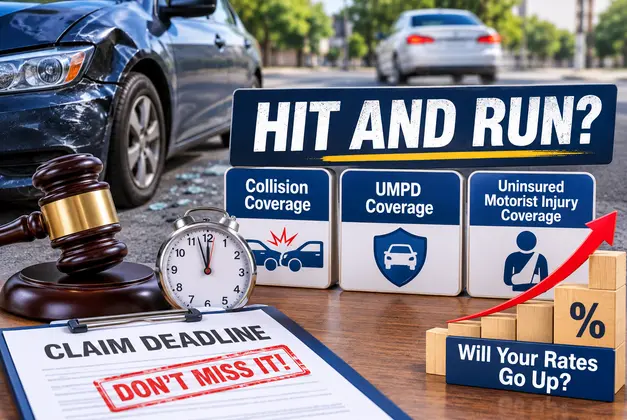
Quick answer: If the driver is never found, your own policy pays. Collision covers your car minus your deductible, and uninsured motorist coverage covers injuries. Some states let uninsured motorist property damage (UMPD) pay instead of collision, often with a lower deductible, but others (like California) require the driver to be identified. Without collision or UMPD, the car repair is on you.
Report it now. Call the police today, even for a parking-lot dent. In California the law requires a police report within 24 hours to claim uninsured motorist injury benefits after a hit-and-run, and many policies set short deadlines too.
Your car
Collision, or UMPD where it covers unknown drivers. If the driver is found, their insurer pays first.
Your injuries
Uninsured motorist bodily injury, PIP or MedPay, then health insurance.
Your rates
Depends on your state and insurer. California and Oklahoma bar higher rates for accidents you did not cause.
Answer six questions to see which coverage pays first and what you will pay out of pocket: jump to the tool.
State rules verified November 5, 2026.
Hit-and-Run: Who Pays? (Free Tool)
This tool ranks the coverages that may apply to your situation and does the deductible math. It does not store or send anything you enter.
Guides this tool points to: claim or pay out of pocket, who pays your medical bills, hit by a car while walking.
The First Hour After a Hit and Run
In the first hour, get safe, call the police, and capture the evidence that disappears fastest: camera footage, debris, paint transfer, and your own memory of the other vehicle.
Never chase the other driver. A dent is not worth a second crash or a confrontation. Write down what you saw and let the police handle the rest. If anyone is hurt, call 911 first.
If someone hit your parked car and left
Walk around the car before you touch anything. Check the windshield and the other cars nearby for a note. Photograph the damage, any paint transfer, and debris on the ground before you move the car or wipe anything off.
Then call the police, even for a parking-lot dent. Some departments take property-damage reports by phone or online, so ask. If the lot has cameras, ask the manager today, because footage is often overwritten within days.
If you were driving
Pull over somewhere safe and turn on your hazard lights. Call 911 if anyone is hurt. Write down the time, place, direction of travel, and the other vehicle’s color, make, and any part of the plate. Ask witnesses to stay and give you their names and numbers.
Get checked out even if you feel fine. Adrenaline hides pain, and a gap between the crash and your first medical visit can hurt an injury claim later.
The First 24 Hours (copyable checklist)
- Safety first. Call 911 if anyone is hurt. Do not chase the driver.
- Call the police, even for a parked-car dent. Get the report number.
- Write down everything now: time, place, direction, color, make, partial plate, and where the damage is.
- Photograph the damage, paint transfer, debris, the scene, and street signs.
- Look for cameras: nearby businesses, doorbells, parking garages, and your own dashcam. Ask today, because footage can be overwritten.
- Find witnesses. Get names and numbers.
- Notify your insurer promptly, in writing if possible. Ask which coverage applies and how the claim will be coded.
- Get medical care for any pain, even if it seems minor, and keep the records.
- Calendar the deadlines in your policy’s uninsured motorist section.
For the full accident playbook, see What to Do After a Car Accident.
Who Pays for Your Car
Your car is paid for by the other driver’s insurer if they are found and insured; otherwise by your UMPD (only where your state lets it cover an unknown driver) or your collision coverage; and with neither, by you.
There is no such thing as “hit-and-run insurance.” Several ordinary coverages can apply, and which one does depends on three things: whether the driver is found, whether the other vehicle touched yours, and what you bought.
DRIVER FOUND
The driver’s property damage liability insurance pays first, if they are insured. If they have no insurance, your UMPD or collision coverage steps in.
DRIVER UNKNOWN
Collision pays regardless of fault, minus your deductible. UMPD pays only where your state and policy extend it to unidentified drivers. Some states do not.
NO CONTACT
If the other car never touched yours and you hit something else, you have a single-vehicle claim. Collision may still pay for your car, but uninsured motorist coverage often will not.
No collision and no UMPD usually means you pay for the repair yourself. Liability-only coverage pays for damage you cause to others, never for your own car.
| Coverage | Pays when | Typical deductible | Limits | Watch out for |
|---|---|---|---|---|
| Other driver’s property damage liability | The driver is identified, at fault, and insured | None for you; you claim against their policy | Their policy’s property damage limit | Their limit may be low; you need their identity and insurer |
| UMPD | Your state and policy extend it to your situation | Varies by state and policy; check your declarations page | Set by state or policy (California: lesser of actual cash value or $3,500) | Some states’ UMPD does not cover unidentified drivers; California requires an identified driver and physical contact |
| Collision | Your car is damaged in a collision, regardless of fault, driver found or not | The amount on your declarations page | Repair cost, up to the car’s actual cash value | You pay the deductible first; liability-only policies do not include it |
| Collision deductible waiver | An identified uninsured driver hits you (in California) | Waives the collision deductible | The deductible amount | California applies it to identified drivers only; other states vary |
| Comprehensive | Usually not for hit-and-run, which is a collision with a vehicle | Your comprehensive deductible | Actual cash value | Do not assume it applies; ask your insurer in writing |
The other driver’s insurer
If the police or a witness identify the driver, file with their property damage liability insurer using the police report number. You can also ask your own insurer to pay under collision and pursue the other driver, which can be faster. More on that in If the Driver Is Found Later.
UMPD and its state limits
UMPD is coverage for damage caused by an uninsured driver. Whether an unidentified hit-and-run driver counts as “uninsured” for UMPD depends on the state. Insurers’ own consumer guides say that in some states UMPD will not cover a hit-and-run unless the driver is identified, which is why collision matters.
California is the clear example. UMPD there pays the lesser of your car’s actual cash value or $3,500, requires that the uninsured owner or operator be identified (or the vehicle identified by license number), requires direct physical contact, and is aimed at vehicles without collision coverage. Report the accident to your insurer within 10 business days. The California rules are in Table 3.
Not sure about your state? Do not guess. Ask your insurer, in writing: “Does my UMPD cover damage from an unidentified hit-and-run driver, and is there a deductible?” For the buying decision, see Is Uninsured Motorist Coverage Worth It?.
Collision and the deductible math
Collision is the most reliable path because it does not depend on who the other driver was. The trade-off is your deductible.
Say the repair estimate is $2,400 and your deductible is $500. Collision would pay $1,900 and you would pay $500. If the estimate is $700 and your deductible is $1,000, collision pays nothing and you pay the full $700. In that second case, filing buys you nothing but a claim on your record.
Before filing a close call, read Insurance Claim or Pay Out of Pocket. If the repair costs approach the car’s value, see Totaled Car. If the car is fixed but worth less, see Diminished Value Claim.
Who Pays for Your Injuries
Your injuries are paid by whichever of PIP, MedPay, uninsured motorist bodily injury (UMBI), and health insurance you have, and UMBI is the coverage that can pay for more than medical bills, such as lost income and pain and suffering.
Get medical care first. Sorting out which policy pays can wait; your health cannot.
| Coverage | What it pays | When it applies | Notes |
|---|---|---|---|
| PIP (personal injury protection) | Medical bills and often some lost income | In no-fault states, regardless of fault, if you carry it | Often pays first where you have it; limits vary by state |
| MedPay | Medical expenses for you and passengers | Regardless of fault, if you bought this optional coverage | Usually smaller limits; check your declarations page |
| UM bodily injury (UMBI) | Injury damages you could have recovered from the unknown or uninsured driver | Driver unknown or uninsured, and your state’s and policy’s conditions are met | Can include lost income and pain and suffering; has the strictest conditions (contact, report, sworn statement) |
| Health insurance | Covered treatment under your plan | Any time you have a plan | Your health insurer may seek reimbursement from a settlement |
UM bodily injury is the main event
When the driver is never found, UMBI is usually the coverage that matters most, because an unidentified driver is generally treated as uninsured. It is also the coverage with the sharpest conditions. Many states and policies require a prompt police report, and some require physical contact or a sworn statement. See Deadlines and No Contact.
For what an injury claim can include, read How Is Pain and Suffering Calculated. For what is left after fees and liens, read How Much of Your Settlement Will You Keep.
PIP, MedPay, and health insurance
PIP and MedPay pay regardless of fault, so they can start covering bills while the UMBI claim is still being worked out. Health insurance picks up covered care. For the full order of payment, see Who Pays Your Medical Bills After a Car Accident; this article does not repeat it.
If you were walking or biking
The same coverages can apply, with extra wrinkles about which policy responds. See Hit by a Car While Walking.
For injuries, or any denied claim, talk to an attorney. This article is general information, not legal advice.
The Deadlines That Can Kill a Claim
The deadline that matters most is the police report, so make it the same day; deadlines can come from state law, your policy, and the statute of limitations, and they are not the same number.
Report today. A late police report is a common reason claims are denied.
Police report timing
The 24-hour report is California law and a common policy term. It is not a national rule. Other states and policies use other wording, such as “promptly,” so the safe move is the same everywhere: report immediately. A same-day report also helps the police find the driver while cameras and memories are fresh.
Telling your insurer
Notify your insurer promptly, in writing if you can. Policies often require “prompt notice,” and some name a number of days. In California, UMPD requires you to report the accident within 10 business days.
California as the concrete example
For an unidentified hit-and-run vehicle to count as uninsured for UM bodily injury in California, Insurance Code §11580.2(b) requires three things: physical contact, a police report within 24 hours, and a sworn statement filed with your insurer within 30 days after that report. The statute text lists no separate exception for corroboration.
UMPD: identified driver and $3,500 cap
The uninsured owner or operator must be identified (or the vehicle identified by license number), with direct physical contact. Pays the lesser of actual cash value or $3,500 for vehicles without collision coverage; report within 10 business days. Source: Ins. Code §11580.26(a)(2), (b).
Collision deductible waiver
If you have collision, the insurer pays your collision deductible for a collision with an identified uninsured vehicle. Source: Ins. Code §11580.26(a)(1), (b).
UMBI: physical contact
The bodily injury must arise out of physical contact of the unknown vehicle with you or with a car you occupy. Source: Ins. Code §11580.2(b)(1).
24-hour police report
Report within 24 hours to the city police, or in unincorporated areas to the county sheriff or the California Highway Patrol. Source: Ins. Code §11580.2(b)(2).
30-day sworn statement
File a statement under oath with your insurer within 30 days after the report, saying you have a cause of action against someone whose identity cannot be determined, with supporting facts. Source: Ins. Code §11580.2(b)(2).
| Rule | What it requires | Source |
|---|---|---|
| UMPD identified-driver rule and $3,500 cap | The uninsured owner or operator must be identified (or the vehicle identified by license number), with direct physical contact. Pays the lesser of actual cash value or $3,500 for vehicles without collision coverage. Report within 10 business days. | Ins. Code §11580.26(a)(2), (b) |
| Collision deductible waiver | If you have collision, the insurer pays your collision deductible for a collision with an identified uninsured vehicle. | Ins. Code §11580.26(a)(1), (b) |
| UMBI physical contact | The bodily injury must arise out of physical contact of the unknown vehicle with you or with a car you occupy. | Ins. Code §11580.2(b)(1) |
| 24-hour police report | Report within 24 hours to the city police, or in unincorporated areas to the county sheriff or the California Highway Patrol. | Ins. Code §11580.2(b)(2) |
| 30-day sworn statement | File a statement under oath with your insurer within 30 days after the report, saying you have a cause of action against someone whose identity cannot be determined, with supporting facts. | Ins. Code §11580.2(b)(2) |
Table 3 (mobile view). California hit-and-run rules, verified from published code text on November 5, 2026.
What if you miss a deadline?
Do not assume the claim is dead, and do not assume it is safe. California courts have decided late-filing disputes differently. In Hanover Insurance Co. v. Carroll (1966), a court let a claim go forward over a late insurer statement because the insurer was not harmed. In California State Automobile Ass’n v. Blanford (1970), a court blocked a claim where the insured did not report on time and the insurer showed it was prejudiced. Those are old, fact-specific rulings, so do not plan around them. If you are late, tell your insurer when you reported and why, and talk to an attorney.
The claim deadline is a different clock
Time limits to sue or demand arbitration on a UM claim can come from the policy or from statute, and they may be shorter or longer than the injury deadline. Find the “uninsured motorist” section of your policy and calendar the dates. State-by-state injury deadlines are in Statute of Limitations by State.
No Contact? The Miss-and-Run Problem
If the other car never touched you, some states and policies treat it as a “phantom vehicle” and may deny uninsured motorist injury coverage, while others accept the claim if you can corroborate what happened.
NO CONTACT
A car cuts you off, you swerve into a guardrail, and the other car keeps going. That is often called a miss-and-run or phantom vehicle accident. The other driver caused it, but nothing touched yours.
No contact with the other car can mean no uninsured motorist claim in some states. Check the “uninsured motorist” section of your policy for how it defines a hit-and-run or unidentified vehicle.
The physical-contact rule
California requires physical contact between the unidentified vehicle and you or your car for a UM bodily injury claim (Ins. Code §11580.2(b)(1)), and for UMPD (§11580.26(b)). Other states and policies vary, so check your policy rather than assuming.
The corroboration alternative
Arizona takes a different approach. For an uninsured or underinsured motorist injury or death claim involving an unidentified vehicle and no physical contact, A.R.S. §20-259.01(M) requires the insured to provide corroboration that the unidentified vehicle caused the accident. The statute defines corroboration as additional, confirming testimony, facts, or evidence that strengthens the credibility of your account.
What evidence helps
- Dashcam or doorbell footage showing the other vehicle.
- A witness who saw the other car, with a name and phone number.
- A same-day police report that describes the other vehicle and what you did to avoid it.
- Photos of skid marks, debris, and damage that match your account.
- 911 call records, if you called.
Do not stretch the facts
If there was no contact, say so. Calling a miss-and-run a “hit” to fit a policy’s contact rule is misreporting, and it can void your coverage. Collision may still pay for your car if you hit a guardrail, a pole, or a parked car, even when the other driver is never found. That is a collision claim, not a hit-and-run claim.
No Plate, No Witnesses: Building the Claim Anyway
You can build a claim without a plate or witnesses, because it rests on the police report, your photos, physical evidence, and any cameras that caught the other vehicle.
DRIVER UNKNOWN
Your goal is a clean paper trail that shows a real accident, reported fast, with consistent facts.
Cameras first
Ask nearby businesses, apartment managers, parking garages, and neighbors with doorbell cameras. Ask today, and ask them to save the clip. Tell the police which cameras you found, because officers can often request footage in ways you cannot.
Paint transfer and debris
Photograph any paint left on your car before you wash it, with a ruler or coin for scale. Photograph broken lights and plastic on the ground. Color, height of the damage, and part fragments can help police narrow down the other vehicle.
The repair shop
Ask the shop to note paint transfer, the height and direction of the impact, and the photos they took on intake. A shop’s written estimate with those notes supports the claim.
The police report
A same-day report is the backbone of the claim. It records the date, time, and facts while they are fresh, and many states and policies require it for uninsured motorist coverage. Keep the report number and a copy.
If you post in a neighborhood group, share facts and a request for footage, not accusations about a person.
Will Your Insurance Go Up?
Whether your rates go up depends on your state’s rules and on how your insurer codes the claim; some states clearly bar a surcharge for accidents you did not cause, and many leave it to the insurer.
A hit-and-run is usually not your fault, but a claim can still be recorded, and how it is coded matters. A 2017 Consumer Federation of America study found that drivers in eight of the 10 cities it tested could be surcharged for a not-at-fault accident, while California and Oklahoma law prevented it. That study is a snapshot; the statutes below are the better guide.
California
An insurer may rate on accidents where you are principally at fault (at least 51 percent of the legal cause). A lawfully parked vehicle, or damage from a hit-and-run reported to authorities within a reasonable time, is presumed not principally at fault. Cal. Code Regs. tit. 10, §2632.13(b), (c)(1), (c)(4). Verified November 5, 2026.
Oklahoma
For liability or collision policies, an insurer may not add points, cancel, refuse to renew, or charge a higher rate after a collision in which the insured was not at fault. 36 O.S. §941(A). Verified November 5, 2026.
Georgia
No insurer may surcharge or cancel a motor vehicle policy because of involvement in a multivehicle accident where the insured was not at fault. O.C.G.A. §33-9-40; Georgia Insurance Commissioner Bulletin 18-EX-2 (February 21, 2018). Ask whether your insurer treats a hit-and-run as a multivehicle accident. Verified November 5, 2026.
Virginia
No points or premium increase after an accident unless the named insured, a household resident, or another customary operator caused it in whole or in part. Va. Code §38.2-1905(A). Verified November 5, 2026.
Delaware
No surcharge for any claim paid arising from a not-at-fault accident. 18 Del. Admin. Code §609-5.1.1. A single-car accident with a claim payment is presumed at fault, which is why you should never mislabel one. Verified November 5, 2026.
New York
No points or surcharge unless aggregate property damage exceeds $2,000, and none for an accident while the vehicle was lawfully parked. N.Y. Ins. Law §2335(a); 11 NYCRR §169.1 (Insurance Regulation 100). Verified November 5, 2026.
Rhode Island
An insurer may not consider an accident or claim in setting a surcharge if the insured is 50 percent or less at fault; an accident is not chargeable if the car was legally parked and unattended. R.I. Gen. Laws §27-9-4(d); 230-RICR-20-05-3. Verified November 5, 2026.
Table 4 (mobile view). Not-at-fault rate rules snapshot. Not exhaustive; how an insurer codes a hit-and-run varies.
| State | Rule | Citation | Verified |
|---|---|---|---|
| California | An insurer may rate on accidents where you are principally at fault (at least 51 percent of the legal cause). A lawfully parked vehicle, or damage from a hit-and-run reported to authorities within a reasonable time, is presumed not principally at fault. | Cal. Code Regs. tit. 10, §2632.13(b), (c)(1), (c)(4) | Nov. 5, 2026 |
| Oklahoma | For liability or collision policies, an insurer may not add points, cancel, refuse to renew, or charge a higher rate after a collision in which the insured was not at fault. | 36 O.S. §941(A) | Nov. 5, 2026 |
| Georgia | No surcharge or cancellation because of involvement in a multivehicle accident where the insured was not at fault. Ask whether your insurer treats a hit-and-run as a multivehicle accident. | O.C.G.A. §33-9-40; Ga. Insurance Commissioner Bulletin 18-EX-2 (Feb. 21, 2018) | Nov. 5, 2026 |
| Virginia | No points or premium increase unless the named insured, a household resident, or another customary operator caused the accident in whole or in part. | Va. Code §38.2-1905(A) | Nov. 5, 2026 |
| Delaware | No surcharge for any claim paid arising from a not-at-fault accident. A single-car accident with a claim payment is presumed at fault. | 18 Del. Admin. Code §609-5.1.1 | Nov. 5, 2026 |
| New York | No points or surcharge unless aggregate property damage exceeds $2,000, and none for an accident while the vehicle was lawfully parked. | N.Y. Ins. Law §2335(a); 11 NYCRR §169.1 | Nov. 5, 2026 |
| Rhode Island | An insurer may not consider an accident or claim in setting a surcharge if the insured is 50 percent or less at fault; an accident is not chargeable if the car was legally parked and unattended. | R.I. Gen. Laws §27-9-4(d); 230-RICR-20-05-3 | Nov. 5, 2026 |
Ask before you file
Before you open the claim, ask your insurer: “If I file this as a hit-and-run, how will it be coded: not-at-fault, comprehensive, or at-fault? Will it affect my renewal?” Get the answer in writing if you can. For how rates are built, see How Car Insurance Rates Are Calculated. For small damage, run the numbers in Insurance Claim or Pay Out of Pocket.
If the Driver Is Found Later
If the driver turns up, the claim shifts toward their insurer, and your insurer may recover what it paid, which can include your deductible.
DRIVER FOUND
Give your insurer the update and the police report number right away, and do not contact the driver yourself.
Switching to their insurer
If the driver is insured, their property damage and bodily injury liability coverage becomes the primary source. If the driver has no insurance, your UMPD, collision, and uninsured motorist coverage apply, and in states like California the identification may unlock UMPD that was unavailable while the driver was unknown.
Subrogation and your deductible
When your insurer pays a claim and later identifies the at-fault driver, it can pursue that driver or their insurer. This is called subrogation. If it recovers money, it may refund your deductible, in whole or in part, depending on your policy and state law. Ask your insurer how it handles this before you close the claim.
The criminal case
Leaving the scene is a crime in every state, and penalties rise with injury. If the driver is charged, ask the prosecutor’s office or a victim advocate whether you can request restitution for your costs, including your deductible.
Talking to Your Insurer
When you call your insurer, stick to facts you know, ask which coverage applies and how the claim will be coded, and get the answers in writing.
- Report the facts you saw. If you do not know something, say “I don’t know.” A guess becomes a contradiction later.
- Ask: “Which of my coverages applies, what is the deductible, and how will this claim be coded?”
- Ask for your claim number and the adjuster’s name and direct line.
- Ask for any denial or coverage position in writing, with the policy language it relies on.
- Keep a log: date, time, who you spoke with, and what was said.
If you have already given a statement and are worried about it, read Gave a Recorded Statement: Now What. Before giving a recorded statement on an injury claim, consider talking to an attorney.
| Mistake | Why it hurts | What to do instead |
|---|---|---|
| Waiting to report | Some states and policies set short deadlines, and camera footage gets overwritten | Call the police today and get the report number |
| Not seeking care | Gaps in treatment weaken an injury claim, and untreated injuries get worse | Get checked, even for minor pain, and keep the records |
| Guessing in a recorded statement | Guesses can be treated as inconsistencies | State what you know; say “I don’t know” for the rest |
| Assuming liability-only covers your car | Liability pays for damage you cause, not damage to your own car | Check your declarations page for collision or UMPD |
| Not checking cameras quickly | Footage is often overwritten within days | Ask today and tell the police which cameras you found |
| Calling a single-car crash a hit-and-run | That is misreporting, can void coverage, and can bring criminal fraud charges | Describe what happened accurately; collision may still apply |
If You’re the One Who Hit a Parked Car
If you hit a parked car, stop, find the owner or leave a visible note with your contact information, and report as your state requires, because leaving is a crime.
The details vary by state. In California, Vehicle Code §20002 requires you to stop and either give the owner your name and address or leave a written note on the damaged property and notify the police without unnecessary delay. Failing to comply is a misdemeanor, punishable by up to six months in county jail, a fine of up to $1,000, or both. Report the damage to your own insurer too. “No one saw it” is not a plan.
Frequently Asked Questions
Short answers first; the sections above have the detail.
Someone hit my parked car and left. What do I do?
Photograph the damage and scene, look for cameras, and call the police today to get a report number. Then tell your insurer promptly. Collision or UMPD, where it applies, pays for the car.
Does car insurance cover a hit and run?
There is no “hit-and-run insurance.” Collision or UMPD may cover your car, and UM bodily injury, PIP, MedPay, or health insurance may cover injuries. Liability-only policies do not pay for your own car.
Will collision cover a hit and run?
Usually yes. Collision pays for damage to your car regardless of fault, whether or not the driver is found, minus your deductible. Check your declarations page to confirm you carry it.
Does UMPD cover a hit and run if the driver isn’t found?
It depends on your state and policy. Some states’ UMPD covers unidentified drivers; others, including California, require the driver to be identified. Ask your insurer in writing.
What if I only have liability insurance?
Liability pays for damage you cause to others, not your own car. If the driver is not found and you have no collision or UMPD, the repair is likely on you. Injury coverage may still apply.
Do I have to pay my deductible for a hit and run?
Under collision, yes, unless the driver is found and your insurer recovers it or a deductible waiver applies. UMPD deductibles vary by state and policy.
Who pays my medical bills after a hit and run?
Usually PIP or MedPay first if you have them, then uninsured motorist bodily injury, with health insurance for covered care. Get treated first and sort out billing later.
Does uninsured motorist coverage cover hit-and-run injuries?
Often yes, because an unidentified driver is typically treated as uninsured. States and policies may require physical contact, a prompt police report, or a sworn statement.
How long do I have to report a hit and run?
Report to the police the same day. California requires a report within 24 hours for UM bodily injury, and many policies set short deadlines too. Other states and policies differ, so check yours.
What if I didn’t report it right away?
Report it now and tell your insurer why it was late. Some states and policies treat a late report as grounds for denial, and outcomes vary. For an injury claim, talk to an attorney.
What if the other car never touched me?
Some states and policies require physical contact for an uninsured motorist claim; California does. Arizona lets you substitute corroborating evidence. Collision may still cover your car if you hit something.
Can I file a claim with no witnesses?
Yes. A police report, photos, paint transfer, camera footage, and repair-shop notes can support a claim. Witnesses help, but contact and reporting rules still apply to injury claims.
Will my insurance go up after a hit and run?
It depends on your state and insurer. California, Oklahoma, and several other states restrict surcharges for not-at-fault accidents. Ask how the claim will be coded before you file.
Does a hit and run count as an at-fault accident?
Generally not, since you did not cause it, but insurers code claims differently. California presumes a driver is not principally at fault when a reported hit-and-run damaged the car. Ask your insurer.
What happens if the police find the driver?
The claim shifts toward their insurer. Your insurer may recover what it paid and may refund your deductible. The driver may also face charges, since leaving the scene is a crime in every state.
Can I get my deductible back?
Possibly. If your insurer recovers money from the driver, it may reimburse your deductible, depending on your policy and state. That usually requires the driver to be found and insured.
Should I get a lawyer after a hit and run?
For injuries, a denied claim, or a missed deadline, talk to an attorney. For a small parked-car dent with collision coverage, you may not need one. This is not legal advice.
What if I hit a parked car?
Stop, try to find the owner or leave a visible note with your name and contact information, and report as your state requires. Leaving without doing so is a crime.
Sources and Statutes
State rules were checked against published code text on November 5, 2026. Statutes change, so confirm against the current official text.
- California Insurance Code §11580.2 (uninsured motorist; hit-and-run conditions) and §11580.26 (UMPD, $3,500, deductible waiver).
- California Vehicle Code §20002 (property damage; leaving the scene).
- Cal. Code Regs. tit. 10, §2632.13 (principally at-fault accidents).
- Arizona A.R.S. §20-259.01 (uninsured and underinsured motorist coverage; corroboration).
- Oklahoma 36 O.S. §941 (premium increases after not-at-fault collisions).
- Georgia O.C.G.A. §33-9-40 (not-at-fault surcharges).
- Virginia Code §38.2-1905 (points and premium increases).
- Delaware 18 Del. Admin. Code §609-5.0 (surcharge plans).
- New York Insurance Law §2335 (surcharge threshold) and 11 NYCRR §169.1 (Insurance Regulation 100).
- Rhode Island Gen. Laws §27-9-4 (rate considerations) and 230-RICR-20-05-3 (private passenger auto rating).
- Consumer Federation of America, Major Insurance Companies Raise Premiums After Not-At-Fault Accidents (February 13, 2017).
- Your state insurance department and the National Association of Insurance Commissioners (NAIC) consumer resources.
Last updated:
This article is general information, not legal advice. Coverage depends on your policy wording and your state’s law. State rules were verified on November 5, 2026.

Daniel Hayes is the founder and sole researcher at AdvoraHQ. He covers U.S. personal finance, insurance, and consumer law — working directly from IRS publications, federal and state statutes, court opinions, and SEC filings rather than secondary summaries. His focus is the gap between what readers think they know and what the source documents actually say. Daniel is not a licensed attorney, CPA, or financial advisor; his articles are educational and not personalized advice. Reach him at Daniel.Hayes@advorahq.com.
