
Your own policy
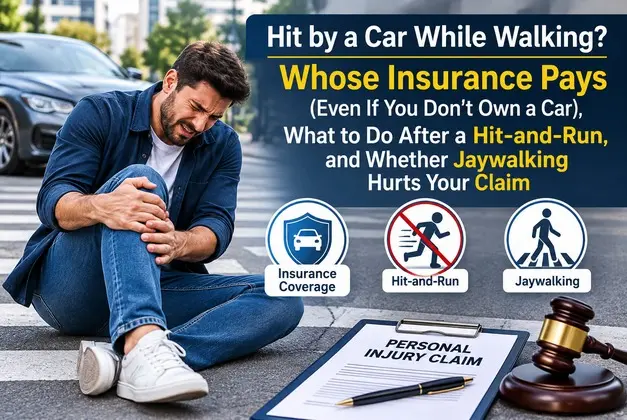
If you were hit by a car while walking, your own car insurance may pay your first medical bills, even though you weren’t in a car. In no-fault states that’s your PIP.
No car?
A household member’s policy, the driver’s insurance, or a state plan may apply.
Driver fled?
Your uninsured motorist coverage may treat it like an uninsured driver. Report it to police right away.
Get medical care first. Call 911 and keep every record.
Find who pays you, in what order, in your state
The first 72 hours: what to do before evidence disappears
- Who pays first
- No-fault states
- No car?
- Hit-and-run
- Jaywalking & fault
- Parking lots
- Health insurance & liens
- Deadlines
State rules and data verified on November 2, 2026. State law varies; check yours.
Who Pays a Pedestrian? Claim-Order Tool
Answer seven questions to see which insurers and state plans to notify, in what order, in your state.
Nothing you enter is stored or sent anywhere. Do not type names, policy numbers, or medical details; the tool does not ask for them. Deadlines differ by state: see Statute of Limitations by State.
Who Pays First: The Order of Claims
Most injured pedestrians have up to five possible payers, and the order depends on your state, your own coverage, and whether the driver is known and insured.
We group the payers into three tiers, always in this order:
PAYS FIRST
Your PIP or MedPay, or, depending on the state, a household member’s policy or the PIP on the vehicle that struck you. These pay medical bills (and sometimes part of lost wages) without waiting to decide who was at fault.
PAYS FOR FAULT
The driver’s liability insurance, or your uninsured/underinsured motorist (UM/UIM) coverage if the driver has no insurance, too little, or can’t be found. These pay for losses the driver is legally responsible for, usually after the claim is resolved.
FILLS THE GAPS
Your health insurance (which may be repaid from a settlement) and state assigned-claims plans or funds, which step in when no policy applies.
The most useful rule: tell your own auto insurer, and the insurer of anyone you live with, about the crash early. You don’t have to have been driving.
- PAYS FIRST. Your own auto policy: PIP, or MedPay if you bought it. In some states the policy on the vehicle that struck you comes before yours.
- PAYS FIRST. A household member’s policy, or the PIP on the striking vehicle, depending on your state.
- PAYS FOR FAULT. The driver’s bodily injury liability insurance, if the driver was at fault. Your share of fault can reduce or bar it.
- PAYS FOR FAULT. Your (or a household member’s) UM/UIM coverage, if the driver is uninsured, underinsured, or unidentified and the policy covers pedestrians.
- FILLS THE GAPS. Health insurance (with possible liens) and state assigned-claims plans or funds when no policy applies.
| Step | Tier | Policy | Who it covers | Notes |
|---|---|---|---|---|
| 1 | PAYS FIRST | Your own auto policy: PIP or MedPay | You, and often relatives who live with you | In no-fault states this is PIP. In New York, Massachusetts, Kentucky, Hawaii and a few others, the striking vehicle’s policy comes first. |
| 2 | PAYS FIRST | A household member’s policy, or the striking vehicle’s PIP | Pedestrians with no car of their own | State-specific order. See the no-fault section. |
| 3 | PAYS FOR FAULT | The driver’s bodily injury liability | You, if the driver was at fault | Can include more than medical bills. Your share of fault can reduce or bar it. Usually paid after the claim is resolved. |
| 4 | PAYS FOR FAULT | Your or a household member’s UM/UIM | You, if the policy covers pedestrians | For uninsured, underinsured, or unidentified drivers. Check definitions, exclusions, and notice deadlines. |
| 5 | FILLS THE GAPS | Health insurance, then state plans or funds | You | Health plans may be repaid from a settlement. Plans such as MVAIC, MACP, and the UCJF pay when no policy applies. |
For occupant-focused PIP and MedPay detail, see Who Pays Your Medical Bills After a Car Accident.
No-Fault States: Your PIP Follows You on Foot
In the 12 no-fault states, personal injury protection (PIP) generally pays your medical bills and some lost wages regardless of who caused the crash, and it applies to you as a pedestrian.
The 12 are Florida, Hawaii, Kansas, Kentucky, Massachusetts, Michigan, Minnesota, New Jersey, New York, North Dakota, Pennsylvania, and Utah. Kentucky, New Jersey, and Pennsylvania are “choice” states, where drivers pick between limited and full tort.
Which policy pays PIP for a pedestrian is where states differ. There are three patterns:
- Your policy first. Florida, Michigan, Minnesota, New Jersey, and Pennsylvania start with your own policy, then a household member’s.
- The striking vehicle first. New York, Massachusetts, Kentucky, Hawaii, North Dakota, Kansas, and Utah generally start with the insurer of the vehicle that hit you.
- A state plan last. Where no policy applies, several states have an assigned-claims plan or fund (see the next sections).
Florida shows the scale: PIP is up to $10,000, and initial treatment generally has to start within 14 days. You may see claims online that Florida repealed PIP in 2026. Reports in May 2026 said that was wrong, and lawmakers have filed repeal bills repeatedly without one taking effect. Check the Florida Office of Insurance Regulation for current status.
Table 2. No-fault states and pedestrian PIP
| State | Who pays PIP for a pedestrian | Assigned-claims plan | Source |
|---|---|---|---|
| Florida | Your own PIP first (if you own a Florida-insured vehicle), then a resident relative's PIP. If neither applies and you are a Florida resident, the PIP on the vehicle that struck you. Non-residents are generally not covered by the striking vehicle's PIP. PIP is $10,000, and initial treatment generally must start within 14 days. | None confirmed | Fla. Stat. § 627.736 |
| Hawaii | The insurer of the vehicle that struck you pays PIP first. If that vehicle had no insurance, other no-fault coverage that applies to you (such as your own) pays. Medical PIP is generally $10,000. | None confirmed | HRS § 431:10C-305 |
| Kansas | A pedestrian struck by an insured vehicle generally claims PIP from that vehicle's insurer; your own or a household policy can apply in some situations. You generally must have been struck by the vehicle. If no coverage can be identified, the Kansas assigned claims plan may pay. | Kansas assigned claims plan (K.S.A. 40-3116) | K.S.A. 40-3107, 40-3109, 40-3116 |
| Kentucky (choice) | The security covering the vehicle that struck you pays basic reparation benefits first. If that insurer has not paid within 30 days, or no security covers the vehicle, your own coverage applies. If no coverage can be identified, the Kentucky Assigned Claims Plan. Benefits are capped at $10,000 unless you bought more. | Kentucky Assigned Claims Plan | KRS 304.39-050, 304.39-160 |
| Massachusetts | PIP ($8,000 minimum) from the policy on the insured vehicle that struck you. If that vehicle is not insured for PIP, you and your household can look to your own household policy. You must have been struck: a near miss without contact generally does not count. | Massachusetts assigned claims plan (M.G.L. c. 90, § 34M) | M.G.L. c. 90, §§ 34A, 34M |
| Michigan | Your own policy, a spouse's policy, or a resident relative's policy pays first. If none applies, you claim through the Michigan Assigned Claims Plan. The striking vehicle's policy is no longer the next payer for a pedestrian. | Michigan Assigned Claims Plan (MACP) | MCL 500.3114(1), 500.3115 |
| Minnesota | A policy under which you are an insured (yours or a household member's) pays first, then the policy covering a vehicle involved in the crash. If neither applies, the Minnesota Assigned Claims Plan. | Minnesota Automobile Assigned Claims Plan | Minn. Stat. §§ 65B.47, 65B.63 |
| New Jersey (choice) | Your own PIP, or a household member's policy, generally applies first. Otherwise PIP may come from the policy on the vehicle that struck you. If no coverage applies, the Unsatisfied Claim and Judgment Fund may provide PIP benefits to a pedestrian. | Unsatisfied Claim and Judgment Fund (UCJF) | N.J.S.A. 39:6A-4; 39:6-86.1, 39:6-86.7 |
| New York | File with the insurer of the vehicle that struck you. If it is unknown or uninsured, file with the insurer of a household relative's auto policy (or your own). If no household policy exists, MVAIC. Basic no-fault is $50,000. | MVAIC (Motor Vehicle Accident Indemnification Corporation) | NY Ins. Law Art. 51 and 52; NY DFS |
| North Dakota | The no-fault insurer of the insured vehicle that struck you pays basic no-fault benefits. If the vehicle was not insured, the no-fault insurer that affords benefits to you (for example, your own policy) pays. | None confirmed | N.D.C.C. §§ 26.1-41-06, 26.1-41-13 |
| Pennsylvania (choice) | Your own policy first, then a household member's, then (if you are otherwise uncovered) the policy on any vehicle involved in the crash. If no policy applies, the Pennsylvania Assigned Claims Plan. | Pennsylvania Assigned Claims Plan | 75 Pa.C.S. §§ 1713, 1752 |
| Utah | PIP ($3,000 minimum) extends to a pedestrian hurt in a crash with the insured vehicle, so the striking vehicle's PIP generally pays; your own Utah PIP may also apply. No assigned-claims plan was confirmed. | None confirmed | Utah Code §§ 31A-22-308, 31A-22-309 |
No-fault benefits are limited. When bills exceed PIP, the next layers are the driver’s liability insurance (where your state lets you sue) and your health insurance.
At-Fault States: MedPay, the Driver’s Liability, and UM
In at-fault states there is no automatic no-fault payer, so a pedestrian usually relies on MedPay or PIP if it is on a policy that applies, then the driver’s liability insurance, your UM/UIM, and your health insurance.
MedPay is optional medical payments coverage on many auto policies. It generally covers you as a person, including on foot, and pays regardless of fault, but the limits are usually modest. A few at-fault states also require PIP or require insurers to offer it, so check your declarations page.
The driver’s liability insurance pays for what the driver is legally responsible for, such as medical bills, lost income, and pain and suffering. It depends on proving fault and usually pays only after the claim is resolved.
UM/UIM steps in when the driver has no insurance, too little, or can’t be identified. Many policies cover the policyholder and relatives as pedestrians, but the wording differs. Ask your insurer in writing. See Is Uninsured Motorist Coverage Worth It.
Your health insurance is often the practical first payer for hospital bills while the other claims play out. Tell the provider about the crash and keep every bill.
| Coverage | Covers you on foot? | Pays for | When it applies |
|---|---|---|---|
| PIP | Often, in no-fault states and where it is on your policy | Medical bills and some lost wages, regardless of fault | Whenever it applies to the crash; limits vary |
| MedPay | Usually, if you bought it | Medical bills, regardless of fault | Optional in many states; limits are often modest |
| Driver’s bodily injury liability | Yes, if the driver is at fault | Medical bills, lost income, pain and suffering | When the driver is identified and insured |
| UM | Often; check the policy | Losses a liable but uninsured or unknown driver would owe | Uninsured driver or hit-and-run |
| UIM | Often; check the policy | Losses above the driver’s liability limits | Driver insured but with low limits |
| Health insurance | Yes, as treatment coverage | Covered treatment under your plan | Any time; may be repaid from a settlement |
“I Don’t Own a Car”: Household Policies and State Plans
Not owning a car doesn’t leave you without options: a household member’s policy, the vehicle that hit you, a state assigned-claims plan, and your health insurance can all apply.
A relative’s policy may cover you
Auto coverage often follows the person, not the car. If a spouse, parent, or other relative who lives with you has an auto policy, it may cover you as a pedestrian. The definition of a resident relative differs by insurer and state, so ask each insurer in writing.
The vehicle that hit you
In some states, the PIP on the striking vehicle pays pedestrians who have no coverage of their own. Florida limits this to Florida residents. Visitors should not assume they are covered.
State assigned-claims plans and funds
If nothing else applies, a state plan may pay first-party benefits. Names and rules differ, and most have notice deadlines. Examples:
- New York: MVAIC. Hit-and-run claims generally require a police report within 24 hours.
- New Jersey: the Unsatisfied Claim and Judgment Fund (UCJF), which can provide PIP-type benefits to a pedestrian with no other coverage.
- Pennsylvania: the Pennsylvania Assigned Claims Plan.
- Michigan: the Michigan Assigned Claims Plan (MACP), which is the main route for most pedestrians who aren’t covered through their own or a relative’s policy.
- Kentucky, Minnesota, Kansas, Massachusetts: each has an assigned-claims plan under its statute.
Plans are usually a last resort: you generally have to show no other policy applies. Ask the state insurance department for the current process.
Even with no policy at all, you can still claim against the driver’s liability insurance if the driver was at fault, and use your health insurance.
Hit-and-Run: What to Do and Who Pays
If the driver fled, your own uninsured motorist coverage, or a state fund such as New York’s MVAIC, may treat the crash like one with an uninsured driver, so report it to police immediately and notify your insurer.
That 25% figure is the Governors Highway Safety Association’s finding for the past five years of pedestrian fatalities. An AAA Foundation analysis found that the share of pedestrian deaths and injuries in hit-and-run crashes rose from 20% in 2017 to 25% in 2023.
How UM works in a hit-and-run
Many policies treat an unidentified driver as uninsured, but they often come with conditions. Common ones are a police report within a short window, physical contact with the vehicle, and prompt written notice to your insurer. The exact rules differ by state and policy, so read yours today.
If you have no policy of your own or a relative’s, a state fund or assigned-claims plan may be the route. See the no-car section. For more on UM, see Is Uninsured Motorist Coverage Worth It.
| Item | Why | Deadline |
|---|---|---|
| Police report | Creates the official record; UM insurers and state funds often require it | Immediately. New York’s MVAIC generally requires it within 24 hours. |
| Notice to your UM insurer | Triggers coverage and starts the claim | Check your policy for its deadline; do it now. |
| State fund notice (for example, MVAIC) | Opens a claim when no policy applies | New York generally requires a notice of intention within 90 days for a hit-and-run. Verify with the fund. |
| Camera footage from nearby businesses and homes | Recordings are often overwritten within days or weeks | Ask today. |
| Witness names and numbers | Memories and contact details fade | At the scene, or as soon as possible. |
| Medical records | Connect your injuries to the time and place | Start with the first visit. |
Hit-and-run evidence list
- Vehicle details: color, make, plates or any partial plate, damage you noticed.
- Direction of travel and the time.
- Police report number and the officer’s name.
- Any debris from the vehicle left at the scene.
- Camera locations: stores, homes with doorbell cameras, buses, traffic cameras.
- Witness names and phone numbers.
- Medical records that connect your injuries to the time and place.
- Prompt notice to your UM insurer. Check your policy’s deadline.
Jaywalking, Crosswalks, and Fault
Jaywalking may no longer get you a ticket in some places, but your own fault in the crash still shapes your claim against the driver, and in a few states even a small share can bar it.
Where the law has changed
- Virginia (2021): jaywalking became a secondary offense, so police can’t stop you for it alone.
- Nevada (2021): crossing violations are no longer a misdemeanor.
- California (Freedom to Walk Act, AB 2147, effective January 1, 2023): officers may cite a pedestrian only when there is immediate danger of a collision.
- New York City (Intro 346-A): passed in September 2024 and became law in October 2024, with a delayed start. Pedestrians may cross outside crosswalks or against signals without a violation, but they don’t have the right of way and must yield. City officials noted that pedestrians can still be liable in civil cases.
Decriminalizing a ticket is not the same as removing civil fault. Courts and insurers can still weigh whether you crossed carefully.
Your own coverage doesn’t depend on fault
PIP and MedPay generally pay regardless of fault. Fault matters for the driver’s liability claim and for lawsuits for pain and suffering.
The fault systems
Your state uses one of five approaches. The same crossing can mean very different outcomes. For the full breakdown, see Partially at Fault in an Accident.
| Fault system | What it means for a pedestrian | Example states | Jaywalking status where reformed |
|---|---|---|---|
| Pure comparative | Your recovery is reduced by your share of fault but never barred. | Alaska, Arizona, California, Kentucky, Mississippi, Missouri, New Mexico, Rhode Island, Washington; New York for claims outside the motor-vehicle rule below | California: citations limited to immediate danger (AB 2147). |
| Modified comparative, 50% bar | At 50% or more fault you generally recover nothing from the driver. | Arkansas, Colorado, Georgia, Idaho, Kansas, Maine, Nebraska, North Dakota, Tennessee, Utah | None of these has a statewide reform we confirmed. |
| Modified comparative, 51% bar | At more than 50% fault you generally recover nothing from the driver. | Connecticut, Delaware, Florida, Hawaii, Illinois, Indiana, Iowa, Louisiana (accidents from 2026), Massachusetts, Michigan, Minnesota, Montana, Nevada, New Hampshire, New Jersey, New York (motor-vehicle suits filed from May 26, 2026), Ohio, Oklahoma, Oregon, Pennsylvania, South Carolina, Texas, Vermont, West Virginia, Wisconsin, Wyoming; DC for pedestrians | Nevada: no longer a misdemeanor (2021). New York City: no violation (Intro 346-A). |
| Contributory negligence | Any fault by you can bar your claim against the driver, subject to doctrines like last clear chance. | Alabama, Maryland, North Carolina, Virginia | Virginia: secondary offense (2021), but the civil bar remains. |
| Slight-gross | Recovery is barred unless your negligence was slight compared with the driver’s. | South Dakota | None confirmed. |
The contributory-negligence trap
In Alabama, Maryland, North Carolina, and Virginia, being even slightly at fault can defeat a claim against the driver. The District of Columbia is also contributory in general, but it gives pedestrians and bicyclists a special rule: a pedestrian is barred only if their negligence is greater than the combined negligence of the defendants.
Virginia’s 2021 jaywalking reform doesn’t change this. A pedestrian who crosses against the signal there may be cited less often, yet still face a contributory-negligence defense in court. Doctrines such as last clear chance can sometimes help, which is a good reason to talk to a lawyer early in these states.
New York’s 2026 change
For motor-vehicle personal injury lawsuits subject to the no-fault law that were started on or after May 26, 2026, New York now bars recovery if your fault is greater than the defendant’s or the combined defendants’. The change affects lawsuits, not no-fault benefits. Plenty of online guides still describe New York as purely comparative.
Hit in a Parking Lot, Driveway, or Private Property
Being hit on private property usually doesn’t remove your auto insurance coverage, but the rules, the paperwork, and the people who may share responsibility can differ from a road crash.
These crashes are undercounted. NHTSA’s crash database counts public roadways only. The CDC’s National Center for Health Statistics estimates 8,747 pedestrian deaths in 2024 including non-traffic places such as driveways and parking lots, compared with 7,080 in NHTSA’s roadway data.
What to know:
- Coverage: PIP, MedPay, and UM generally turn on the use of a motor vehicle, not the location. Some policies or state rules narrow this on private property, so ask your insurer.
- Police: officers sometimes treat private-lot crashes differently. Ask for a report anyway, and file one yourself if they decline.
- Property owner: in some cases, lighting, signage, or layout of a lot may support a separate claim against the owner or manager. This depends on the facts.
- Household drivers: if a relative who lives with you was driving, insurance exclusions can apply. Ask a lawyer before assuming either way.
- Video: stores and apartment buildings often have cameras. Ask for footage immediately.
Health Insurance, Medicare, Medicaid, and Liens
Health insurance can pay your bills while other claims are pending, but your plan, Medicare, or Medicaid may ask to be repaid from a settlement.
Who pays first is state-specific. In many no-fault states, PIP is meant to pay before your health plan. In other states, the health plan may pay first. Don’t assume; ask the billing office to bill the right payer.
Liens and subrogation. A health plan that pays accident-related bills may have a right to be repaid when you recover money from someone else. Rules vary by plan type and state.
Medicare. Medicare generally pays second when other insurance, such as PIP or MedPay, is responsible. It may make conditional payments and then seek repayment. Tell Medicare about the accident.
Medicaid. Medicaid may also pay first and seek repayment from a settlement, under state rules.
Keep every letter about a lien and respond on time. Settlement money often has to cover liens before you receive it. For how this affects what you keep, see How Much of Your Settlement Will You Keep.
Lost Wages, Pain and Suffering, and Settlements
Different payers cover different losses: PIP often covers medical bills and part of lost wages, while pain and suffering generally comes only from the driver’s liability claim or UM/UIM, and often only if your injuries meet your state’s threshold.
- Medical bills: PIP, MedPay, health insurance, and later the driver’s liability or UM/UIM.
- Lost wages: some PIP plans pay part; liability and UM/UIM can cover more if you prove them.
- Pain and suffering: liability or UM/UIM, subject to your state’s rules. See How Is Pain and Suffering Calculated.
- Other costs: mileage to appointments, household help, and similar out-of-pocket expenses. Save receipts.
No one can promise a result. Outcomes depend on your injuries, the evidence, the policies, and your state’s law, so we don’t give amounts or averages.
Special Cases
A few situations change who pays or how fast you have to act.
Hit by an Uber or Lyft driver
Rideshare drivers have coverage that depends on whether the app was on and whether a ride was in progress. See the Rideshare Insurance Gap.
Hit while walking for work
If you were on the job, workers’ compensation may pay medical bills and part of lost wages, and you may still have a claim against the driver. Tell your employer promptly and ask the workers’ compensation insurer how it coordinates with other coverage.
Hit by a government vehicle
Claims against cities, counties, transit agencies, and the state often have short notice-of-claim deadlines and special procedures. In New York a notice of claim against a city or other public entity is generally due within 90 days, and New Jersey uses a 90-day notice for public entities too. Act quickly and confirm your state’s rule.
A child pedestrian
A child may be covered by a parent’s or household member’s policy. Deadlines and settlement approval rules for minors can differ, so ask a lawyer.
Fatal crashes
If a pedestrian died, the family may have a wrongful death claim in addition to any insurance benefits, such as a PIP death benefit. Deadlines can be short.
The First 72 Hours
The first three days matter because injuries become clearer, records are created, and evidence such as camera footage can disappear.
The Governors Highway Safety Association projects 6,732 pedestrians were killed in U.S. traffic crashes in 2025, down 7% from 2024 but still 5% above 2019. More than three-quarters of pedestrian deaths happen after dark, and in 2024 federal data, 74% occurred in dark conditions. That is why lighting, video, and witnesses matter so much.
- Medical care now. Follow every instruction. Keep records and bills.
- Police report. Get the report number. For a hit-and-run, report immediately.
- Photos and video. The scene, lighting, crosswalk, signals, your injuries, and your clothing.
- Witnesses. Get names and phone numbers.
- Cameras. Ask nearby businesses and homes (including doorbell cameras) to save footage today.
- Notify your own auto insurer, and the household member’s, even if you weren’t driving.
- Don’t give a recorded statement to the driver’s insurer before you understand your claim. See Gave a Recorded Statement? Here’s What to Do Now.
- Write down what you remember, with times.
- Keep a file: proof of lost wages, mileage to appointments, receipts.
- Check your deadline. See Statute of Limitations by State.
For general steps after any crash, see What to Do After a Car Accident.
Deadlines that matter
- Police report: now. In a hit-and-run, immediately.
- Notice to insurers: promptly. UM and hit-and-run claims often have short notice rules.
- No-fault applications and first treatment: vary by state. New York generally requires the application within 30 days, and Florida generally requires first treatment within 14 days.
- Government claims: can be as short as 90 days.
- Lawsuit deadline (statute of limitations): set by state. See Statute of Limitations by State.
When to Talk to a Lawyer
You don’t need a lawyer for every pedestrian claim, but it is worth a free consultation with a licensed personal-injury attorney when the stakes or the complications are high.
- Serious injuries: surgery, long recovery, or lasting limits.
- Disputed fault: the driver or insurer says you caused it.
- A contributory-negligence state: Alabama, Maryland, North Carolina, Virginia, or DC.
- Hit-and-run or an uninsured driver: UM and state-fund rules have traps.
- A government vehicle: short notice deadlines.
Many personal-injury attorneys work on a contingency fee, which means they are paid from a recovery rather than upfront. See How Much of Your Settlement Will You Keep and Car Accident Lawyer: Fees, Claims & Settlements. We don’t recommend or refer to any attorney.
FAQ
Who pays if I’m hit by a car while walking?
Usually several payers, in order. First-party coverage pays first: your PIP or MedPay, a household member’s policy, or the striking vehicle’s PIP, depending on the state. The driver’s liability insurance pays for fault-based losses, your UM/UIM covers an uninsured or unknown driver, and health insurance and state plans fill gaps. Use the claim-order tool above for your state.
Does my car insurance cover me as a pedestrian?
Often, yes. PIP and MedPay generally cover you as a person, not only as a driver or passenger, and UM/UIM often does too. Read your policy’s definitions and exclusions, and ask your insurer to confirm in writing.
What if I don’t own a car?
A household member’s policy, the striking vehicle’s coverage in some states, a state assigned-claims plan or fund, and your health insurance may apply. See the section on not owning a car.
Does PIP cover pedestrians?
In no-fault states, generally yes, but which policy pays depends on the state. Some at-fault states also require PIP or require insurers to offer it. Check your declarations page.
Does MedPay cover pedestrians?
MedPay on your auto policy usually covers you when struck as a pedestrian, and sometimes relatives who live with you. It is optional in many states and the limits are often modest.
Does health insurance pay for a pedestrian accident?
Health insurance generally covers treatment, but your plan may seek repayment from a settlement. In some states PIP is meant to pay first, so the order is state-specific.
What if the driver had no insurance?
Your PIP or MedPay still applies if you have it, and your UM coverage may apply. If you have no policy, a state plan or fund may help. You can also pursue the driver personally, though collecting can be hard.
What if the driver fled?
Report it to police immediately, notify your insurer, and gather evidence. Your UM coverage, or a state fund such as New York’s MVAIC, may treat it like an uninsured driver. Some rules require contact with the vehicle or a short reporting window.
How soon do I need to report a hit-and-run?
As soon as you can, ideally immediately. Some rules fix a short time, such as New York’s 24-hour police-report requirement for MVAIC claims, and your policy may require prompt notice.
Can I get compensation if I was jaywalking?
Possibly. In most states your share of fault reduces your claim against the driver. In 50% and 51% bar states, too much fault can bar it. In Alabama, Maryland, North Carolina, and Virginia, any fault can bar it, subject to exceptions. PIP and MedPay generally don’t depend on fault.
Is jaywalking legal in New York City?
Since Intro 346-A, crossing outside crosswalks or against signals is no longer a violation in New York City. Pedestrians who do so don’t have the right of way and must yield, and they can still be assigned fault in a civil case.
What is contributory negligence?
A rule that bars you from recovering from the driver if you were even partly at fault. It applies in Alabama, Maryland, North Carolina, and Virginia, and in DC with a pedestrian exception. Doctrines like last clear chance can soften it.
What if I was hit in a parking lot?
Auto coverage generally still applies, but check your policy and state rules. Ask for a police report, get video quickly, and consider whether the lot’s owner may share responsibility.
Can I sue the driver?
Often, if the driver was at fault and you act within your state’s deadline. In no-fault states a lawsuit for pain and suffering may require meeting a threshold. A licensed attorney can tell you what applies.
Will Medicare or Medicaid take part of my settlement?
They may seek repayment for accident-related care they paid. The amounts and process vary. Tell them about the accident and respond to every letter.
How long do I have to file a claim?
There are several clocks: a police report now, insurer notice promptly, no-fault application and first-treatment deadlines in some states, state-fund notices, government notices that can be as short as 90 days, and the statute of limitations. See Statute of Limitations by State.
Should I give the driver’s insurer a recorded statement?
Generally you aren’t required to give the other driver’s insurer a recorded statement, and it is wise to wait until you understand your injuries and coverage. Your own insurer may require cooperation under your policy. See Gave a Recorded Statement?
Do I need a lawyer for a pedestrian accident?
Not always. Consider one for serious injuries, disputed fault, contributory-negligence states, hit-and-runs, and government vehicles. Many attorneys work on contingency. See Car Accident Lawyer.
Sources
- Governors Highway Safety Association, Pedestrian Traffic Fatalities by State: 2025 Preliminary Data (July 2026), and the 2024 data release (hit-and-run and darkness findings).
- National Safety Council, Injury Facts: Pedestrians (NHTSA FARS 2024: 74% in the dark; NCHS 8,747 including non-traffic).
- AAA Foundation for Traffic Safety, Understanding the Increase in Fatal Hit-and-Run Crashes (March 2026).
- New York State Department of Financial Services, When and where should I file my no-fault claim.
- Michigan, MCL 500.3115. Pennsylvania, 75 Pa.C.S. § 1713. Kentucky, KRS 304.39-050. Minnesota, Minn. Stat. 65B.47. Massachusetts, G.L. c. 90, § 34M. Utah, Utah Code 31A-22-308. North Dakota, N.D.C.C. 26.1-41-06. Kansas, K.S.A. 40-3109. Hawaii, Act 149 (1991). Florida, Fla. Stat. § 627.736.
- New Jersey Property-Liability Insurance Guaranty Association, PIP claims for pedestrians (UCJF).
- Matthiesen, Wickert & Lehrer, Contributory Negligence / Comparative Fault Laws in All 50 States (2026 update).
- District of Columbia, D.C. Law 21-167, Motor Vehicle Collision Recovery Act of 2016.
- Wilson Elser, New York’s 2026 tort reform (CPLR 1411(b), effective May 26, 2026).
- NYC Council, Introduction 346-A; Associated Press and local reporting on the October 2024 enactment (for example 6sqft).
- FindLaw: Jaywalking (Virginia 2021, Nevada 2021, California 2023).
- Claims Journal, May 6, 2026: Florida’s PIP law was not repealed.
Last updated:
This article is general information, not legal or insurance advice. State law, insurance policy terms, and deadlines vary and change. Rules and data were verified on November 2, 2026. Seek medical care first, and consult a licensed attorney about your situation.

Daniel Hayes is the founder and sole researcher at AdvoraHQ. He covers U.S. personal finance, insurance, and consumer law — working directly from IRS publications, federal and state statutes, court opinions, and SEC filings rather than secondary summaries. His focus is the gap between what readers think they know and what the source documents actually say. Daniel is not a licensed attorney, CPA, or financial advisor; his articles are educational and not personalized advice. Reach him at Daniel.Hayes@advorahq.com.
