
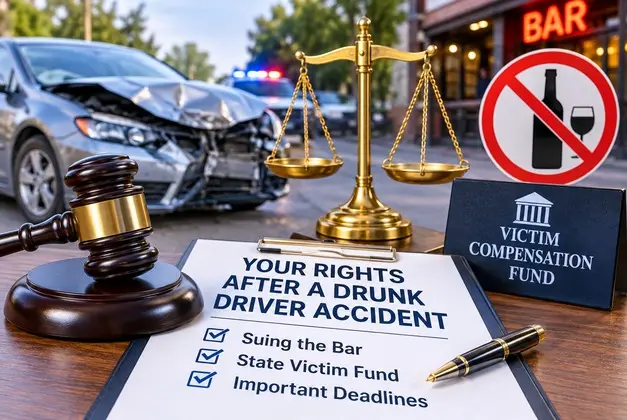
Who can pay you
- INSURANCE PAYS FIRST The drunk driver’s liability insurance
- INSURANCE PAYS FIRST Your own coverage: uninsured/underinsured motorist, MedPay/PIP, health insurance
- OTHERS WHO MAY OWE YOU The bar, restaurant, or store that overserved them (in most states)
- OTHERS WHO MAY OWE YOU A party host, in limited situations
- LAST-RESORT MONEY Your state’s crime victim compensation fund
- LAST-RESORT MONEY Court-ordered restitution in the criminal case
The driver’s policy is often the smallest piece. The sources that can pay the most have the shortest deadlines.
Find every source that may apply in your state →
See how much your insurance actually covers →
State rules verified November 24, 2026. Deadlines vary — check yours before relying on any example here.
Why now: NHTSA counted 1,038 people killed in drunk-driving crashes in December 2023, the latest year it shows, and more than 4,931 across the Decembers of 2019 to 2023. Its winter holiday “Drive Sober or Get Pulled Over” paid-media window runs December 16, 2026 to January 1, 2027.
Who Can Pay You? Source Finder
Answer nine quick questions to see which sources of money may apply to you, in the order they usually pay.
Who Pays First: The Order of Money
Money after a drunk-driving crash usually comes in layers: insurance first, then others who may owe you, then last-resort public funds that pay only what is left.
INSURANCE PAYS FIRST The driver’s liability policy, then your own uninsured/underinsured motorist, MedPay or PIP, and health coverage.
OTHERS WHO MAY OWE YOU The bar, restaurant or store that overserved the driver, a party host, or an employer in limited cases.
LAST-RESORT MONEY The state crime victim fund and court-ordered restitution.
The order matters most for the victim fund. Programs we checked describe themselves as the payer of last resort, so they generally expect insurance and other benefits to be used first.
1. The driver’s liability insurance
INSURANCE PAYS FIRST
- Who pays
- The driver’s insurer
- What it covers
- Medical bills, lost income, property damage and pain and suffering, up to the policy limit
- When it applies
- When the driver has a policy; the limit sets the ceiling
- Deadline to watch
- Your state’s injury lawsuit deadline
2. Your own coverage
INSURANCE PAYS FIRST
- Who pays
- Your insurers
- What it covers
- Uninsured/underinsured motorist coverage fills what the driver’s policy cannot; MedPay, PIP and health insurance pay medical bills
- When it applies
- When the driver has no insurance, too little, or is unknown; medical coverage can start right away
- Deadline to watch
- Notice terms in your own policy
3. The bar, restaurant or store
OTHERS WHO MAY OWE YOU
- Who pays
- The business that served the driver, usually through its liquor liability insurance
- What it covers
- Injury-related losses, within your state’s limits
- When it applies
- Only if your state allows it and the facts fit, such as serving someone visibly intoxicated or underage
- Deadline to watch
- Can be short: 1 year to sue in Illinois, 240 days for your attorney’s notice in Minnesota
4. A party host or work event
OTHERS WHO MAY OWE YOU
- Who pays
- A host or employer, in limited cases
- What it covers
- Injury-related losses
- When it applies
- Narrow; where it exists it often involves serving underage guests
- Deadline to watch
- Your state’s injury lawsuit deadline; check yours
5. State crime victim compensation
LAST-RESORT MONEY
- Who pays
- A state program
- What it covers
- Out-of-pocket costs such as medical care, counseling, lost wages and funeral costs, within program limits
- When it applies
- After insurance and other benefits, and only if the crash qualifies
- Deadline to watch
- A police report within days in some states, and a filing window from 180 days to 3 years in the examples we checked
6. Court-ordered restitution
LAST-RESORT MONEY
- Who pays
- The convicted driver, usually through the court or an agency
- What it covers
- Documented out-of-pocket losses; pain and suffering is usually not part of it
- When it applies
- Only if the driver is charged and convicted and the judge orders it
- Deadline to watch
- Tell the prosecutor early, before sentencing
| Source | Tier | Who pays | What it covers | When it applies | Deadline to watch |
|---|---|---|---|---|---|
| 1. The driver’s liability insurance | INSURANCE PAYS FIRST | The driver’s insurer | Medical bills, lost income, property damage and pain and suffering, up to the policy limit | When the driver has a policy; the limit sets the ceiling | Your state’s injury lawsuit deadline |
| 2. Your own coverage | INSURANCE PAYS FIRST | Your insurers | UM/UIM fills what the driver’s policy cannot; MedPay, PIP and health insurance pay medical bills | When the driver has no insurance, too little, or is unknown; medical coverage can start right away | Notice terms in your own policy |
| 3. The bar, restaurant or store | OTHERS WHO MAY OWE YOU | The business, usually through liquor liability insurance | Injury-related losses, within your state’s limits | Only if your state allows it and the facts fit | 1 year to sue in Illinois; 240 days for attorney notice in Minnesota |
| 4. A party host or work event | OTHERS WHO MAY OWE YOU | A host or employer, in limited cases | Injury-related losses | Narrow; often limited to serving underage guests | Your state’s injury lawsuit deadline |
| 5. State crime victim compensation | LAST-RESORT MONEY | A state program | Out-of-pocket medical, counseling, lost wages, funeral costs, within program limits | After insurance and other benefits, if the crash qualifies | Police report within days in some states; filing windows from 180 days to 3 years in the examples |
| 6. Court-ordered restitution | LAST-RESORT MONEY | The convicted driver, via the court or an agency | Documented out-of-pocket losses; pain and suffering usually not included | Only after a conviction and a restitution order | Tell the prosecutor before sentencing |
The Drunk Driver’s Insurance — and Why It Often Runs Out
The driver’s liability policy is the first place to claim, but it pays only up to its limits, and a serious injury can cost more than a state-minimum policy provides.
Per person and per accident limits
Liability policies usually carry one limit for each injured person and a larger limit for the whole accident, plus a separate property damage limit. When several people are hurt, they share the per-accident amount.
Does being drunk void the driver’s coverage?
Many people assume it does. Policies and state laws differ, and some policies include alcohol-related exclusions. But liability coverage exists to protect the people the insured hurts, and in many states an exclusion does not cut off an injured person’s claim. The insurer may then try to recover what it paid from its own customer. We have not verified every state’s rule, so ask the insurer for its coverage position in writing, and have a lawyer review any denial.
How to find the limits
Ask the driver’s insurer, or have your lawyer ask, to confirm the limits in writing. The police report usually names the insurer. Enter the limit in the Coverage Gap Calculator to see where it stops.
If the limit is too low for your losses, read what to do when the at-fault driver’s insurance is not enough.
Your Own Coverage Fills the Next Layer
Your own policy can add money when the driver’s coverage falls short: uninsured and underinsured motorist coverage for the shortfall, and MedPay, PIP or health insurance for medical bills.
Uninsured motorist (UM) coverage can apply when the driver has no insurance or is never identified. Underinsured motorist (UIM) coverage can apply when the driver’s limits are too low. In some states UIM sits on top of the driver’s limits (“excess”); in others it is reduced by what the driver’s policy pays (“offset”). That difference changes your gap, which is why the calculator below shows both. For the full explanation, see uninsured motorist coverage and when the at-fault driver’s insurance is not enough.
MedPay and PIP, where you have them, and your health insurance can pay medical bills while the larger claims are sorted out. These payers may have a right to be repaid from a settlement. The order in which they pay is covered in who pays medical bills after a car accident.
Tell your own insurer about the crash early, since policies often set notice requirements. Before you give a recorded statement to the other driver’s insurer, read what to do about a recorded statement.
Coverage Gap Calculator
Enter your losses and limits to see, in dollars, where the driver’s policy and your underinsured motorist coverage stop.
More on what the numbers leave out: how pain and suffering is calculated and how much of a settlement you keep.
Can You Sue the Bar That Served Them?
In many states, yes: dram shop laws can let an injured person sue a licensed seller that served someone visibly intoxicated or underage who then caused the injury, but scope, deadlines and caps differ sharply by state.
OTHERS WHO MAY OWE YOU A dram shop claim is separate from your claim against the driver. A personal-injury attorney should look at it, because the deadlines can be short and the rules are technical.
What dram shop laws require
Most dram shop laws look at what the seller did. Typically the question is whether the seller served a person who was visibly or obviously intoxicated, or who was under the legal age, and whether that service helped cause the injury. In Texas, for example, the statute asks whether it was apparent to the provider that the person was obviously intoxicated to the point of being a clear danger, and the state’s high court has stressed that this turns on what the provider could see, not only on how much was served.
Third-party claims
A third-party claim is brought by someone the intoxicated person injured. That is the situation this guide covers. Claims by the intoxicated person themselves follow different rules and are not covered here.
Drinking companions
Some states can bar a dram shop claim by someone who helped cause the driver’s intoxication. Illinois courts, for example, recognize a court-made “complicity” defense for plaintiffs who actively contributed to or took a material part in the drinking. Other states handle it differently. If you were drinking with the driver, tell your attorney at the first meeting.
State snapshot
Choose a state to see its card. States we have not verified show “Check statute.”
| State | Dram shop claim allowed? | Who can be sued | Notice or filing deadline | Cap | Statute | Verified |
|---|---|---|---|---|---|---|
| Illinois | Yes | A person who sells or gives the alcohol that causes the intoxication. Some owners or lessors of premises where alcohol is sold are also reached; read § 6-21(a). | Lawsuit must be started within 1 year after the claim accrued. A court-made “complicity” defense can bar a plaintiff who helped cause the intoxication. | 2026: $90,411.55 per person for injury or property damage; $110,503.00 for loss of means of support or society. Applies to judgments or settlements on or after Jan. 20, 2026. Multiple dram shops share the limit as a group. | 235 ILCS 5/6-21; Illinois Comptroller, 2026 Dram Shop Liability Limits | November 24, 2026 |
| Minnesota | Yes | Licensed sellers that make an illegal sale, such as to an obviously intoxicated person or someone under 21. | Written notice to the seller, served by your attorney within 240 days of entering an attorney-client relationship. Actual notice of enough facts to alert the seller to a possible claim also counts. Lawsuit within 2 years of the injury. | Check statute | Minn. Stat. §§ 340A.801–.802; Buskey v. American Legion Post #270 (Minn. 2018) | November 24, 2026 |
| South Dakota | No. The statute generally bars civil liability of the seller for another person’s intoxication. | Not applicable | Not applicable | Not applicable | S.D. Codified Laws § 35-4-78 | November 24, 2026 |
| Texas | Yes, narrowly | A “provider” that sells or serves alcohol, if it was apparent the person was obviously intoxicated to the point of being a clear danger to self and others, and the intoxication was a proximate cause of the damages. | Check statute | Check statute | Tex. Alco. Bev. Code § 2.02 | November 24, 2026 |
| California | Generally no. Civil immunity is the rule, with a narrow exception. | A licensed seller that sells alcohol to an obviously intoxicated minor. | Check statute | Check statute | Cal. Civ. Code § 1714; Bus. & Prof. Code §§ 25602, 25602.1 | November 24, 2026 |
| Florida | Very limited | A seller that willfully and unlawfully sells or furnishes alcohol to someone under the lawful drinking age, or knowingly serves someone habitually addicted to alcohol. | Check statute | Check statute | Fla. Stat. § 768.125 | November 24, 2026 |
| New York | Yes | Anyone who unlawfully sells alcohol, such as to a visibly intoxicated person or someone under 21, and so causes or contributes to the intoxication. | Check statute | Check statute | N.Y. Gen. Oblig. Law § 11-101; Alco. Bev. Control Law § 65 | November 24, 2026 |
| All other states | Check statute | Check statute | Check statute | Check statute | Check your state’s statute | Not yet verified here |
Worked example: Illinois
Illinois sets a one-year limit: a dram shop action is barred unless it is started within one year after the claim accrued (235 ILCS 5/6-21). It also caps recovery, and the Illinois Comptroller adjusts the caps each year using the CPI-U. The 2026 limits are $90,411.55 per person for injury or property damage and $110,503.00 for loss of means of support or loss of society. They apply to judgments or settlements on or after January 20, 2026. When more than one dram shop is liable, the limits apply to them as a group, so they cannot be stacked.
Worked example: Minnesota
Minnesota requires written notice to the seller, served by your attorney within 240 days of entering an attorney-client relationship, and no action may go forward without notice (Minn. Stat. § 340A.802). Suit must also be started within two years of the injury. Missing the notice can end a claim. In Buskey v. American Legion Post #270 (Minn. 2018), the state supreme court revived a dismissed claim, holding that “actual notice” means notice of enough facts to alert the seller to a possible claim. That is a narrow path, not a plan.
Worked example: South Dakota
South Dakota is the “no” example. Its statute makes it a crime for a licensee to serve an obviously intoxicated person, but it generally bars civil liability of the seller for another person’s intoxication (S.D. Codified Laws § 35-4-78).
California and Florida sit near that end too. California gives sellers broad civil immunity with a narrow exception for selling to an obviously intoxicated minor, and Florida limits liability to willful and unlawful service to someone underage or knowing service to someone habitually addicted to alcohol. New York and Texas allow claims on the facts described in the table. Rules also change; confirm your state’s current text with an attorney.
How Overservice Is Proven
Overservice is usually proven with records and witnesses: receipts or tabs, point-of-sale data, security video, staff and customer accounts, and a timeline linking the drinking to the driver’s blood-alcohol test.
What helps
Receipts and tabs. Closed and open checks, card and cash records, and the driver’s own receipts show what was ordered and when.
Point-of-sale data. Drink orders, voids and timestamps can show the pace of service.
Security video. Footage may show how the driver looked and acted. It may be overwritten, so send a preservation letter promptly.
Staff schedules and incident logs. They identify who was working and whether anyone noted a problem or refused service.
Witnesses. Friends, other patrons and staff can describe how the driver looked and acted.
The timeline. The police report, any breath or blood test, and the crash time help tie the evidence together. The standard differs by state, so ask what the seller would have seen.
The State Victim Fund That Pays What Insurance Won’t
Every state runs a crime victim compensation program, funded in part by the federal Crime Victims Fund, that can reimburse out-of-pocket costs after a covered crime, and many programs list drunk-driving offenses as eligible.
LAST-RESORT MONEY Programs typically reimburse medical care, mental health counseling, lost wages, funeral costs and similar expenses, within their own limits. The federal program that supports them is described by the Office for Victims of Crime.
Does it cover drunk-driving crashes?
Many programs say so. Maine’s lists victims of violent crimes including OUI, Texas lists DWI, intoxication assault and intoxication manslaughter among covered vehicle crimes, Wisconsin’s list includes operating under the influence, and Utah lists DUI with injury or death. Colorado’s state page names vehicular assault and vehicular homicide and says its list is not complete. Ask your program directly whether your crash qualifies.
Payer of last resort
Programs generally expect you to use insurance and other benefits first. That is why the order of payment in this guide matters, and why you should keep every bill, explanation of benefits and denial letter.
The reporting trap
Programs also ask about your own conduct. South Carolina, Maine and Wisconsin each say compensation can be denied if the victim’s own conduct or criminal activity contributed to the injury. If you were a passenger, or had been drinking yourself, ask how your program treats that.
| State | Report to police within | Apply within | Program page |
|---|---|---|---|
| Colorado | A police or sheriff report is required for injury and death claims (or a forensic exam record). The 72-hour rule on the state page applies only to residential property damage claims. | State page lists 6 months for property damage and states no deadline for injury or death; local district forms have listed 1 year. Confirm with your judicial district. | Colorado program |
| Florida | 120 hours, or good cause for the delay (crimes on or after Oct. 1, 2019). | 3 years after the crime, or up to 5 years with good cause shown. | Florida program |
| Maine | 5 days, unless the victim is a minor or there is good cause. | 3 years of the injury or loss, or within 60 days of discovering it, whichever is later; good cause can extend. | Maine program |
| South Carolina | 48 hours (may be waived for good cause). | 180 days (may be waived for good cause). | South Carolina program |
| Texas | A reasonable time that does not hamper the investigation; no fixed number of hours found. | 3 years from the crime, unless good cause is shown. | Texas program |
| Wisconsin | 5 days of the crime, or within 5 days of when a report could reasonably be made (may be waived in the interest of justice). | 1 year of the crime (may be waived in the interest of justice). | Wisconsin program |
If you settle later
Programs often seek repayment if you later recover money for the same expenses. Wisconsin’s application says money received from other sources, such as restitution, a lawsuit or an insurance settlement, must be repaid to the program for expenses it paid. Maine says restitution may be payable directly to its fund when the fund has made an award. Check your program’s wording before you sign a settlement.
The victim fund, restitution and a settlement are three different things. Keep them separate when you track what you have received and what you may owe back.
Where to start
The Office for Victims of Crime keeps a directory of state victim compensation programs. MADD Victim Services offers free, 24/7 support for people affected by impaired-driving crashes at 1-877-MADD-HELP (1-877-623-3435).
The Criminal Case vs. Your Claim
The criminal case punishes the driver and may produce restitution, while your civil claim is separate and seeks compensation, so you should not wait for the criminal case to end before protecting your rights.
LAST-RESORT MONEY Restitution is ordered by the judge in the criminal case and usually paid through the court or an agency. It is typically limited to documented out-of-pocket losses, and whether it can include pain and suffering depends on your state. In Wisconsin, the victim fund application says the victim must request restitution to be eligible, so tell the prosecutor’s office early.
A conviction or plea in your civil case. Whether a conviction or guilty plea can be used in the civil case varies by state. No-contest pleas often cannot be used. Even when a conviction helps, you still have to prove your own damages.
Do not wait. Civil deadlines keep running while the criminal case moves slowly, and some of the shortest ones belong to the sources that can pay the most. See statutes of limitations by state.
Register for victim notification in the criminal case, and ask how restitution, any victim fund award and any settlement will be coordinated so you are not surprised by repayment demands.
Punitive Damages: When They’re Possible and Who Pays
Punitive damages punish especially reckless conduct instead of repaying losses; they are possible in some drunk-driving cases, and whether insurance pays them depends on your state’s public policy.
Many states require more than ordinary carelessness before punitive damages can be awarded, and some limit the amount. The proof standard and caps differ by state, so we give no figures here. A lawyer can tell you whether your facts and your state make a punitive claim realistic.
If insurance cannot or does not pay, the driver is personally responsible, and collecting depends on what the driver owns or earns. Debts for injury or death caused by driving while intoxicated are generally not erased in bankruptcy, as explained in the next section.
If the Driver Has No Insurance and No Assets
If the driver has no insurance, start with your own uninsured motorist coverage, then check the victim fund and any bar or host that may owe you, and remember that a judgment against the driver can be collected later.
INSURANCE PAYS FIRST Your uninsured motorist coverage is usually the first stop; see uninsured motorist coverage. OTHERS WHO MAY OWE YOU A bar or store that served the driver may carry its own liability insurance. LAST-RESORT MONEY The victim fund may reimburse eligible out-of-pocket costs.
A court judgment against the driver can matter even if the driver has nothing today, because how long it lasts and what it can reach depend on state law.
Because a no-insurance case has more moving parts, speak with a personal-injury attorney early.
If Someone Was Killed
When a drunk driver kills someone, certain family members or the estate can bring a wrongful death claim, and some dram shop laws separately allow recovery for loss of support.
Who may file, and what can be claimed, depends on your state’s wrongful death law; read the wrongful death guide. Dram shop acts can add their own claims for loss of means of support, and in Illinois that loss is capped separately at $110,503.00 for 2026. Victim funds may also help with funeral costs; Maine’s program lists funeral expenses for homicide victims, for example.
Deaths are cases for a personal-injury attorney. MADD advocates are available at 1-877-MADD-HELP (1-877-623-3435), day or night. Some deadlines run while you grieve, and the Source Finder above can help you list them.
Special Situations
Some situations change who can pay you, and each one is covered in more detail in a linked guide.
You were the drunk driver’s passenger
A passenger can usually claim against the driver’s liability coverage, and may have other sources too. Programs and courts may look at whether you knew the driver had been drinking, so tell your attorney the full story.
You had also been drinking
Your own conduct can affect fault, the bar claim and the victim fund. See partially at fault.
The driver was working
If the driver was on the job, an employer may be involved. See employee car accident on a work errand.
Rideshare
If a rideshare driver or passenger was involved, coverage can have gaps. See the rideshare insurance gap.
The drunk driver fled
If the driver left the scene and is unknown, your own uninsured motorist coverage may apply. See hit and run: who pays.
You were a pedestrian or cyclist
Different coverage may apply. See pedestrian hit by a car: who pays.
What Your Claim May Be Worth — Honestly
No honest article can put a dollar figure on your claim, because it depends on your injuries, your state’s rules, the available insurance, and who else may owe you.
The factors that matter most are how serious and lasting your injuries are, your medical costs and lost income, any shared fault, the limits of the driver’s and your own coverage, whether the driver can pay beyond insurance, state caps, and the strength of the evidence. Being hit by a drunk driver does not automatically add a percentage to a claim. It can open other sources, such as a bar, and in some states punitive damages.
For the pieces, see how pain and suffering is calculated, how much of a settlement you keep, and whether to accept the first offer.
Every Deadline in One Place
Deadlines come from different laws and run on different clocks, so treat the shortest one as your deadline and confirm each for your state.
| Deadline | Typical range | Verified example | What happens if you miss it |
|---|---|---|---|
| Police report for the victim fund | Days, from 48 hours to 5 days in the states we checked | South Carolina: 48 hours. Maine and Wisconsin: 5 days. Florida: 120 hours. | The fund may deny the claim unless it finds good cause for the delay. |
| Victim fund application | 180 days to 3 years in the examples | South Carolina: 180 days. Wisconsin: 1 year. Maine, Texas and Florida: 3 years, with exceptions. | The application may be denied unless the program waives the time limit for good cause. |
| Dram shop notice | Varies; some states require notice within months | Minnesota: your attorney serves written notice within 240 days of entering the attorney-client relationship. | The claim against the bar can be barred. |
| Dram shop lawsuit | Varies by state | Illinois: 1 year after the claim accrued. Minnesota: 2 years from the injury. | The lawsuit is barred. |
| General injury lawsuit | Check your state; see statute of limitations by state | See the linked guide for your state. | Your right to sue the driver ends. |
| UM/UIM notice to your insurer | Set by your policy and state law; not verified here | Check your policy’s notice terms. | Your insurer may dispute coverage. |
Do You Need a Lawyer?
Often yes: a personal-injury attorney is clearly worth consulting for any dram shop claim, a death, a serious injury, a punitive damages claim, or a driver with no insurance.
Dram shop and punitive claims depend on technical state rules and short deadlines. Many personal-injury lawyers are paid from the recovery rather than upfront, so ask about fees on the first call; see how much of a settlement you keep. Ask whether the lawyer is licensed in the state where the crash happened and has handled alcohol-service claims. This guide cannot recommend any firm or insurer.
Your First 10 Days
In the first ten days, focus on care, a police report, your insurance, evidence, and the earliest deadlines.
Frequently Asked Questions
These are the questions people most often ask after a drunk-driving crash, answered briefly.
What am I entitled to if I’m hit by a drunk driver?
There is no fixed amount. You may be able to claim your losses from the driver, your own coverage, sometimes the bar or a host, and in some cases a state victim fund. See the order of money.
Can I sue both the drunk driver and the bar?
In many states you can pursue both. Each has its own deadlines, and some states cap what a bar can owe. You cannot generally collect more than your total losses. See suing the bar.
Can I sue a restaurant or liquor store?
Many dram shop laws cover licensed sellers of all kinds, including restaurants and stores. A few states, such as South Dakota, generally bar these suits. See the state snapshot.
How do you prove a bar overserved someone?
With receipts and tabs, point-of-sale data, video, staff and witness accounts, and a timeline from the police report. See how overservice is proven.
How long do I have to sue a bar?
It depends on the state, and it can be short. Illinois allows one year, and Minnesota requires your attorney’s written notice within 240 days of being hired. Check your state and speak with an attorney quickly.
Can I sue a party host?
Sometimes, but it is much narrower than suing a bar, and is often limited to serving underage guests. California generally grants hosts immunity. See party hosts.
Does the drunk driver’s insurance pay punitive damages?
It depends on the state. Some bar insuring punitive damages, such as California and Pennsylvania; in others the policy wording controls. See punitive damages.
Do I get more because the driver was drunk?
There is no automatic extra amount. Drunk driving can open other sources, such as a bar claim, and in some states punitive damages. See what your claim may be worth.
What if the drunk driver has no insurance?
Start with your own uninsured motorist coverage, then look at the victim fund, any bar or host, and the driver personally. See no insurance.
What if they have no assets?
A judgment can still be collected later in many cases, and the other sources do not depend on the driver’s assets. See no insurance and no assets.
Can a drunk driver erase what they owe me in bankruptcy?
Usually not. Federal law lists debts for injury or death caused by driving while intoxicated among those not discharged (11 U.S.C. § 523(a)(9)).
Does crime victim compensation cover drunk-driving crashes?
Many programs list drunk-driving offenses as eligible, but each state decides. See the victim fund section.
How fast must I report to qualify for the victim fund?
It varies, from 48 hours in South Carolina to 5 days in Maine and Wisconsin and 120 hours in Florida. Exceptions for good cause are common. See every deadline.
Will the victim fund want money back if I settle?
Often, yes. Programs commonly seek repayment of what they paid if you recover the same expenses elsewhere. Check your program’s wording before you settle.
Does a DUI conviction win my civil case?
No. Whether a conviction or plea can be used varies by state, and no-contest pleas often cannot be used. You still have to prove your damages.
Is restitution the same as a settlement?
No. Restitution is ordered in the criminal case and usually covers documented out-of-pocket losses. A settlement resolves your civil claim. See the criminal case vs. your claim.
Should I wait for the criminal case to finish?
No. Civil deadlines keep running. See statute of limitations by state.
Will my insurance rates go up if a drunk driver hit me?
Rules differ by state and insurer, and we have not verified them state by state. Ask your insurer directly whether a claim in which you were not at fault will affect your premium, and ask for the reason in writing if it will.
Sources Checked
These are the primary pages we used. Check the current text before relying on any example.
- NHTSA: Drive Sober This December and the winter holiday campaign dates
- Illinois: 235 ILCS 5/6-21; Comptroller 2026 dram shop liability limits; Illinois dram shop jury instructions
- Minnesota: Minn. Stat. § 340A.802; Buskey v. American Legion Post #270 (Minn. 2018)
- South Dakota: S.D. Codified Laws § 35-4-78
- Texas Alcoholic Beverage Code, chapter 2; California Supreme Court on civil immunity for furnishing alcohol; Florida Statutes § 768.125; New York Alcoholic Beverage Control Law § 65; New York General Obligations Law § 11-100 and § 11-101, as discussed by a state appeals court
- Office for Victims of Crime: victim compensation; 34 U.S.C. § 20102
- State programs: Colorado, Florida, Maine, South Carolina, Texas, Wisconsin, Utah
- 11 U.S.C. § 523
- Third Circuit on insuring punitive damages under Pennsylvania law; California appeals court on the public-policy bar; overview of the state-by-state split
- MADD Victim Services
Last updated: . The Illinois dram shop caps change each January.
This article is general information, not legal advice. Rules on dram shop liability, victim compensation and punitive damages differ by state and change. State examples were verified on November 24, 2026. Consult an attorney licensed in your state.

Daniel Hayes is the founder and sole researcher at AdvoraHQ. He covers U.S. personal finance, insurance, and consumer law — working directly from IRS publications, federal and state statutes, court opinions, and SEC filings rather than secondary summaries. His focus is the gap between what readers think they know and what the source documents actually say. Daniel is not a licensed attorney, CPA, or financial advisor; his articles are educational and not personalized advice. Reach him at Daniel.Hayes@advorahq.com.

Party Hosts, Homeowners, and Work Events
Suing a party host is much harder than suing a bar: where social host liability exists at all, it is usually narrower and often limited to cases where underage guests were served.
OTHERS WHO MAY OWE YOU Examples show how much it varies. California’s high court has described civil immunity as the rule for people who are not licensed sellers and merely furnish alcohol, with a narrow exception for selling to an obviously intoxicated minor. New York’s General Obligations Law § 11-100 reaches a provider who unlawfully furnishes alcohol to minors. Most states fall somewhere between, so check yours.
Work events add another question: whether an employer or event host can be responsible. That depends on the facts, such as who supplied the alcohol and who controlled the event. The business side is covered in company holiday party liability. If the driver was on a work errand, read employee car accident on a work errand. A homeowner’s or employer’s insurance may or may not respond; a lawyer can tell you after reviewing the facts.