
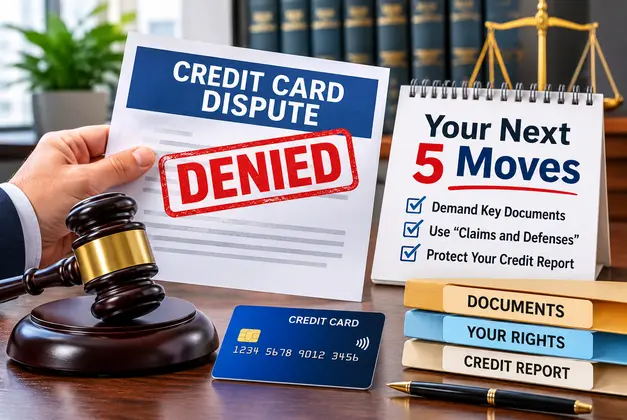
A denial isn’t the end. You can demand the documents the issuer relied on, send new evidence, use a separate federal right called “claims and defenses” for defective or misrepresented purchases, escalate to the CFPB, or go after the merchant directly.
Pick your denial reason to see your next move →
Dispute Denied? Next-Move Finder
Answer what you can. Everything stays on your device: no storage, no network calls. Don’t type card numbers, account numbers or names.
Your next moves
The 5 Moves at a Glance
- 1 Get the evidence
- 2 Protect your credit
- 3 Claims and defenses
- 4 Re-dispute with new proof
- 5 Escalate or sue the merchant
This guide is Step 2. If you haven’t filed yet, start with Step 1: How to Dispute a Credit Card Charge.
Regulation text checked . Not legal advice.
Why Your Dispute Was Denied — and What Each Reason Really Means
Issuers deny disputes when they conclude no billing error occurred, usually because the merchant supplied proof, the dispute looked late, or the data suggests you authorized the purchase, and each of those reasons points to a different next move than the others.
FEDERAL RIGHT
If the issuer finds no error, it must send a written explanation of its reasons (12 CFR § 1026.13(f)). That letter is your starting point. Read its exact wording before you pick a path.
Swipe the table sideways to see every column.
| Denial reason | What it usually means | Your best next move |
|---|---|---|
| Merchant showed proof of delivery | The merchant gave tracking, a signature or a delivery photo. Proof of delivery to an address isn’t proof it reached you. | Request the evidence (Move 1). Check the address, date and signature. Add carrier or police records (Move 4). |
| Merchant says its policy allows the charge | The issuer accepted the merchant’s terms, such as a no-refund or restocking policy. A policy doesn’t answer a defect or a misrepresentation. | Request the evidence. If the item wasn’t as described, check claims and defenses (Move 3). |
| I missed a deadline | The issuer says your notice came too late. A billing-error notice must reach the issuer within 60 days after it sent the first statement showing the charge. | Ask in writing which dates it used. Claims and defenses is a separate right with its own conditions (Move 3). |
| It looks authorized | The issuer’s records (chip, PIN, your device, your address) suggest the purchase was made by you or with your access. | Request the evidence. If you truly didn’t make it, see the fraud section. If you did, don’t re-dispute it. |
| Quality issue, not an error | Billing-error rules cover goods “not accepted” or “not delivered as agreed.” They don’t cover the quality of goods you accepted. | Claims and defenses is the route built for this (Move 3). |
| No clear reason given | If no error was found, the issuer must send a written explanation of its reasons. | Ask for it, plus the evidence (Move 1). |
CARD NETWORK RULE
“Merchant showed proof” usually means the issuer asked the merchant’s bank for the merchant’s side and accepted it. Those exchanges run on card network rules, which you can’t invoke yourself.
A denial is the issuer’s decision, not a court ruling. It can rest on an incomplete record, a merchant statement you haven’t seen, or a rule that doesn’t fit your problem.
Billing Error, Chargeback, or Claims and Defenses? Three Different Systems
Three separate systems get lumped together as a dispute — a federal billing-error process, a card-network chargeback between banks, and a federal claims-and-defenses right — and each has its own deadlines, payment rules and credit-reporting protections, so knowing which one applies decides your next move.
Swipe the table sideways to see every column.
| System | Source | Covers | Deadline | Can you withhold payment? | Credit-reporting rule |
|---|---|---|---|---|---|
| Billing error (FEDERAL RIGHT) | Regulation Z, 12 CFR § 1026.13 (Fair Credit Billing Act) | Unauthorized charges, goods or services not accepted or not delivered as agreed, wrong amounts, and other listed errors. | Written notice within 60 days after the first statement showing the charge. The issuer acknowledges within 30 days and resolves within 2 billing cycles, no later than 90 days. | Not the disputed portion while the investigation is pending. After a denial, you generally owe what the notice says. | No adverse report for nonpayment while pending. After a denial, it may report delinquent once the window passes, but if you sent a “still in dispute” notice in time, it must also report the dispute. |
| Chargeback (CARD NETWORK RULE) | Card network rules and issuer procedures | How banks move money back and forth with the merchant’s bank, using network reason codes. | Set by the networks and issuers, not by public consumer law. Ask your issuer. | No federal withholding right comes from the chargeback itself. | The federal reporting protections attach to the billing-error and claims routes, not to the network process. |
| Claims and defenses (FEDERAL RIGHT) | 12 CFR § 1026.12(c); 15 U.S.C. § 1666i | Claims (other than tort claims) and defenses against the merchant over property or services bought with the card. | No fixed deadline in the federal text we checked. Some state guidance gives one, so act early. | Yes, up to the credit outstanding for that purchase, if the conditions in Table 4 are met. | The issuer may not report that amount as delinquent until the dispute is settled or judgment is rendered. It may report it as disputed. |
Which one did your dispute go through?
Most people filed a billing error, even if the app called it a “dispute.” Behind the scenes, many issuers run an investigation by sending a chargeback to the merchant’s bank.
Wording like “we found no billing error” points to the billing-error system. Wording like “the merchant provided documentation” describes the chargeback side.
Why that matters now
The official commentary says billing-error rights are independent of the claims-and-defenses provisions. So a denial under one route doesn’t automatically end the other. Claims and defenses is also a right you may need to raise yourself, in writing.
Move 1: Demand the Evidence
When the issuer finds no error it must explain its reasons in writing and, only if you ask, send copies of the documentary evidence of the debt, so request those documents in writing now and keep a copy of your request.
What to look for when the documents arrive
- The delivery address, and whether it matches yours.
- The delivery date and any signature or photo.
- How the merchant describes the item compared with your order.
- The merchant’s policy, and whether you saw it before paying.
- Authorization data, if the reason was “looks authorized.”
- Dates or amounts that don’t line up.
You can also ask for the merchant’s submission. The issuer may share what it holds, though the rule’s text speaks of documentary evidence of the debt.
Send Letter 1 to the issuer’s billing-inquiries address, not the payments address. Do it inside your payment window if you can.
Move 2: Protect Your Credit Report in the Payment Window
After a denial, the issuer must state what you owe and when, then wait your grace period or 10 days, whichever is longer, before reporting it late, and if you send written notice in that window that you still dispute it, any late report must also show the dispute.
The timeline
- Day 0. You send a written billing-error notice.
- Within 30 days. The issuer acknowledges it in writing.
- Within 2 billing cycles, no later than 90 days. The issuer resolves it.
- Denial notice. It says how much you owe and when payment is due.
- Payment window. At least 10 days, or your grace period if longer.
- “Still in dispute” notice. Sent in the window, it means any report must show “disputed.”
| Step | When | What happens |
|---|---|---|
| Written dispute | Day 0 | You send a billing-error notice. While it is pending, you need not pay the disputed portion and the issuer may not try to collect it or make or threaten an adverse report for not paying it. |
| Acknowledgment | Within 30 days | The issuer must acknowledge in writing. |
| Resolution | Within 2 billing cycles, no later than 90 days | The issuer must resolve the dispute. |
| Denial notice | On or after resolution | The issuer explains its reasons and tells you in writing how much you owe and when payment is due. |
| Payment window | Grace period or 10 days, whichever is longer | The issuer must allow this time before reporting the amount as delinquent. |
| “Still in dispute” notice | Inside the window | Any delinquency report must also show the dispute, name who it went to, and report any later resolution. |
What “reported as disputed” means
The rule is not a ban on reporting. If you send further written notice inside the window that any part is still in dispute, the issuer may report the amount as delinquent only if it also reports that it is in dispute.
It must also tell you in writing who it reported to, and report any later resolution to them (§ 1026.13(g)(4)). That is the protection Letter 2 invokes.
What can still happen
- Interest and fees on the amount you owe may still apply. Read the notice for the figures.
- If you owe an undisputed portion, pay it on time.
- If the issuer gave you a temporary credit and takes it back, the amount returns to your balance. See Provisional Credit.
- If a late payment already posted, see Remove a Late Payment From Your Credit Report.
Move 3: Use Claims and Defenses
Separately from the billing-error process, federal law lets you assert against the card issuer claims and defenses you have against the merchant and withhold payment up to the amount still owed for that purchase, if you meet specific conditions about good faith, price and location.
FEDERAL RIGHT
The conditions
- You made a good-faith attempt to resolve it with the merchant. No special procedure is required.
- The purchase exceeded $50.
- It happened in your state or within 100 miles of your current designated address.
See Table 4 for what counts and the exceptions.
Swipe the table sideways to see every column.
| Condition | What counts | Exception |
|---|---|---|
| Good-faith attempt | You tried to resolve it with the merchant. No special procedure is required. | None. The exceptions apply only to the $50 and location limits. |
| Over $50 | The purchase price exceeded $50. | The limit doesn’t apply in the cases in the last two rows. |
| In your state or within 100 miles | The purchase occurred in your state or within 100 miles of your current designated address. | The limit doesn’t apply in the cases in the next two rows. |
| Online or phone | Covers mail, internet and phone orders. Where the transaction occurred is decided by state or other applicable law. | Not automatically your home state. |
| Issuer is the seller or mailed the offer | The merchant is the issuer, controls or is controlled by it (or is under common control with it), is a franchised dealer in the issuer’s products, or the order came from a mail solicitation the issuer made or participated in. | Simply honoring or advertising acceptance of the card doesn’t count. |
| Amount still unpaid | The claim can’t exceed the credit outstanding for that transaction when you first notify the issuer. Payments are applied first to amounts other than the disputed transaction. | None. |
Online and phone purchases
Where an online or phone order “occurred” is a question for state or other applicable law. Don’t assume it counts as your home state. If this condition decides your case, get local advice.
The amount limit and how payments are applied
You can withhold up to the credit outstanding for that purchase, plus finance charges on it. Because payments go first to other amounts, check how your payments were applied before you rely on the right.
How long you have
The federal text we checked sets no fixed deadline. State guidance can: the California Attorney General says you can assert claims and defenses up to one year after the bill was issued. Treat that as a reason to act early.
Installment plans
The CFPB says this right can also cover the card’s own pay-over-time or split-payment features. See Credit Card Installment Plans.
Use Letter 3. The issuer may disagree, and outcomes aren’t guaranteed. Keep paying the undisputed part of your bill.
Your Three Letters
Each of Moves 1 to 3 has a letter. Fill in the capitalized brackets, copy the text, and send it.
Letter 1: Request for documentation
Source: 12 CFR § 1026.13(f)(2). Send to the billing-inquiries address.
[YOUR NAME]
[YOUR ADDRESS]
[DATE]

[CARD ISSUER]
Billing Inquiries (use the address on your statement for billing inquiries)

Re: Request for documentary evidence. Account ending in [LAST 4 DIGITS]

I am writing about the charge of $[AMOUNT] from [MERCHANT NAME] dated [CHARGE DATE]. I disputed this charge. Your notice dated [DATE OF DENIAL NOTICE] says no billing error was found.

Under 12 C.F.R. § 1026.13(f), please send me copies of the documentary evidence of the indebtedness that you relied on in reaching this decision. Where you hold it, please also include the merchant's submission or response to my dispute, including any proof of delivery, order records, signed receipts or policy terms it provided.

I do not accept this decision. I am keeping a copy of this letter and will review the documents you send. I may provide additional information.

Sincerely,
[YOUR NAME]
[PHONE OR EMAIL]
Letter 2: Notice that the amount is still in dispute
Source: 12 CFR § 1026.13(g)(4). Send it inside the payment window.
[YOUR NAME]
[YOUR ADDRESS]
[DATE]

[CARD ISSUER]
Billing Inquiries (use the address on your statement for billing inquiries)

Re: Notice that the amount remains in dispute. Account ending in [LAST 4 DIGITS]

This is further written notice under 12 C.F.R. § 1026.13(g)(4) that I still dispute $[AMOUNT] of the charge from [MERCHANT NAME] dated [CHARGE DATE]. Your notice dated [DATE OF DENIAL NOTICE] says this amount is owed. I am sending this within the time you allowed for payment.

My reasons:
1. [REASON IN ONE LINE]
2. [REASON IN ONE LINE]

If you report this amount to any consumer reporting agency or other person, please report that it is in dispute. Please also tell me in writing the name and address of each person to whom you reported it, and report any later resolution to them.

I will continue to pay the undisputed part of my balance by its due date.

Sincerely,
[YOUR NAME]
[PHONE OR EMAIL]
Letter 3: Assertion of claims and defenses
Source: 12 CFR § 1026.12(c). Use it only if you meet the conditions in Table 4.
[YOUR NAME]
[YOUR ADDRESS]
[DATE]

[CARD ISSUER]
Billing Inquiries (use the address on your statement for billing inquiries)

Re: Assertion of claims and defenses. Account ending in [LAST 4 DIGITS]

I am asserting my claims and defenses against you under 12 C.F.R. § 1026.12(c) and 15 U.S.C. § 1666i.

Purchase: [MERCHANT NAME], [DATE OF PURCHASE], $[PRICE]. Where it was made: [CITY, STATE, OR "ONLINE" OR "BY PHONE"]. State where I was when I ordered, if online or by phone: [STATE].

Problem: [THE DEFECT OR MISREPRESENTATION, IN TWO OR THREE LINES].

Good-faith attempt: On [DATES] I contacted [MERCHANT NAME] by [METHOD]. Their response was: [RESPONSE]. The problem was not resolved.

Amount: The credit still outstanding for this purchase is $[AMOUNT]. I am withholding payment of that amount and any finance charges on it. I will continue paying the rest of my account.

Reporting: Under 12 C.F.R. § 1026.12(c)(2), please do not report that amount as delinquent until the dispute is settled or judgment is rendered. Please confirm in writing that you have received this letter.

Sincerely,
[YOUR NAME]
[PHONE OR EMAIL]
Move 4: Re-dispute With New Evidence
You can re-dispute a denied charge, but the request works only when it adds something the issuer hasn’t seen, such as new documents, a carrier claim or the merchant’s own correspondence, because repeating the same dispute without new proof usually returns the same answer.
CARD NETWORK RULE
Whether the issuer reopens a case is its decision. Network time limits aren’t public consumer law, so ask the issuer for its deadline. Consumers can’t request “pre-arbitration”; that is an issuer-to-bank stage.
What counts as new
- Documents you didn’t send the first time.
- Results from a carrier trace or claim.
- The merchant’s own messages, refund promises or admissions.
- Proof that something the merchant told the issuer is wrong.
Evidence by dispute type
- Not received: carrier claim or trace, building or neighbor records, a police report where a package was stolen. See Package Stolen From Your Porch.
- Not as described or defective: photos or video, screenshots of the listing, return tracking, the merchant’s refusal in writing.
- Unauthorized: an identity-theft report, proof of where you were or which device you used, and a police report, which strengthens a fraud claim.
- Wrong amount or charged twice: both statement lines and the single order confirmation. See Charged Twice.
- Canceled subscription: the cancellation confirmation with date and time, plus the terms you agreed to. See Canceled Subscription Still Charged.
- Refund promised: the written promise, return tracking and delivery proof. See How Long Does a Credit Card Refund Take.
Why repeating the same dispute doesn’t work
Under § 1026.13(h), once an issuer has fully complied with the billing-error steps, it has no further duties if you reassert substantially the same error, apart from the reporting rule in Move 2. A police report alone doesn’t force a reopen either.
Move 5: Escalate — CFPB Complaint, Then the Merchant
If the issuer won’t move, you can file a CFPB complaint, which companies generally answer within 15 days, then send the merchant a written demand and, if that fails, consider small claims court, because each route gives you leverage the issuer’s internal review doesn’t.
YOUR LEVERAGE
CFPB complaint outline
Fill it in, copy it, and paste it into the complaint form at consumerfinance.gov/complaint.
Open the complaint outline
You generally get one complaint per problem. Include everything now.

WHAT HAPPENED (WITH DATES):
[DATE OF PURCHASE, WHAT YOU BOUGHT, FROM WHOM, AMOUNT]

WHAT I DISPUTED AND WHY:
[DATE YOU DISPUTED, THE REASON, HOW YOU SENT IT]

THE DENIAL AND ITS STATED REASON:
[DATE OF DENIAL NOTICE, THE REASON GIVEN, THE AMOUNT AND DUE DATE IT STATED]

EVIDENCE I SENT AND WHAT I REQUESTED:
[DOCUMENTS YOU SENT; DATE YOU REQUESTED THE ISSUER'S EVIDENCE; WHAT YOU RECEIVED OR DID NOT RECEIVE; DATE YOU SENT A "STILL IN DISPUTE" NOTICE]

WHAT I WANT:
[RE-INVESTIGATION, CREDIT FOR THE CHARGE, CORRECTION OF CREDIT REPORTING]

ATTACHMENTS:
[LIST EACH DOCUMENT]
The merchant demand letter
Write one page and send it by a trackable method. Include:
- What you bought, when, and for how much.
- What went wrong, with dates of your earlier contacts.
- What you want (a refund, a replacement) and a reasonable deadline.
- That you’ll consider other options if it isn’t resolved.
- Copies, not originals, of your evidence.
Small claims and your state attorney general
If the merchant ignores the demand, small claims court may be an option. See How to Sue in Small Claims Court and How to Collect a Small Claims Judgment.
You can also report a merchant to your state attorney general’s consumer protection office.
If It Was Fraud, Not a Purchase Problem
If you never made the purchase, treat it as unauthorized use rather than a purchase problem: federal rules cap your liability, a police or identity-theft report strengthens your claim, and separate guides cover what to do when the issuer still says no.
FEDERAL RIGHT
For a credit card, your liability for unauthorized use can’t exceed the lesser of $50 or the value obtained before you notified the issuer, subject to the other conditions in § 1026.12(b).
- Report it to the issuer right away, in writing.
- File an identity-theft report at the FTC’s IdentityTheft.gov if someone used your information.
- A police report strengthens a fraud claim. It doesn’t force a reopen.
See Unauthorized Credit Card Charges and Someone Opened a Card in My Name.
What Not to Do
Four mistakes cost people the most after a denial: ignoring the bill, refiling the same dispute repeatedly, disputing a purchase you received as described, and paying off the disputed purchase when you were relying on claims and defenses, which limits that right to what you still owe.
- Ignoring the bill. Use the payment window to act in writing, and pay what is undisputed.
- Refiling the same dispute. Without new evidence it repeats the same result (Move 4).
- Disputing something you received as described. It can get your account closed. See Credit Card Closed Without Notice.
- Paying off the purchase if you plan to use claims and defenses. The right is limited to the credit outstanding for that purchase when you first notify the issuer, and payments are applied first to other amounts. This is how the rule works. If you plan to rely on it, send Letter 3 early and ask the issuer how it applies payments.
Special Cases
The rules in this guide fit consumer credit cards; debit cards, payment apps funded by a card, buy-now-pay-later plans, business cards, travel purchases and subscriptions each change which rights and deadlines apply, so check the case that matches yours before you act.
- Debit cards. Regulation E governs, with different timing and liability. See Credit or Debit for Online Shopping.
- PayPal, Venmo and similar apps funded by a credit card. The official commentary to § 1026.13(a)(3) says a dispute over a purchase made through a payment service funded by open-end credit generally falls under that provision, if the credit is extended at the time of purchase and matches the purchase amount. It doesn’t apply if the card only funds the app account without a purchase, or covers only part of the purchase. Ask the issuer which rule it applied.
- Buy-now-pay-later apps vs. the card’s own plan. A card’s own installment plan stays on your card account (see Credit Card Installment Plans). A separate BNPL lender has its own terms. A 2024 CFPB interpretation treating BNPL like credit cards was later withdrawn, so don’t assume card-style rights.
- Business cards. Some federal consumer protections may not apply. Check your agreement.
- Airline and travel disputes. Keep the itinerary, cancellation terms and every message. Where the transaction occurred can matter for claims and defenses.
- Subscriptions. Save the cancellation confirmation. See Canceled Subscription Still Charged.
FAQ: Credit Card Dispute Denied
Below are the sixteen questions people ask most after a denial, each answered briefly with the rule that supports it, so you can check a specific point quickly without rereading the guide, and each links back to the move that explains it.
What can I do if my credit card dispute is denied?
You have five moves: ask the issuer in writing for the documents it relied on, use the payment window to send a written “still in dispute” notice, check whether the separate claims-and-defenses right applies, re-dispute with new evidence, and escalate with a CFPB complaint or a demand to the merchant.
Outcomes are never guaranteed.
See: Next-Move Finder
Can I appeal a denied dispute?
The federal billing-error rule describes no formal appeal. In practice you ask the issuer to reopen the case by sending new evidence, and you can escalate to the CFPB if it won’t.
Some issuers have their own reconsideration process, so ask what yours offers and request the answer in writing.
Can I dispute the same charge again?
You can ask, but repeating the same dispute without anything new usually gets the same answer.
Once an issuer has followed the billing-error steps, the rule says it has no further duties if you reassert the same error, apart from the reporting rule. Bring new documents.
Consumers also can’t request a network “pre-arbitration” stage; that happens between banks.
How do I see the merchant’s evidence?
Ask in writing. When an issuer finds no error, it must send a written explanation and, if you request them, copies of the documentary evidence of the debt (12 CFR § 1026.13(f)).
Letter 1 does this. You can also ask for the merchant’s submission, which the issuer may share if it holds it.
Why did the bank side with the merchant?
Usually because the merchant supplied documents the issuer treated as enough, such as tracking, a signature, policy terms or authorization data, or because the issuer decided your problem falls outside the billing-error rule, as with a quality complaint about goods you accepted.
A denial is a decision, not a ruling, so ask to see what it relied on.
Do I have to pay after a denial?
Generally you owe what the issuer says is due, unless a right such as claims and defenses lets you withhold a specific amount. Don’t ignore the bill.
Pay the undisputed part, use the payment window to protect your credit report, and read the notice for interest and fees that may still apply. This is general information, not legal advice.
How long do I have to pay before it’s reported late?
After a denial, the issuer must wait the longer of the grace period it disclosed or 10 days before it can report the amount as delinquent (12 CFR § 1026.13(g)).
Find the date on the denial notice and count from there. If the notice is unclear, ask the issuer in writing.
Does a denied dispute hurt my credit score?
The federal reporting rules govern reporting an unpaid disputed amount as delinquent, not the denial itself.
If the amount stays unpaid past the payment window and no dispute is reported with it, a late payment can follow, and late payments can lower scores.
Scoring models vary, and nothing here predicts your score.
Can the bank report a disputed amount as late?
Not while a billing-error investigation is pending.
After a denial and the payment window, it may report the amount as delinquent, but if you sent written notice inside the window that you still dispute it, it may do so only if it also reports the dispute, tells you in writing who it reported to, and reports any later resolution (§ 1026.13(g)(4)).
Separately, if you withhold payment under claims and defenses, the issuer may not report that amount as delinquent until the dispute is settled or judgment is rendered (§ 1026.12(c)(2)); it may report it as disputed.
What is “claims and defenses”?
It is a separate federal right (12 CFR § 1026.12(c); 15 U.S.C. § 1666i).
If a merchant fails to resolve a dispute about property or services you bought with a credit card, you may assert against the card issuer the claims (other than tort claims) and defenses you have against the merchant, and withhold payment up to the amount still owed for that purchase, if its conditions are met.
Does the 100-mile rule apply to online purchases?
The rule asks whether the purchase happened in your state or within 100 miles of your designated address.
For mail, internet and phone orders, where the transaction occurred is decided by state or other applicable law, so it is not automatically your home state.
The limit also doesn’t apply when the merchant is the issuer or is tied to it, as the guide explains.
Can I withhold payment for a defective product?
Possibly, under claims and defenses, if you made a good-faith attempt to resolve it with the merchant, the purchase exceeded $50, and it meets the location rule or an exception.
You may withhold only up to the credit outstanding for that purchase. The issuer may disagree, so send Letter 3, keep records, and keep paying everything else.
Will a CFPB complaint reverse the decision?
Not necessarily. The CFPB sends the complaint to the company, which generally responds within 15 days; some companies give a final response within 60 days.
A complaint puts your case in front of the company’s complaint team, but it doesn’t guarantee a particular result.
See: Move 5: Escalate
Can I file more than one CFPB complaint?
Generally you can’t submit a second complaint about the same problem, so include everything in the first one: dates, the denial reason, what you sent and requested, and what you want.
After the company responds, you have 60 days to give feedback on its response.
See: Move 5: Escalate
Should I take the merchant to small claims court?
It can make sense when the amount is worth the effort and the merchant can be found and served. A written demand first often clarifies the dispute.
Check your local court’s limits and rules, and see our small claims guides for the steps and for collecting a judgment.
See: Move 5: Escalate
Can my card be closed for disputing too often?
Yes, an issuer can close an account. The risk is highest when disputes look unfounded, and disputing a purchase you authorized and received as described can get an account closed and can be fraud.
Honest disputes about real problems are what the process is for.
See: What Not to Do
Sources
- CFPB: Regulation Z § 1026.13, billing error resolution, with commentary
- CFPB: Regulation Z § 1026.12, special credit card provisions, with commentary
- Cornell LII: 12 CFR § 1026.13
- 15 U.S.C. § 1666i, claims and defenses
- CFPB: the complaint process
- Ask CFPB
- California Attorney General: Credit Cards, Disputing a Charge (an example of state guidance)
This is general information about federal Regulation Z, checked on November 24, 2026. It is not legal advice. Card network rules and issuer policies vary, state law may affect claims and defenses, and outcomes are not guaranteed.

Daniel Hayes is the founder and sole researcher at AdvoraHQ. He covers U.S. personal finance, insurance, and consumer law — working directly from IRS publications, federal and state statutes, court opinions, and SEC filings rather than secondary summaries. His focus is the gap between what readers think they know and what the source documents actually say. Daniel is not a licensed attorney, CPA, or financial advisor; his articles are educational and not personalized advice. Reach him at Daniel.Hayes@advorahq.com.
